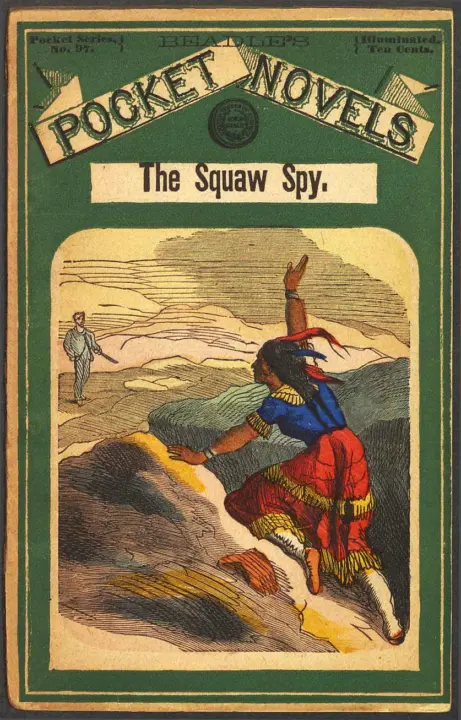
The squaw spy; or the rangers of the lava-beds
T. C. (Thomas Chalmers) Harbaugh
THE CLASSIC COLLECTION · 1884
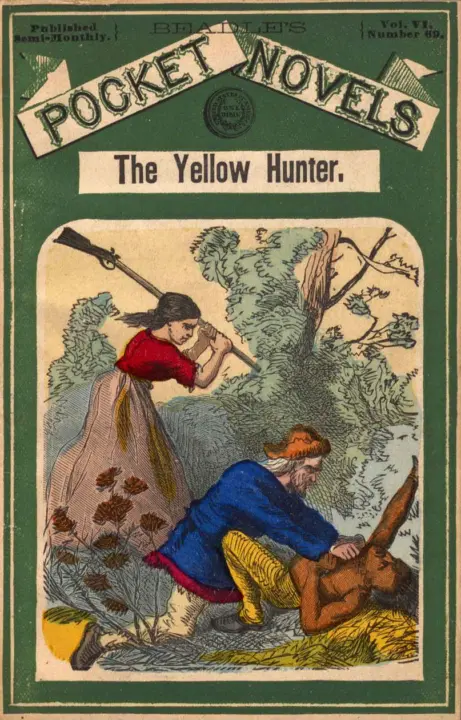
"The Yellow Hunter; or, The Winding Trail of Death" by T. C. Harbaugh is a historical novel written in the late 19th century. The story centers around the tumultuous events following the assassination of the Native American leader Pontiac, igniting a fierce conflict between various tribes and white settlers. The narrative unfolds through the experiences of the Blount family, particularly focusing on Kate Blount, who faces dangers from avenging Indians while trying to protect her father. The opening portion establishes a tense atmosphere, depicting the aftermath of Pontiac’s death and the ensuing vengeful actions of his followers as they seek retribution against both the Illinois Native Americans and the English settlers. We meet Kate Blount, a determined young woman, who anxiously waits for her father amid rumors of an impending war. As she encounters Swamp Oak, a Peoria Indian, warnings about the threat posed by the Ojibwa tribe unfold. The narrative shifts quickly to a violent siege on their home, showcasing Kate's bravery and resolve as she defends Swamp Oak against the attackers. This backdrop sets up a gripping tale of survival and the complex relationships between different cultures in a time of conflict.
Introduction adapted from the source catalogue; source summaries may be automatically generated.
Free to read · English · 32,869 words · No account needed
MAKE TIME FOR A GOOD BOOK
On by default. Untick to stop anonymous reading totals. Each page counts after 10 seconds in view. How this works.
Anonymous counting is on unless you have switched it off.
For a moment the young Indian’s head dropped upon his breast, and when he raised it, his captors read the decision he had made in his dark eyes.
“Nogawa will obey his brother”--glancing at the knife; “what else
should he do?”
“Then, quick upon the trail!” cried Somerville, who thought of the brave girl whose life, at that moment, might be in imminent danger.
The young Ojibwa obeyed by moving forward, his arm still encircled by the long fingers of Nehonesto.
“Where did the Yellow Bloodhound send Nogawa?” asked Nehonesto, as they walked cautiously down the bank of the Cahokia.
“He sent him with a band who hunted for the three pale-faces,” replied the Indian, “and Nogawa was to return and tell him if his eyes had fallen upon the dire Snake Queen.”
“And did Nogawa see Coleola?” asked our hero, a shudder creeping to his heart, as the dread woman appeared to his imagination, clothed in the hideousness of vengeance.
“He did!”
“And where was she?”
“She was on the bank of the creek, where the muskrats dwell.”
Somerville looked at Nehonesto.
“The red hag is going to work us trouble,” he said. “She will not leave this country without the scalps of all whom she hates. She hunts the Bloodhound now.”
“And she hates Nehonesto as the Indian hates the copperhead,” grated the Ojibwa between his set teeth.
“She may even now be near!”
“Nehonesto saw her not when he approached,” replied the long-haired chief, “and Nehonesto’s eyes are as sharp as the eagle’s.”
Thus, with dark forebodings to keep him continually alive to their presence, Bob Somerville walked on, venturing no more to question Nogawa, who seemed to be reconciled to his fate.
At length they reached the beginning of the high banks, but instead of ascending, Nogawa stepped into the water and waded on up the stream, carefully noting every thing around him. At the water’s edge a thick growth of willows thrived, and bending, kissed the ripples in the center of the stream. Their well-leaved branches prevented the sharpest eye from beholding the stalks, and when the forced guide paused before the king of the weepers, Nehonesto griped his arm more tightly, and in a whisper bade him proceed.
“The Bloodhound’s cave is here,” replied Nogawa, and he looked up to see that no heads were peering over the cliff.
“Here!” said Nehonesto, exhibiting some astonishment, and parting the bushes, he could discover nothing that indicated the presence of a hidden home.
The young Ojibwa did not reply, but stepped forward, and a moment later
the trio had vanished.
Your reading position is saved on this browser. Take it to another device with a library code. Reading pages adapt to text, rather than matching a printed edition.
T. C. (Thomas Chalmers) Harbaugh
T. C. (Thomas Chalmers) Harbaugh
T. C. (Thomas Chalmers) Harbaugh
BEHIND THE BOOK
This eBook is for the use of anyone anywhere in the United States and most other parts of the world at no cost and with almost no restrictions whatsoever. You may copy it, give it away or re-use it under the terms of the Project Gutenberg License included with this eBook or online at www.gutenberg.org. If you are not located in the United States, you will have to check the laws of the country where you are located before using this eBook. Read the source licence.
The original source file, including credits and licence, is retained by this library. Request an original-format copy at no charge. Please include the book title and Project Gutenberg identifier #67958.
KEEP YOUR CURIOSITY GOING
Cécile Tormay

Moritz Busch
Coulson Kernahan
John L. Ransom

Maurice Baring
Frances Wright