THE CLASSIC COLLECTION✦The Disappearing EyeCLASSIC FREE BOOKS
The Disappearing Eye
Fergus Hume
THE CLASSIC COLLECTION · 1903
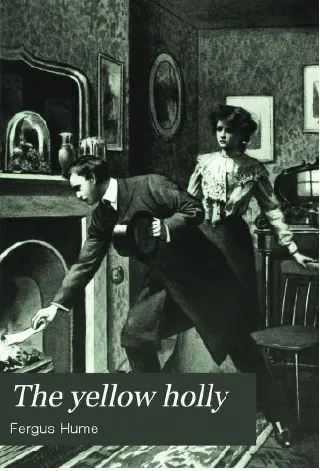
"The Yellow Holly" by Fergus Hume is a novel written in the early 20th century. The story sets the stage for a murder mystery that revolves around the mysterious death of Mrs. Jersey, the owner of a boarding house filled with colorful, eccentric characters. As the narrative unfolds, we are introduced to a young visitor named Leonard Train who becomes entangled in the intrigue, particularly in connection to George Brendon, who has a hidden past and a complicated relationship with the deceased. At the start of the novel, we find Mrs. Jersey hosting a casual gathering for her boarders in her drawing room. The atmosphere is filled with old-fashioned charm and an underlying tension, hinting at the complicated lives of those in attendance, including the intriguing newcomer, Leonard Train. As the night progresses, we learn that Mrs. Jersey harbors secrets that connect her to one of the attendees, George Brendon. The opening concludes with the sudden and shocking murder of Mrs. Jersey, setting off a series of events that will challenge the relationships and motives of all characters involved, leaving readers eager to discover who may be responsible for the tragedy that has befallen Amelia Square.
Introduction adapted from the source catalogue; source summaries may be automatically generated.
Free to read · English · 100,057 words · No account needed
MAKE TIME FOR A GOOD BOOK
On by default. Untick to stop anonymous reading totals. Each page counts after 10 seconds in view. How this works.
Anonymous counting is on unless you have switched it off.
Mr. Granger, who had been waiting for this moment, was only too happy. He knew but one song, and had sung it dozens of times in that very room. It was natural to suppose that he knew it by heart. All the same he produced his music, and read the words as he sang. Margery played his accompaniment without looking at the notes. She was as familiar with them as she was with the moment when Mr. Granger's voice would crack. This night he cracked as usual, apologized as usual, and his hearers accepted the apology as usual, so it was all very pleasant. "'The Death of Nelson,'" said Granger, "is a difficult song to sing when the singer is not in voice. The fog, you know----"
"Quite so," murmured Train, politely. "Do you know 'Will-o-the-Wisp,'
Mr. Granger?"
Mr. Granger did not, much to his regret, and Mr. Harmer joined in the conversation. "Now there's a song," said he--"'Will-o-the-Wisp.' I knew a man who could bring the roof down with that song. Such lungs!"
"I don't love that loud shouting, myself," said Mrs. Taine in her fat voice. "Give me something soft and low, like 'My Pretty Jane!'"
"Ah! you should have heard Sims Reeves sing it," said Harmer.
"I have heard him," said Leonard, to whom the remark was addressed.
Harmer was annoyed. "Perhaps you have heard Grisi and Mario also?"
"No, sir. But my grandfather did."
"Probably," said Harmer, glancing at his fresh face and bald head in a near mirror. "I was a mere child myself when I heard them. Do you know much about music, Mr. Train?"
"I have heard it a good deal talked about," replied Leonard, with the air of saying something clever.
"And great rubbish they talk," put in Mrs. Taine, smoothing one hand over the other. "In my young days we talked of Wagner and Weber. Now it is all Vagner and Veber--such affectation."
"Ah! manners are not what they used to be," sighed another old lady, who prided herself on her straight back and clear eyesight.
"Nor singers," said Mr. Granger. "There are no voices nowadays, none."
"What about Calve and Melba?" asked Leonard.
"Those are foreigners," said Mr. Granger, getting out of the difficulty. "I speak of our native talent, sir."
"Melba comes from Australia."
"She is not English--a foreigner, I tell you. Don't talk to me, sir."
Mr. Granger was becoming restive at being thus contradicted, and privately thought Leonard an impertinent young man. Madame, seeing that the old gentleman was ruffled, hastily intervened. "If Mrs. Taine will play us the 'Canary Bird Quadrilles' how pleased we shall be."
Your reading position is saved on this browser. Take it to another device with a library code. Reading pages adapt to text, rather than matching a printed edition.
Fergus Hume

Fergus Hume

Fergus Hume
Fergus Hume
BEHIND THE BOOK
This eBook is for the use of anyone anywhere in the United States and most other parts of the world at no cost and with almost no restrictions whatsoever. You may copy it, give it away or re-use it under the terms of the Project Gutenberg License included with this eBook or online at www.gutenberg.org. If you are not located in the United States, you will have to check the laws of the country where you are located before using this eBook. Read the source licence.
The original source file, including credits and licence, is retained by this library. Request an original-format copy at no charge. Please include the book title and Project Gutenberg identifier #54979.
KEEP YOUR CURIOSITY GOING
Coulson Kernahan

Maurice Baring
Frances Wright
Cécile Tormay

Frederic Jesup Stimson

W. H. P. (William Henry Pope) Jarvis