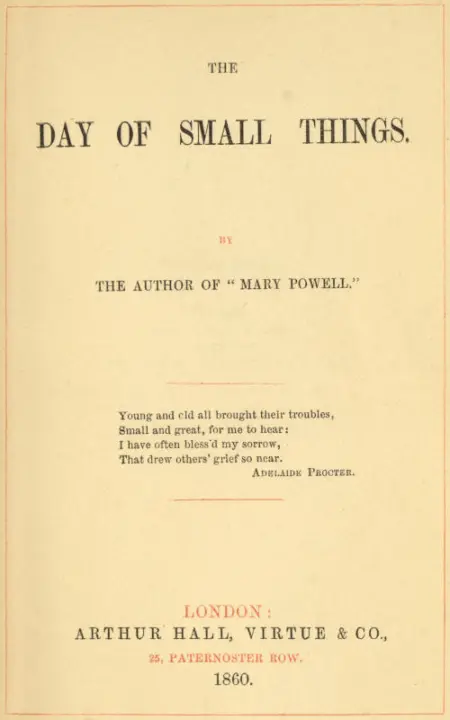
The Day of Small Things
Anne Manning
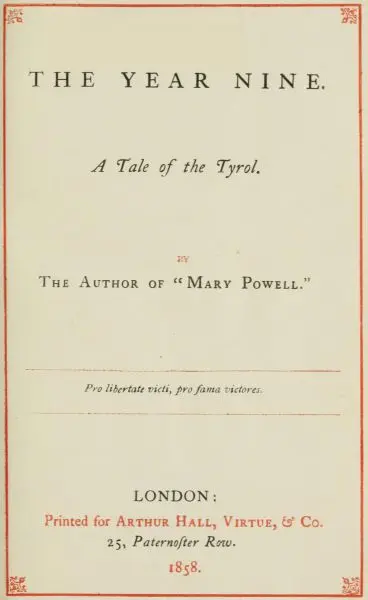
THE CLASSIC COLLECTION · 1858
"The Year Nine: A Tale of the Tyrol" by Anne Manning is a historical novel written in the mid-19th century. Set against the backdrop of the Tyrolean region during the early 1800s, the book likely explores themes of resistance, national identity, and the struggle for freedom amidst the Napoleonic Wars. Central characters include Andreas Hofer, a Tyrolese innkeeper turned folk hero, and several other local figures who become embroiled in the fight against Bavarian forces. At the start of the novel, a thunderstorm sets a dramatic scene in a small Tyrolean inn. The innkeeper, known as Sandwirth, interacts with various patrons, including peasants and travelers, discussing simple life and deeper matters of morality, particularly surrounding a planned shooting match. As conversations hint at underlying tensions in the region, we are introduced to key characters like Joseph Speckbacher, a notable figure among the locals, and Father Joachim, a Capuchin friar who later plays a significant role in organizing resistance efforts. The atmosphere suggests a brewing conflict that intertwines personal lives with larger nationalistic ambitions, foreshadowing the imminent uprising in defense of Tyrol's freedoms.
Introduction adapted from the source catalogue; source summaries may be automatically generated.
Free to read · English · 67,502 words · No account needed
MAKE TIME FOR A GOOD BOOK
On by default. Untick to stop anonymous reading totals. Each page counts after 10 seconds in view. How this works.
Anonymous counting is on unless you have switched it off.
"All that you said just now," rejoined he, after a short silence, "about my getting brandy, and selling horses, and looking after cows,--to which you might have added doctoring them when ill,--is true enough, Theresa; and what is more, it has put a goodish bit of money into my pocket."
"Very likely," said Theresa; "but what of that? Money is not the thing of most consequence in the world."
"Well, I almost think it is."
"It is of much consequence, certainly, Franz, in this way, I grant you,--the way it is employed,--whether good or evil. If it enables (and inclines) you to be generous and helpful to your poor old blind mother, and your hard-working sister, it is an instrument of good; but if you only hide it in a hole, it is of no good at all; and if you spend it in betting and drinking, it is worse than no good, for it is downright evil."
"All that is very well to say,"--began Franz.
"Nothing is very well to say, unless it be true," interrupted Theresa.
"But it's quite certain," continued Franz, "that money is a real good, whether or no: and for this plain reason--that it gives you power."
"Power of some sort," said Theresa.
"Almost endless power," returned Franz, warming with his subject. "Why, now, how could Buonaparte carry on this war without money?"
"Without wit, rather," said Theresa. "I never heard that he was very rich to start with, but quite the reverse; the thing was, he had a clever head, and made use of it. He was very pains-taking, very resolute; and that has made him so powerful; not money."
"It has put him in possession of money, without which he could not pay his troops," argued Franz; "and if they were not paid, they would not fight for him."
"Not they! I believe you there," said Theresa. "They have not the motives for fighting that we poor Tyrolese have; and that is why we so often beat them."
"Well, but, Theresa, when I began to speak about money, I did not mean to get into this long argument. What I was going to tell you,--(in confidence, you know,)--is that I've a goodish bit of money underground, in a pot--"
"Then, there it will rot!"
"No, it won't! It will increase!"
"What! like a grain of corn? Franz, I wonder how you can tell such
stories!"
"I didn't say like corn. It will increase, because I shall put more to
it."
"Oh! that's one way--"
Your reading position is saved on this browser. Take it to another device with a library code. Reading pages adapt to text, rather than matching a printed edition.
Anne Manning
Anne Manning
Anne Manning
Anne Manning
BEHIND THE BOOK
This eBook is for the use of anyone anywhere in the United States and most other parts of the world at no cost and with almost no restrictions whatsoever. You may copy it, give it away or re-use it under the terms of the Project Gutenberg License included with this eBook or online at www.gutenberg.org. If you are not located in the United States, you will have to check the laws of the country where you are located before using this eBook. Read the source licence.
The original source file, including credits and licence, is retained by this library. Request an original-format copy at no charge. Please include the book title and Project Gutenberg identifier #49290.
KEEP YOUR CURIOSITY GOING
Cécile Tormay

Moritz Busch
Coulson Kernahan
John L. Ransom

Maurice Baring
Frances Wright