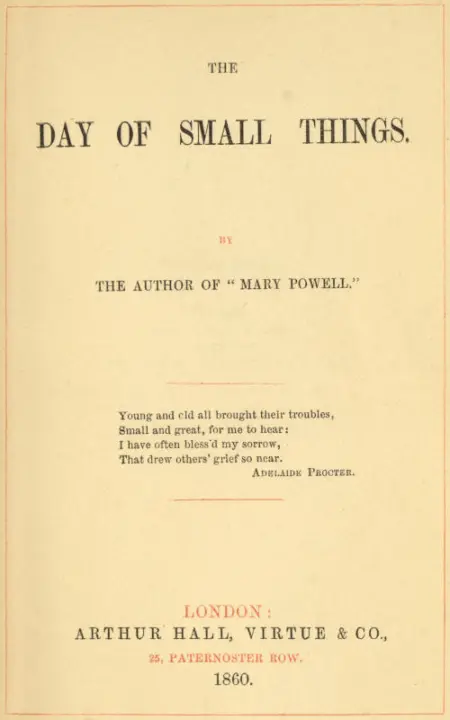
The Day of Small Things
Anne Manning
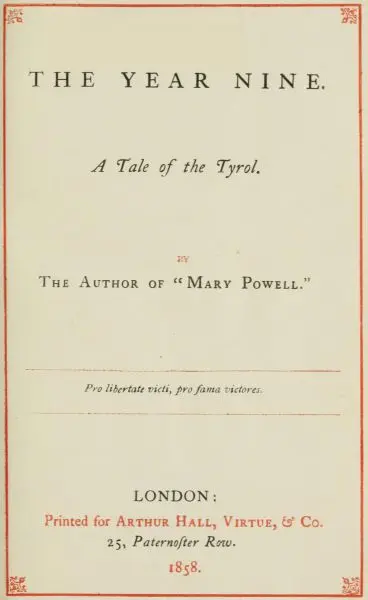
THE CLASSIC COLLECTION · 1858
"The Year Nine: A Tale of the Tyrol" by Anne Manning is a historical novel written in the mid-19th century. Set against the backdrop of the Tyrolean region during the early 1800s, the book likely explores themes of resistance, national identity, and the struggle for freedom amidst the Napoleonic Wars. Central characters include Andreas Hofer, a Tyrolese innkeeper turned folk hero, and several other local figures who become embroiled in the fight against Bavarian forces. At the start of the novel, a thunderstorm sets a dramatic scene in a small Tyrolean inn. The innkeeper, known as Sandwirth, interacts with various patrons, including peasants and travelers, discussing simple life and deeper matters of morality, particularly surrounding a planned shooting match. As conversations hint at underlying tensions in the region, we are introduced to key characters like Joseph Speckbacher, a notable figure among the locals, and Father Joachim, a Capuchin friar who later plays a significant role in organizing resistance efforts. The atmosphere suggests a brewing conflict that intertwines personal lives with larger nationalistic ambitions, foreshadowing the imminent uprising in defense of Tyrol's freedoms.
Introduction adapted from the source catalogue; source summaries may be automatically generated.
Free to read · English · 67,502 words · No account needed
MAKE TIME FOR A GOOD BOOK
On by default. Untick to stop anonymous reading totals. Each page counts after 10 seconds in view. How this works.
Anonymous counting is on unless you have switched it off.
"Ah, he has done good service, nevertheless. General Chastelar finds fault with our training, calls us round-shouldered, and who knows what?--and wants to drill us a little. He won't be able to turn a wild lark into a piping bulfinch, though, it's my opinion. As long as we beat the enemy, what does it signify how we do it? He is doing real good service, however, by giving muskets to those who have no fire-arms, but only spears and such like of their own manufacture. Now, then, where are the children?"
Theresa went to the door to give a jödel, which would answer the purpose of a dinner-bell; but, changing her purpose, returned, saying, "Father, here is a young, olive-coloured man, who looks something like a soldier, coming up to the house; in quest, apparently, of you."
Almost at the same instant, the young man stepped in, taking off his cap and saluting Hofer in a foreign accent as Signor Andrea.
"Come sta?" returned Hofer, who rather piqued himself on a smattering of Italian. "Sedete voi. Andiamo pranzare--Fate lo stesso."
"Mille grazie," returned the youth, who, however, preferred his own German to Hofer's Italian. "The Signor Barone has sent me, Giuseppe Eisenstecken, with the desire you will accept me as adjutant."
"What want have I of an adjutant?" inquired the Sandwirth. "What are
you to do?"
"Che vi piace," returned Giuseppe, spreading out his hands; "I am
quite at your service."
"But, my good lad, I don't want your services; so where's the good?"
Giuseppe raised his eyebrows; then replied, "A little training, the Signor Barone thought, would be desirable for your men, and some small knowledge of tactics for their chief."
"Ah, my dear youth, you mean to flatten our backs, I suppose, and turn out our toes; but when you have lived as long in a mountainous country as I have, you will find it more convenient, clambering about among the crags, to round your shoulders and turn your toes in. Meanwhile, do as we do--nulla ceremonia!--dine first, and talk afterwards. One thing at a time will last the longer."
The young adjutant looked at first as if he hardly knew how to take this; but at the same instant, three rosy children ran in and flew into their father's arms. While Hofer was embracing and kissing them, Giuseppe looked on with some sympathy; then, drawing a stool towards the table, he prepared to accept the Sandwirth's invitation.
"So Baron Hormayr sent you to me?" said Hofer presently. "Well, I wonder he said nothing about you when I saw him."
"He has written," said Giuseppe, taking a note out of his cap.
Your reading position is saved on this browser. Take it to another device with a library code. Reading pages adapt to text, rather than matching a printed edition.
Anne Manning

Anne Manning
Anne Manning
Anne Manning
BEHIND THE BOOK
This eBook is for the use of anyone anywhere in the United States and most other parts of the world at no cost and with almost no restrictions whatsoever. You may copy it, give it away or re-use it under the terms of the Project Gutenberg License included with this eBook or online at www.gutenberg.org. If you are not located in the United States, you will have to check the laws of the country where you are located before using this eBook. Read the source licence.
The original source file, including credits and licence, is retained by this library. Request an original-format copy at no charge. Please include the book title and Project Gutenberg identifier #49290.
KEEP YOUR CURIOSITY GOING
Cécile Tormay

Moritz Busch
Coulson Kernahan
John L. Ransom

Maurice Baring
Frances Wright