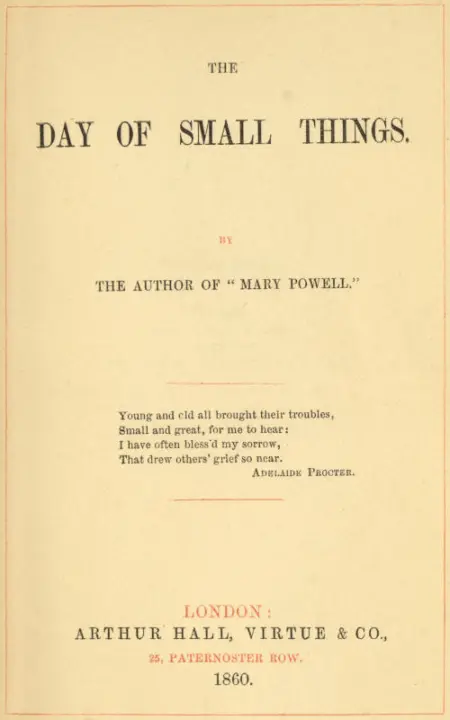
The Day of Small Things
Anne Manning

THE CLASSIC COLLECTION · 1858
"The Year Nine: A Tale of the Tyrol" by Anne Manning is a historical novel written in the mid-19th century. Set against the backdrop of the Tyrolean region during the early 1800s, the book likely explores themes of resistance, national identity, and the struggle for freedom amidst the Napoleonic Wars. Central characters include Andreas Hofer, a Tyrolese innkeeper turned folk hero, and several other local figures who become embroiled in the fight against Bavarian forces. At the start of the novel, a thunderstorm sets a dramatic scene in a small Tyrolean inn. The innkeeper, known as Sandwirth, interacts with various patrons, including peasants and travelers, discussing simple life and deeper matters of morality, particularly surrounding a planned shooting match. As conversations hint at underlying tensions in the region, we are introduced to key characters like Joseph Speckbacher, a notable figure among the locals, and Father Joachim, a Capuchin friar who later plays a significant role in organizing resistance efforts. The atmosphere suggests a brewing conflict that intertwines personal lives with larger nationalistic ambitions, foreshadowing the imminent uprising in defense of Tyrol's freedoms.
Introduction adapted from the source catalogue; source summaries may be automatically generated.
Free to read · English · 67,502 words · No account needed
MAKE TIME FOR A GOOD BOOK
On by default. Untick to stop anonymous reading totals. Each page counts after 10 seconds in view. How this works.
Anonymous counting is on unless you have switched it off.
Hofer came in, looking gloomy, and began unlacing his boots, saying his feet had swollen. Theresa drew off his boots, and tenderly chafed his ankles. There was a subdued, glittering light in the priest's stealthy eye.
"Thou hast lost thy relish, may be, Anderl, for country bread and
cheese," said Anna, smiling.
"When I do, I hope the first mouthful of it will choke me," returned the Sandwirth, vehemently cutting up the loaf in huge slices.
"Cincinnatus, returned to his plough," observed Father Donay ironically.
"I don't know aught of Saint Senatus," remarked Anna, after a moment's thought; "is he in our calendar, father?"
"No, my good woman,--no, daughter, no--A good Roman--"
"That's to say a good Catholic, I suppose," said Anna: but the priest did not answer her--his mouth was full of soup.
Hofer could not get on with his bread and cheese. He sank sorrowfully back in his chair, and covered his eyes with his hand.
"Take courage, son," said Father Donay; "consider what a noble sacrifice thou art about to make--"
"What sacrifice?" cried Anna hastily.
"The sacrifice of his will, daughter; the hardest sacrifice man or
woman can make."
"Something more than that," groaned Hofer.
"What's that?" cried Anna sharply. "Your will was always a good
one--why should you give it up?"
"For the good of all--Hist, dear; these are not women's affairs--"
"No, no, better change the subject," said Father Donay.--"Tell me the meaning of those targets on the wall."
"Boys' playthings, of old, father," said Hofer sadly. "Dangerous ones,
too."
During Father Donay's short stay at am Sand, he never ceased urging on his host the imperative duty, as a Christian patriot, of sacrificing his own views, interests, and safety to the safety of his countrymen; and even to place himself in the hands of General Drouet.
Regulus could not have been more willing than Hofer was to devote himself for the common cause; and, with his judgment obscured by Jesuitical casuistry, he drew up a proclamation to his countrymen, advising them to lay down their arms, and consider their cause as lost.
The proclamation was received with despair by Speckbacher; with disgust by a Tyrolese named Kolb. He, meeting the Sandwirth near Sterzing, whither he had accompanied Father Donay, and where the unfortunate proclamation had been penned, hotly remonstrated with him, and declared his conviction that the document which contained the intelligence of the peace was a forgery. Hofer was confounded, and hastened home to re-digest his thoughts; while Kolb proceeded industriously to spread the impression of the forgery among the other chiefs.
Speckbacher and Rudolf were at am Sand, impatiently awaiting him.
Your reading position is saved on this browser. Take it to another device with a library code. Reading pages adapt to text, rather than matching a printed edition.
Anne Manning

Anne Manning
Anne Manning
Anne Manning
BEHIND THE BOOK
This eBook is for the use of anyone anywhere in the United States and most other parts of the world at no cost and with almost no restrictions whatsoever. You may copy it, give it away or re-use it under the terms of the Project Gutenberg License included with this eBook or online at www.gutenberg.org. If you are not located in the United States, you will have to check the laws of the country where you are located before using this eBook. Read the source licence.
The original source file, including credits and licence, is retained by this library. Request an original-format copy at no charge. Please include the book title and Project Gutenberg identifier #49290.
KEEP YOUR CURIOSITY GOING
Cécile Tormay

Moritz Busch
Coulson Kernahan
John L. Ransom

Maurice Baring
Frances Wright