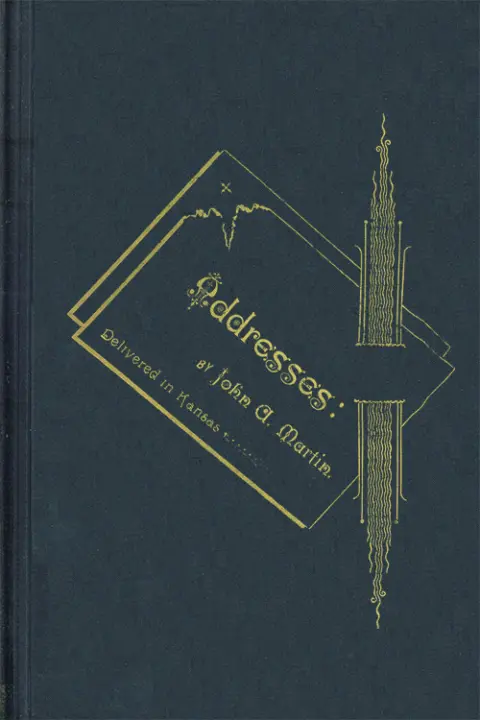
Addresses: by John A. Martin. Delivered in Kansas.
John Alexander Martin
THE CLASSIC COLLECTION · 1882
"The Wyandotte Convention: an address by John Alexander Martin" is a historical address delivered by John Alexander Martin at the reunion of members and officers of the Wyandotte Constitutional Convention held in Wyandotte, Kansas, in the late 19th century. It reflects on the significant event of the convention, which was critical in framing the Kansas Constitution amid the tumultuous backdrop of the antebellum period, marked by conflicts over slavery and statehood. The book presents a detailed examination of the various conventions that preceded it, the people involved, the contentious debates, and the outcomes that shaped the future of Kansas. In his address, Martin recounts the proceedings of the Wyandotte Convention, emphasizing the composition of its members, who were primarily young and previously unrecognized figures in Kansas politics. He highlights the dedicated efforts of the assembly to create a constitution that would serve the diverse needs of the emerging state, addressing issues such as democratic representation, education, and civil rights, while notably rejecting proposals to exclude free blacks from the state. Martin passionately discusses the challenges the convention faced, its ultimate success in creating a lasting constitution, and the broader implications this had for Kansas as a state, encapsulating a period of significant social, political, and economic change in American history.
Introduction adapted from the source catalogue; source summaries may be automatically generated.
Free to read · English · 7,428 words · No account needed
MAKE TIME FOR A GOOD BOOK
On by default. Untick to stop anonymous reading totals. Each page counts after 10 seconds in view. How this works.
Anonymous counting is on unless you have switched it off.
It would violate the proprieties of such an occasion to comment on the personal feuds or partisan broils which once or twice marred the general harmony and orderly progress of the proceedings. These were very few, indeed, and none of them, I think, outlasted the Convention. The members parted, when the final adjournment came, with mutual respect and good will, and the friendships formed during the session have been unusually warm and enduring.
It seems fitting that, in concluding this sketch of the Convention and its labors, I should briefly narrate the subsequent history of its members. It was a small company, that which parted here twenty-three years ago to-day, and it was made up, as I have said, largely of young and vigorous men. But when this reunion was first suggested, and I came to look over the familiar names I had so often called during the long, hot days of that far away July, it was painful to note the havoc death had made. It impressed me something as did a roll-call I once witnessed, in the red glare of bivouac fires after one of the great battles of the war, when surviving comrades answered "killed," or "wounded," to one-half the names of a regiment. Ten of the fifty-two members composing the Convention I have not heard of for many years. Of the remaining forty-two, twenty rest quietly in
—"The reconciling grave,
Where all alike lie down in peace together."
The largest delegation was that from Leavenworth county, and only one of the ten gentlemen comprising it, R. C. Foster, certainly survives. Rare Sam Stinson, whose genial wit and brilliant accomplishments won all hearts, was elected Attorney General in 1861, by a unanimous vote, and died in his old Maine home, in February, 1866. William C. McDowell was chosen Judge of the First Judicial District at the first election under the Constitution; served four years; and was killed by a fall from an omnibus in St. Louis, July 16, 1866. John P. Slough removed to Colorado, was Colonel of a regiment raised in that State, and later a Brigadier General; was appointed, after the war, Chief Justice of New Mexico, and was killed at Santa Fe. Samuel Hipple removed to Atchison county; served as a Quartermaster during the war; was elected State Senator in 1867; and died in January, 1876. William Perry removed to Colorado, where he died. P. S. Parks returned to Indiana, and engaged in journalism and the law until his death, three years ago. Fred. Brown died in St. Joseph, Mo., and John Wright at his home in Leavenworth county. Robert Graham, of Atchison county, the oldest member, died in 1868. Three of the five members from Doniphan county, Robert J. Porter, Benjamin Wrigley and John Stairwalt, are dead. The members from Linn, James M. Arthur and Josiah Lamb, are both dead, as are also N. C. Blood, of Douglas, and T. S. Wright, of Nemaha. W. R. Griffith, of Bourbon, was elected the first State Superintendent of Public Instruction, and died, February 12th, 1862, before the completion of his term. James G. Blunt, of Anderson, who became a Major General during the war, and won renown as a brave and skillful soldier, died, in Washington, a year or more ago. James Hanway, of Franklin, after a long life of usefulness, died at his old home, only a brief while ago. President James M. Winchell returned to New York shortly after the outbreak of the rebellion, and resumed his connection with the Times, first as war correspondent and afterwards as an editorial writer. Until his death, a few years since, he was employed upon that great journal.
Your reading position is saved on this browser. Take it to another device with a library code. Reading pages adapt to text, rather than matching a printed edition.
John Alexander Martin
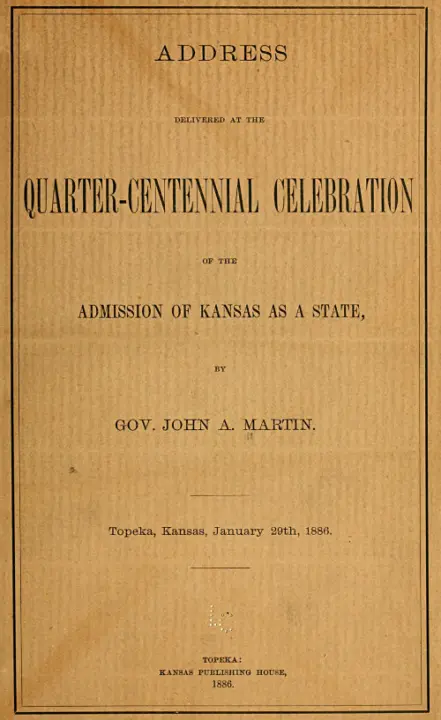
John Alexander Martin
BEHIND THE BOOK
This eBook is for the use of anyone anywhere in the United States and most other parts of the world at no cost and with almost no restrictions whatsoever. You may copy it, give it away or re-use it under the terms of the Project Gutenberg License included with this eBook or online at www.gutenberg.org. If you are not located in the United States, you will have to check the laws of the country where you are located before using this eBook. Read the source licence.
The original source file, including credits and licence, is retained by this library. Request an original-format copy at no charge. Please include the book title and Project Gutenberg identifier #51742.
KEEP YOUR CURIOSITY GOING

David Patterson (Spirit) Hatch

David Patterson (Spirit) Hatch

David Patterson (Spirit) Hatch
Cécile Tormay

Moritz Busch
John L. Ransom