THE CLASSIC COLLECTION✦An outlaw’s diary: the CommuneCLASSIC FREE BOOKS
An outlaw’s diary: the Commune
Cécile Tormay
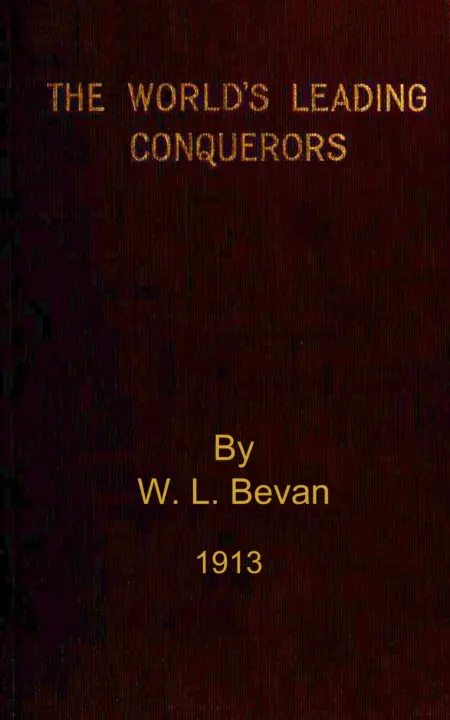
THE CLASSIC COLLECTION · 1913
"The World's Leading Conquerors" by W. L. Bevan is a historical account published in the early 20th century. This work explores the lives and conquests of some of the most significant military figures in Western history, including Alexander the Great, Julius Caesar, and Napoleon, among others. It aims to provide a concise narrative on these conquerors, their strategies, and the historical impact of their actions. The opening of the book introduces Alexander the Great and sets the stage for his rise to power following the assassination of his father, Philip of Macedon. It discusses the political fragmentation of the Greek city-states and how this environment allowed Macedon, under Philip and later Alexander, to dominate Greece. The initial chapters highlight Philip’s military innovations and the subsequent turmoil leading to Alexander's swift consolidation of Macedonian rule, framing the context for Alexander's future conquests and illustrating his complex relationship with power and violence at a formative age.
Introduction adapted from the source catalogue; source summaries may be automatically generated.
Free to read · English · 170,276 words · No account needed
MAKE TIME FOR A GOOD BOOK
On by default. Untick to stop anonymous reading totals. Each page counts after 10 seconds in view. How this works.
Anonymous counting is on unless you have switched it off.
Napoleon’s lack of appreciation of moral standards both in public and in private life is notorious, but he was no hypocrite. The one pleasing side of his character was his devotion to his family. Here the clear light of his intellect could not reach. It is true he made grotesque mistakes in putting his brothers into positions for which they were manifestly unfitted, but this sign of weakness shows that, after all, Napoleon was not entirely selfish. He seems to have had little actual patriotism. He was not a Frenchman either by descent or by sympathy, and what he accomplished was done at the expense of the French people. He understood some of their characteristics, but his own point of view was so practical that there were whole fields of achievement signalized in the records of French genius that he never appreciated. On lower planes of action, however, his driving power was immense, and the very terror he created by the success of his concentrated individualism prepared the way for that progressive acknowledgment of public justice and social righteousness which characterized the civilization of the nineteenth century. In spite of all his limitations, it seems impossible to point to a more marvelous career in the annals of humanity.
Addington, 400
Ajaccio, 402
Alcuin, 181-183
Alexander of Russia, forms alliance with Napoleon, 417;
covets Finland and Sweden, 421;
sympathizes with French defeat in Spain, 422;
confers with Napoleon at Erfurt, 422;
takes aggressive attitude toward the French, 429
Alexander the Great, his descent, 7;
succeeds to the throne of Macedon, 5;
educated under Aristotle, 5;
his precociousness, 5;
master of Macedon, 7;
checks uprisings, 8, 9;
declared guardian of the temple, 9;
renews Hellenic league, 9;
begins his reign with crime, 9-10;
leaves Amphipolis, 11;
offers thanks to Dionysus, 11;
marches up the Danube, 11;
his rumored assassination, 13;
razes Thebes, 14-15;
his placability toward Athens, 16-17;
plans to dethrone Persia’s king, 18;
crosses the Hellespont, 18;
defeats Persians, 20;
marches against Halicarnassus, 21;
concludes peace with the Persians, 25;
is voted a crown, 25;
his reply to Darius, 25-26;
calls himself “Great King of Asia,” 26;
lays siege to Tyre, 27-28;
founds Alexandria, 28;
invades Syria and Egypt, 28-29;
again defeats Persians, 31;
proceeds to Babylon, 31;
razes Persepolis, 32;
takes Drangiana, 35;
executes Philotas and Parmenio, 36;
captures Bessus, 36;
founds new Alexandria, 36;
routs the Scythians, 37;
executes Bessus, 37;
spears Clitus, 38;
massacres Sogdianians, 38-39;
marries Roxane, 39;
hangs Hermolaus, 40;
motives for conquest of India, 40-41;
begins Indian campaign, 42;
fords the Hydaspes, 42;
defeats Indian army, 46;
forced to cease Eastern conquests, 46;
takes up organization of his empire, 49;
endeavors to amalgamate Greeks and Persians, 49-53;
looks after economic development, 52;
tries to legitimatize his rule in the East, 54-56;
his death, 57;
nature of his achievements, 58-59, 64;
his temperament, 38;
his lack of statesmanship, 40;
as an explorer, 46;
as a general, 11, 59-63
Alexander’s Conquest of Greece, 4-17
Your reading position is saved on this browser. Take it to another device with a library code. Reading pages adapt to text, rather than matching a printed edition.
BEHIND THE BOOK
This eBook is for the use of anyone anywhere in the United States and most other parts of the world at no cost and with almost no restrictions whatsoever. You may copy it, give it away or re-use it under the terms of the Project Gutenberg License included with this eBook or online at www.gutenberg.org. If you are not located in the United States, you will have to check the laws of the country where you are located before using this eBook. Read the source licence.
The original source file, including credits and licence, is retained by this library. Request an original-format copy at no charge. Please include the book title and Project Gutenberg identifier #74652.
KEEP YOUR CURIOSITY GOING
Cécile Tormay

Moritz Busch
John L. Ransom
Frances Wright
Cécile Tormay

Mabel Potter Daggett