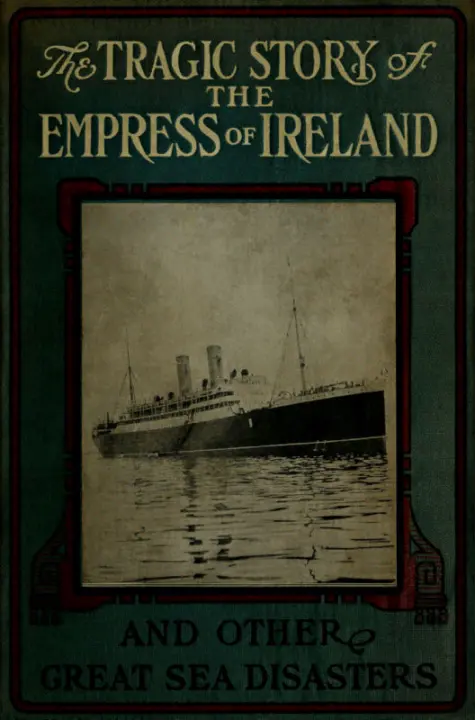
The Tragic Story of the Empress of Ireland, and Other Great Sea Disasters
Logan Marshall
THE CLASSIC COLLECTION · 1915
"The World War" by Logan Marshall is a historical account written in the early 20th century. The text explores the events leading up to World War I, detailing the complex political landscape and the various nations and empires involved in the conflict. It focuses on the dramatic suddenness with which Europe was plunged into war following the assassination of Archduke Franz Ferdinand and the subsequent reactions of the involved nations. The opening of the book sets the stage for the historical narrative that follows, describing the peace that pervaded Europe just before the outbreak of war. It highlights the shock and turmoil experienced across the continent as nations quickly mobilized for conflict. Marshall discusses the deep-rooted causes of the war, emphasizing that the assassination of the archduke served as a catalyst for long-standing tensions between nations. He delves into the political environment, the impacts of militarism, and the catastrophic consequences that ensued, painting a vivid picture of a world on the brink of devastation.
Introduction adapted from the source catalogue; source summaries may be automatically generated.
Free to read · English · 100,105 words · No account needed
MAKE TIME FOR A GOOD BOOK
On by default. Untick to stop anonymous reading totals. Each page counts after 10 seconds in view. How this works.
Anonymous counting is on unless you have switched it off.
Great Britain, meanwhile, had devoted her main attention to the trade and diplomacy and little wars associated with the maintenance of a world-empire and, in self-defense, had cultivated friendships with Russia and France and the United States and Japan as this German power began to come closer and touch the most vital British interests. France naturally strengthened itself as its historic enemy grew in power; Russia improved her military position after the Japanese was as she was bound to do; Germany appeared to set the pace upon sea and land with an aggressive diplomacy in Morocco and in China, at Paris and at St. Petersburg, which was bound to cause trouble and to promote what is commonly called militarism. The vast ambitions and persistent policy of the German ruler and his people, the unsatisfied characteristics of German diplomacy, the militant ideals and military preparations and naval expansion of Germany between 1900 and 1914 became the dominant consideration in the chancelleries of Europe. Armies and navies, wars in the Balkans or struggles for colonial spheres of influence, financial reserves and naval construction and volunteer forces—all came to be measured against current developments in this center of European gravity.
Great Britain tried to hold aloof from this international rivalry, this preparation for a war which her people and leaders hoped against hope would be averted. Royal visits of a pacific character were exchanged, parties of Great Britain’s business men visited Berlin, while leaders such as King Edward and Lord Haldane exercised all their ability in striving for some mutual ground of friendly action. Lovers of peace wrote many volumes and filled many newspapers with articles on the beneficence of that policy and the terrors of militarism—books and articles which were never seen in Germany except by those who regarded them as so many confessions of national weakness. Between 1904 and 1908 Great Britain actually reduced her naval expenditures and limited her construction of battleships in the hope that Germany would follow the lead, pleaded at two Hague Conferences for international reduction of armaments, kept away from all increase in her own almost ridiculous military establishment, urged upon two occasions (in 1912–1913) a naval holiday in construction. The following figures from Brassey’s authoritative NAVAL ANNUAL shows that her naval expenditure upon new ships in 1913 was actually less than in 1904, that Germany’s was nearly three times greater, that France and Russia and Italy had doubled theirs:
Great Britain Germany France Russia Italy Austro-Hungary 1904 £13,508,176 £4,275,489 £4,370,102 £4,480,188 £1,121,753 £1,329,590 1908 8,660,202 7,795,499 4,193,544 2,703,721 1,866,158 716,662 1911 17,566,877 11,710,859 5,876,659 3,240,394 2,677,302 3,125,000 1912 17,271,527 11,491,157 6,997,552 7,904,094 2,500,000 3,620,881 1913 13,276,400 11,176,407 7,595,010 10,953,616 2,800,000 3,280,473
Your reading position is saved on this browser. Take it to another device with a library code. Reading pages adapt to text, rather than matching a printed edition.
BEHIND THE BOOK
This eBook is for the use of anyone anywhere in the United States and most other parts of the world at no cost and with almost no restrictions whatsoever. You may copy it, give it away or re-use it under the terms of the Project Gutenberg License included with this eBook or online at www.gutenberg.org. If you are not located in the United States, you will have to check the laws of the country where you are located before using this eBook. Read the source licence.
The original source file, including credits and licence, is retained by this library. Request an original-format copy at no charge. Please include the book title and Project Gutenberg identifier #3779.
KEEP YOUR CURIOSITY GOING
Cécile Tormay

Moritz Busch
John L. Ransom
Frances Wright
Cécile Tormay

Mabel Potter Daggett