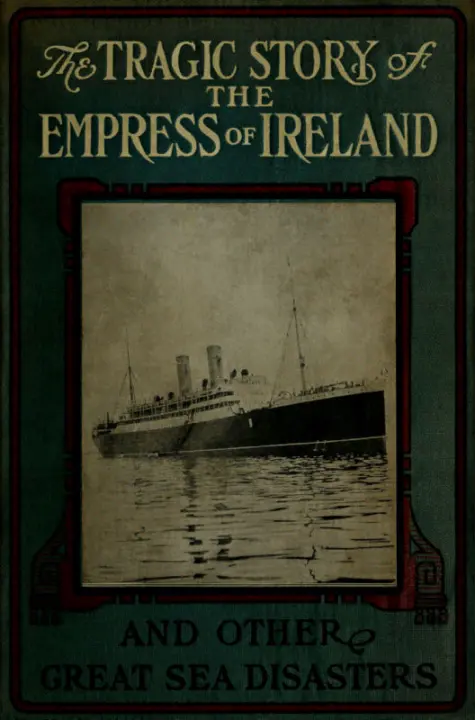
The Tragic Story of the Empress of Ireland, and Other Great Sea Disasters
Logan Marshall
THE CLASSIC COLLECTION · 1915
"The World War" by Logan Marshall is a historical account written in the early 20th century. The text explores the events leading up to World War I, detailing the complex political landscape and the various nations and empires involved in the conflict. It focuses on the dramatic suddenness with which Europe was plunged into war following the assassination of Archduke Franz Ferdinand and the subsequent reactions of the involved nations. The opening of the book sets the stage for the historical narrative that follows, describing the peace that pervaded Europe just before the outbreak of war. It highlights the shock and turmoil experienced across the continent as nations quickly mobilized for conflict. Marshall discusses the deep-rooted causes of the war, emphasizing that the assassination of the archduke served as a catalyst for long-standing tensions between nations. He delves into the political environment, the impacts of militarism, and the catastrophic consequences that ensued, painting a vivid picture of a world on the brink of devastation.
Introduction adapted from the source catalogue; source summaries may be automatically generated.
Free to read · English · 100,105 words · No account needed
MAKE TIME FOR A GOOD BOOK
On by default. Untick to stop anonymous reading totals. Each page counts after 10 seconds in view. How this works.
Anonymous counting is on unless you have switched it off.
The annual revenue of the German Empire is nearly $900,000,000; that of its component states, $1,500,000,000; that of the states at $3,735,000,000. The revenue is derived chiefly from customs duties, excise duties on beet-root sugar, salt, tobacco and malt and contributions from the several states.
Germany is the foster home of modern militarism and is held to have the most complete army system in the world. Every man capable of bearing arms must begin his military training on the 1st of January of the year in which he reaches the age of twenty, and continue it to the end of his forty-second year, unless released from this duty by the competent authorities, either altogether or for times of peace.
Seven years of this time must be spent in the army or fleet; three of them in active service, four in the reserve. Seven more years are passed in the Landwehr, the members of which may be called out only twice for training. The remaining time is passed in the Landsturm, which is called out only in case of invasion of the empire. The total peace strength of the army is given at 870,000; of the reserves at 4,430,000; the total being 5,300,000.
The navel force of Germany is very powerful, though considerably less than that of Great Britain. It comprises 19 of the enormous modern battleships, 7 cruiser battleships, and 20 of older type; 9 first-class and 45 second and third-class cruisers, and numerous smaller warships, including 47 torpedo boats, 141 destroyers and 60 submarines.
Russia, the third of the three nations to which the war was most immediately due, is the most extensive consolidated empire in the world, its total area being estimated at 8,647,657 square miles, of which 1,852,524 are in Europe, the remainder in Asia. The population is given at about 160,000,000, of which 130,000,000 are in Europe.
Agriculture is the chief pursuit of this great population, though manufactures are largely developing. The forests, immense in extent, cover forty-two per cent of the area and contain timber in enormous quantities. While a large part of the area is level ground, there is much elevated territory, and the mineral wealth is very important. It includes gold, silver, platinum, iron, copper, coal and salt, all of large occurrence. Of the people, over 1,800,000 are employed in manufacture, and the annual value of the commerce amounts to $1,300,000,000. The length of railway is about 50,000 miles.
Your reading position is saved on this browser. Take it to another device with a library code. Reading pages adapt to text, rather than matching a printed edition.
BEHIND THE BOOK
This eBook is for the use of anyone anywhere in the United States and most other parts of the world at no cost and with almost no restrictions whatsoever. You may copy it, give it away or re-use it under the terms of the Project Gutenberg License included with this eBook or online at www.gutenberg.org. If you are not located in the United States, you will have to check the laws of the country where you are located before using this eBook. Read the source licence.
The original source file, including credits and licence, is retained by this library. Request an original-format copy at no charge. Please include the book title and Project Gutenberg identifier #3779.
KEEP YOUR CURIOSITY GOING
Cécile Tormay

Moritz Busch
John L. Ransom
Frances Wright
Cécile Tormay

Mabel Potter Daggett