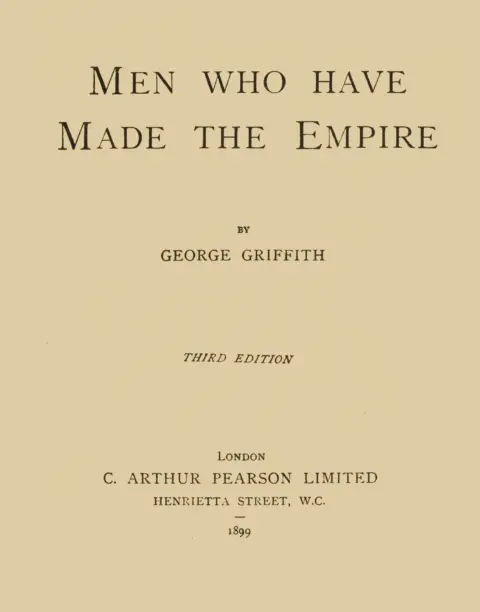
Men Who Have Made the Empire
George Chetwynd Griffith
THE CLASSIC COLLECTION · 1903
"The World Masters" by George Chetwynd Griffith is a novel written in the early 20th century. This science fiction work blends elements of political intrigue and complex character relationships, focusing on themes of power, ambition, and manipulation. The story centers around Doctor Emil Fargeau, a brilliant scientist who, in his desperation to see France reclaim its greatness, invents a device capable of inflicting unparalleled destruction on their enemies. The opening of the novel introduces us to Doctor Emil Fargeau, who is in a fervent state of anticipation within his laboratory in Strasbourg, preparing for a crucial experiment that could change the fate of nations. As he succeeds in shattering a steel plate with his invention, he envisions a future where France dominates the world again, alongside his son's potential bride, Adelaide de Condé, a descendant of noble lineage. Simultaneously, we glimpse the romantic and diplomatic tensions brewing at the German Embassy in Petersburg, where the prince and his beautiful daughter, whom Emil views as essential to his plans, are entwined in the complex web of European politics. This dramatic juxtaposition sets the stage for a fascinating exploration of the intertwining fates of these characters and the catastrophic global implications of Fargeau's discovery.
Introduction adapted from the source catalogue; source summaries may be automatically generated.
Free to read · English · 85,041 words · No account needed
MAKE TIME FOR A GOOD BOOK
On by default. Untick to stop anonymous reading totals. Each page counts after 10 seconds in view. How this works.
Anonymous counting is on unless you have switched it off.
"Why, certainly!" replied Chrysie, flushing a little at the rebuke: "and so we do over our side: but still, all's fair in--well--in love and war, and I guess you won't think me quite so wicked when I tell you who that telegram's addressed to."
"Really, Chrysie, I don't wish to know, and I don't think you ought to know," said Lady Olive, still more stiffly.
"Well," replied Chrysie, defiantly, "I am sorry I riled you, but I do know it; and honestly, Olive, it's what's you and I and all of us ought to know."
At this Lady Olive's curiosity appealed very strongly to her sense of the proprieties, and she said more amiably:
"Do you really mean, Chrysie, that there's something serious in it--that, for instance, it has anything to do with the works?"
"I don't know yet," said Chrysie, "but I've got a pretty good copy of it in my satchel, thanks to those awful pencils they give you to use in British telegraph offices. Anyhow, it was addressed to Count Valdemar, Yacht Vlodoya, Cherbourg; and Cherbourg's not on the way to the Baltic, is it? Let's go and have an ice and some cakes somewhere, so that I can read what is written."
"That's very strange," said Lady Olive, "and the Count professed to be in such a hurry to get back to Petersburg. What on earth can he be doing at Cherbourg?"
"I reckon poppa and the viscount would give something to know that, too," said Chrysie, as they turned into a confectioner's. They ordered ices, and Chrysie took the telegram form out of her satchel and unfolded it gingerly. Her pretty brows puckered over it for a few moments, as she slanted it this way and that to get the light on it. Then she put her elbows on the little marble table, and said in a low tone:
"It's in French, and it tells the Count that the Nadine starts this evening instead of to-morrow morning. The last word is 'Depechez,' and that's French for 'Make haste,' isn't it? Now, do you think I was right in doing a very improper thing--which, of course, it was?"
"I'm afraid you were, Chrysie," said Lady Olive. "It's certainly very mysterious. How is the telegram signed?"
"There isn't any signature," replied Chrysie. "Our friend's a bit too
cute for that."
"What on earth do you mean, Chrysie?" said Lady Olive, with a note of alarm in her voice. "What friend?"
Chrysie looked up and said, with a snap of her eyes: "What other
friend than M'am'selle Felice's mistress--the noble Adelaide de
Conde?"
Your reading position is saved on this browser. Take it to another device with a library code. Reading pages adapt to text, rather than matching a printed edition.
George Chetwynd Griffith
George Chetwynd Griffith
George Chetwynd Griffith
George Chetwynd Griffith
BEHIND THE BOOK
This eBook is for the use of anyone anywhere in the United States and most other parts of the world at no cost and with almost no restrictions whatsoever. You may copy it, give it away or re-use it under the terms of the Project Gutenberg License included with this eBook or online at www.gutenberg.org. If you are not located in the United States, you will have to check the laws of the country where you are located before using this eBook. Read the source licence.
The original source file, including credits and licence, is retained by this library. Request an original-format copy at no charge. Please include the book title and Project Gutenberg identifier #38028.
KEEP YOUR CURIOSITY GOING
Coulson Kernahan

Maurice Baring
Frances Wright
Cécile Tormay
Francis Greenleaf Allinson & Anne C. E. (Anne Crosby Emery) Allinson

Frederic Jesup Stimson