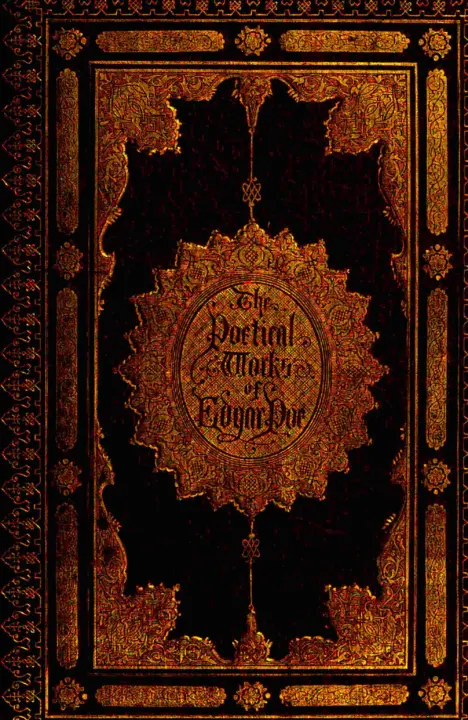
The poetical works of Edgar Allan Poe
Edgar Allan Poe
THE CLASSIC COLLECTION · 1845
"The Works of Edgar Allan Poe — Volume 1" by Edgar Allan Poe is a collection of various literary works, likely written in the mid-19th century. This volume presents a comprehensive look at Poe’s contributions to the genres of horror, mystery, and poetry, showcasing his unique ability to navigate themes of melancholy and the supernatural. This collection includes not only the celebrated tales such as "The Murders in the Rue Morgue" and "The Tell-Tale Heart," but also illuminating prefaces and analyses of his life and works, inviting readers to delve into the mind of one of America's most iconic writers. The beginning of this volume contains a preface, touching upon Poe's life, struggles, and literary achievements, and it sets the tone for the exploration of his works. Notably, it includes reflections on his early life, detailing his adoption by John Allan, his education, and his tumultuous relationships, as well as mentions of his formative experiences and the challenges he faced in his literary career. The opening gives readers insight into the origins of works that blend the macabre with the poetic, suggesting that Poe's life experiences deeply influenced his storytelling. Moreover, it serves as an introduction to the themes of despair, beauty, and complexity that define his body of work, preparing readers for the profound explorations ahead.
Introduction adapted from the source catalogue; source summaries may be automatically generated.
Free to read · English · 91,336 words · No account needed
MAKE TIME FOR A GOOD BOOK
On by default. Untick to stop anonymous reading totals. Each page counts after 10 seconds in view. How this works.
Anonymous counting is on unless you have switched it off.
“But, having established a single word, we are enabled to establish a vastly important point; that is to say, several commencements and terminations of other words. Let us refer, for example, to the last instance but one, in which the combination ;48 occurs—not far from the end of the cipher. We know that the ; immediately ensuing is the commencement of a word, and, of the six characters succeeding this ‘the,’ we are cognizant of no less than five. Let us set these characters down, thus, by the letters we know them to represent, leaving a space for the unknown—
t eeth.
“Here we are enabled, at once, to discard the ‘th,’ as forming no portion of the word commencing with the first t; since, by experiment of the entire alphabet for a letter adapted to the vacancy, we perceive that no word can be formed of which this th can be a part. We are thus narrowed into
t ee,
and, going through the alphabet, if necessary, as before, we arrive at the word ‘tree,’ as the sole possible reading. We thus gain another letter, r, represented by (, with the words ‘the tree’ in juxtaposition.
“Looking beyond these words, for a short distance, we again see the combination ;48, and employ it by way of termination to what immediately precedes. We have thus this arrangement:
the tree ;4(‡?34 the,
or, substituting the natural letters, where known, it reads thus:
the tree thr‡?3h the.
“Now, if, in place of the unknown characters, we leave blank spaces, or substitute dots, we read thus:
the tree thr...h the,
when the word ‘through’ makes itself evident at once. But this discovery gives us three new letters, o, u and g, represented by ‡, ? and 3.
“Looking now, narrowly, through the cipher for combinations of known characters, we find, not very far from the beginning, this arrangement,
83(88, or egree,
which, plainly, is the conclusion of the word ‘degree,’ and gives us another letter, d, represented by †.
“Four letters beyond the word ‘degree,’ we perceive the
combination
“Translating the known characters, and representing the unknown by dots, as before, we read thus:
th.rtee,
an arrangement immediately suggestive of the word ‘thirteen,’ and again furnishing us with two new characters, i and n, represented by 6 and *.
“Referring, now, to the beginning of the cryptograph, we find the
combination,
“Translating as before, we obtain
good,
which assures us that the first letter is A, and that the first two words are ‘A good.’
“It is now time that we arrange our key, as far as discovered, in a tabular form, to avoid confusion. It will stand thus:
5 represents a
† “ d
8 “ e
3 “ g
4 “ h
6 “ i
* “ n
‡ “ o
( “ r
; “ t
? “ u
Your reading position is saved on this browser. Take it to another device with a library code. Reading pages adapt to text, rather than matching a printed edition.
Edgar Allan Poe

Rebecca Harding Davis & Thomas De Quincey & Charles Dickens & Nathaniel Hawthorne & Edward Bulwer Lytton, Baron Lytton & Edgar Allan Poe & Harriet Elizabeth Prescott Spofford
Edgar Allan Poe
Edgar Allan Poe
BEHIND THE BOOK
This eBook is for the use of anyone anywhere in the United States and most other parts of the world at no cost and with almost no restrictions whatsoever. You may copy it, give it away or re-use it under the terms of the Project Gutenberg License included with this eBook or online at www.gutenberg.org. If you are not located in the United States, you will have to check the laws of the country where you are located before using this eBook. Read the source licence.
The original source file, including credits and licence, is retained by this library. Request an original-format copy at no charge. Please include the book title and Project Gutenberg identifier #2147.
KEEP YOUR CURIOSITY GOING
Coulson Kernahan

Maurice Baring
Frances Wright
Cécile Tormay
Francis Greenleaf Allinson & Anne C. E. (Anne Crosby Emery) Allinson

Frederic Jesup Stimson