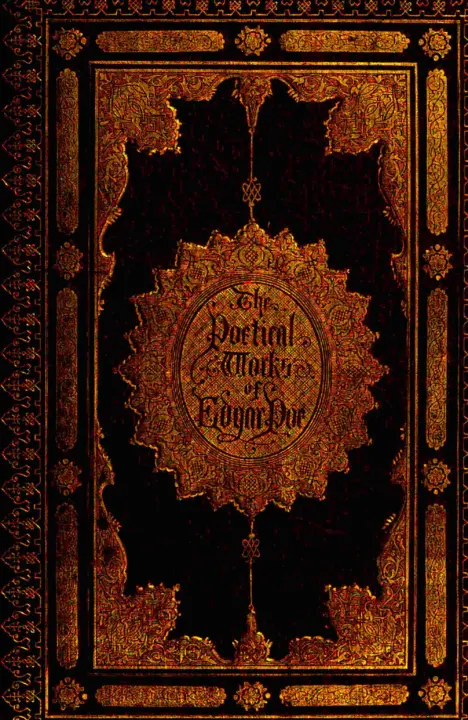
The poetical works of Edgar Allan Poe
Edgar Allan Poe
THE CLASSIC COLLECTION · 1845
"The Works of Edgar Allan Poe — Volume 1" by Edgar Allan Poe is a collection of various literary works, likely written in the mid-19th century. This volume presents a comprehensive look at Poe’s contributions to the genres of horror, mystery, and poetry, showcasing his unique ability to navigate themes of melancholy and the supernatural. This collection includes not only the celebrated tales such as "The Murders in the Rue Morgue" and "The Tell-Tale Heart," but also illuminating prefaces and analyses of his life and works, inviting readers to delve into the mind of one of America's most iconic writers. The beginning of this volume contains a preface, touching upon Poe's life, struggles, and literary achievements, and it sets the tone for the exploration of his works. Notably, it includes reflections on his early life, detailing his adoption by John Allan, his education, and his tumultuous relationships, as well as mentions of his formative experiences and the challenges he faced in his literary career. The opening gives readers insight into the origins of works that blend the macabre with the poetic, suggesting that Poe's life experiences deeply influenced his storytelling. Moreover, it serves as an introduction to the themes of despair, beauty, and complexity that define his body of work, preparing readers for the profound explorations ahead.
Introduction adapted from the source catalogue; source summaries may be automatically generated.
Free to read · English · 91,336 words · No account needed
MAKE TIME FOR A GOOD BOOK
On by default. Untick to stop anonymous reading totals. Each page counts after 10 seconds in view. How this works.
Anonymous counting is on unless you have switched it off.
“Upon the resistance or, more properly, upon the support of an atmosphere, existing in the state of density imagined, I had, of course, entirely depended for the safety of my ultimate descent. Should I then, after all, prove to have been mistaken, I had in consequence nothing better to expect, as a finale to my adventure, than being dashed into atoms against the rugged surface of the satellite. And, indeed, I had now every reason to be terrified. My distance from the moon was comparatively trifling, while the labor required by the condenser was diminished not at all, and I could discover no indication whatever of a decreasing rarity in the air.
“April 19th. This morning, to my great joy, about nine o’clock, the surface of the moon being frightfully near, and my apprehensions excited to the utmost, the pump of my condenser at length gave evident tokens of an alteration in the atmosphere. By ten, I had reason to believe its density considerably increased. By eleven, very little labor was necessary at the apparatus; and at twelve o’clock, with some hesitation, I ventured to unscrew the tourniquet, when, finding no inconvenience from having done so, I finally threw open the gum-elastic chamber, and unrigged it from around the car. As might have been expected, spasms and violent headache were the immediate consequences of an experiment so precipitate and full of danger. But these and other difficulties attending respiration, as they were by no means so great as to put me in peril of my life, I determined to endure as I best could, in consideration of my leaving them behind me momently in my approach to the denser strata near the moon. This approach, however, was still impetuous in the extreme; and it soon became alarmingly certain that, although I had probably not been deceived in the expectation of an atmosphere dense in proportion to the mass of the satellite, still I had been wrong in supposing this density, even at the surface, at all adequate to the support of the great weight contained in the car of my balloon. Yet this should have been the case, and in an equal degree as at the surface of the earth, the actual gravity of bodies at either planet supposed in the ratio of the atmospheric condensation. That it was not the case, however, my precipitous downfall gave testimony enough; why it was not so, can only be explained by a reference to those possible geological disturbances to which I have formerly alluded. At all events I was now close upon the planet, and coming down with the most terrible impetuosity. I lost not a moment, accordingly, in throwing overboard first my ballast, then my water-kegs, then my condensing apparatus and gum-elastic chamber, and finally every article within the car. But it was all to no purpose. I still fell with horrible rapidity, and was now not more than half a mile from the surface. As a last resource, therefore, having got rid of my coat, hat, and boots, I cut loose from the balloon the car itself, which was of no inconsiderable weight, and thus, clinging with both hands to the net-work, I had barely time to observe that the whole country, as far as the eye could reach, was thickly interspersed with diminutive habitations, ere I tumbled headlong into the very heart of a fantastical-looking city, and into the middle of a vast crowd of ugly little people, who none of them uttered a single syllable, or gave themselves the least trouble to render me assistance, but stood, like a parcel of idiots, grinning in a ludicrous manner, and eyeing me and my balloon askant, with their arms set a-kimbo. I turned from them in contempt, and, gazing upward at the earth so lately left, and left perhaps for ever, beheld it like a huge, dull, copper shield, about two degrees in diameter, fixed immovably in the heavens overhead, and tipped on one of its edges with a crescent border of the most brilliant gold. No traces of land or water could be discovered, and the whole was clouded with variable spots, and belted with tropical and equatorial zones.
Your reading position is saved on this browser. Take it to another device with a library code. Reading pages adapt to text, rather than matching a printed edition.
Edgar Allan Poe

Rebecca Harding Davis & Thomas De Quincey & Charles Dickens & Nathaniel Hawthorne & Edward Bulwer Lytton, Baron Lytton & Edgar Allan Poe & Harriet Elizabeth Prescott Spofford
Edgar Allan Poe
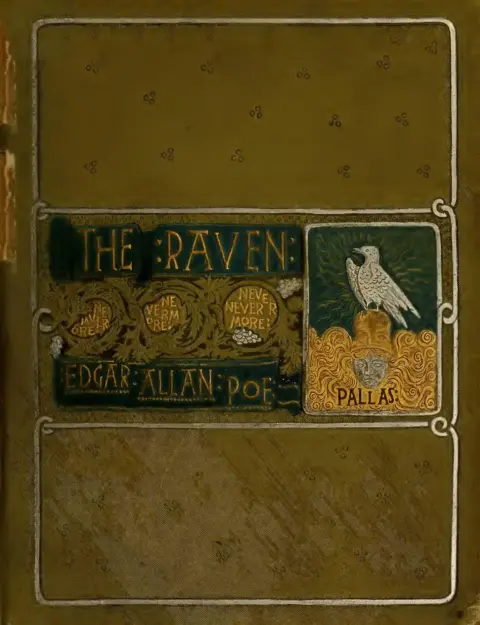
Edgar Allan Poe
BEHIND THE BOOK
This eBook is for the use of anyone anywhere in the United States and most other parts of the world at no cost and with almost no restrictions whatsoever. You may copy it, give it away or re-use it under the terms of the Project Gutenberg License included with this eBook or online at www.gutenberg.org. If you are not located in the United States, you will have to check the laws of the country where you are located before using this eBook. Read the source licence.
The original source file, including credits and licence, is retained by this library. Request an original-format copy at no charge. Please include the book title and Project Gutenberg identifier #2147.
KEEP YOUR CURIOSITY GOING
Coulson Kernahan

Maurice Baring
Frances Wright
Cécile Tormay
Francis Greenleaf Allinson & Anne C. E. (Anne Crosby Emery) Allinson

Frederic Jesup Stimson