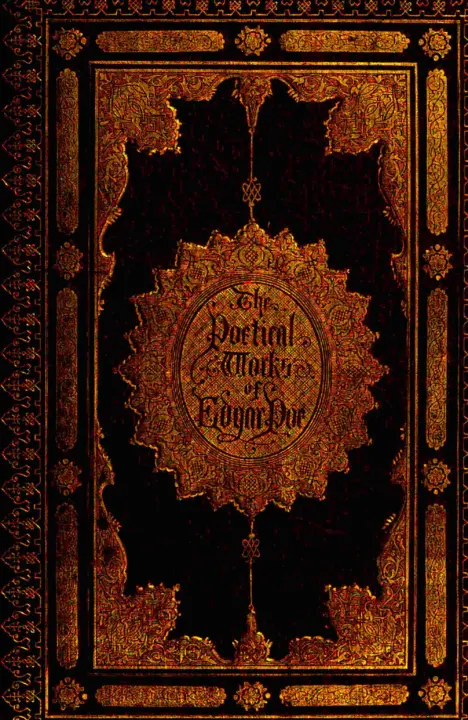
The poetical works of Edgar Allan Poe
Edgar Allan Poe
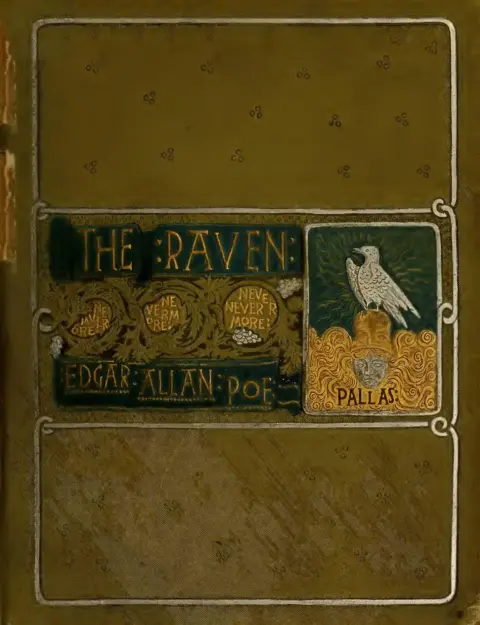
THE CLASSIC COLLECTION · 1845
"The Works of Edgar Allan Poe, The Raven Edition" by Edgar Allan Poe is a comprehensive collection of his literary output, likely compiled in the late 19th century. This collection spans various genres, including poetry, essays, and gothic tales, showcasing Poe's distinctive style and exploration of themes like love, death, and the macabre. The book presents significant works such as "The Raven," "The Tell-Tale Heart," "The Fall of the House of Usher," and many others, illustrating Poe's profound influence on American literature and his mastery of suspense and psychological depth. At the start of this collection, the reader is introduced to a preface that sets the stage for understanding Poe's life and literary journey, giving insights into the struggles he faced, both personally and professionally. The subsequent sections outline key works and achievements in his career, detailing his early poetry, notable prose tales, and his lasting impact on both poetry and fiction. The opening expresses deep admiration for Poe's unique genius, highlighting the interplay between his troubled life and his art, thus creating an engaging entry point for readers new to Poe's work or revisiting it with a fresh perspective.
Introduction adapted from the source catalogue; source summaries may be automatically generated.
Free to read · English · 450,336 words · No account needed
MAKE TIME FOR A GOOD BOOK
On by default. Untick to stop anonymous reading totals. Each page counts after 10 seconds in view. How this works.
Anonymous counting is on unless you have switched it off.
Mr. Ellison became neither musician nor poet; although no man lived more profoundly enamored both of Music and the Muse. Under other circumstances than those which invested him, it is not impossible that he would have become a painter. The field of sculpture, although in its nature rigidly poetical, was too limited in its extent and in its consequences, to have occupied, at any time, much of his attention. And I have now mentioned all the provinces in which even the most liberal understanding of the poetic sentiment has declared this sentiment capable of expatiating. I mean the most liberal public or recognized conception of the idea involved in the phrase “poetic sentiment.” But Mr. Ellison imagined that the richest, and altogether the most natural and most suitable province, had been blindly neglected. No definition had spoken of the Landscape-Gardener, as of the poet; yet my friend could not fail to perceive that the creation of the Landscape-Garden offered to the true muse the most magnificent of opportunities. Here was, indeed, the fairest field for the display of invention, or imagination, in the endless combining of forms of novel Beauty; the elements which should enter into combination being, at all times, and by a vast superiority, the most glorious which the earth could afford. In the multiform of the tree, and in the multicolor of the flower, he recognized the most direct and the most energetic efforts of Nature at physical loveliness. And in the direction or concentration of this effort, or, still more properly, in its adaption to the eyes which were to behold it upon earth, he perceived that he should be employing the best means—laboring to the greatest advantage—in the fulfilment of his destiny as Poet.
“Its adaptation to the eyes which were to behold it upon earth.” In his explanation of this phraseology, Mr. Ellison did much towards solving what has always seemed to me an enigma. I mean the fact (which none but the ignorant dispute) that no such combinations of scenery exist in Nature as the painter of genius has in his power to produce. No such Paradises are to be found in reality as have glowed upon the canvass of Claude. In the most enchanting of natural landscapes, there will always be found a defect or an excess—many excesses and defects. While the component parts may exceed, individually, the highest skill of the artist, the arrangement of the parts will always be susceptible of improvement. In short, no position can be attained, from which an artistical eye, looking steadily, will not find matter of offence, in what is technically termed the composition of a natural landscape. And yet how unintelligible is this! In all other matters we are justly instructed to regard Nature as supreme. With her details we shrink from competition. Who shall presume to imitate the colors of the tulip, or to improve the proportions of the lily of the valley? The criticism which says, of sculpture or of portraiture, that “Nature is to be exalted rather than imitated,” is in error. No pictorial or sculptural combinations of points of human loveliness, do more than approach the living and breathing human beauty as it gladdens our daily path. Byron, who often erred, erred not in saying, I’ve seen more living beauty, ripe and real, than all the nonsense of their stone ideal. In landscape alone is the principle of the critic true; and, having felt its truth here, it is but the headlong spirit of generalization which has induced him to pronounce it true throughout all the domains of Art. Having, I say, felt its truth here. For the feeling is no affectation or chimera. The mathematics afford no more absolute demonstrations, than the sentiment of his Art yields to the artist. He not only believes, but positively knows, that such and such apparently arbitrary arrangements of matter, or form, constitute, and alone constitute, the true Beauty. Yet his reasons have not yet been matured into expression. It remains for a more profound analysis than the world has yet seen, fully to investigate and express them. Nevertheless is he confirmed in his instinctive opinions, by the concurrence of all his compeers. Let a composition be defective; let an emendation be wrought in its mere arrangement of form; let this emendation be submitted to every artist in the world; by each will its necessity be admitted. And even far more than this, in remedy of the defective composition, each insulated member of the fraternity will suggest the identical emendation.
Your reading position is saved on this browser. Take it to another device with a library code. Reading pages adapt to text, rather than matching a printed edition.
Edgar Allan Poe

Rebecca Harding Davis & Thomas De Quincey & Charles Dickens & Nathaniel Hawthorne & Edward Bulwer Lytton, Baron Lytton & Edgar Allan Poe & Harriet Elizabeth Prescott Spofford
Edgar Allan Poe
Edgar Allan Poe
BEHIND THE BOOK
This eBook is for the use of anyone anywhere in the United States and most other parts of the world at no cost and with almost no restrictions whatsoever. You may copy it, give it away or re-use it under the terms of the Project Gutenberg License included with this eBook or online at www.gutenberg.org. If you are not located in the United States, you will have to check the laws of the country where you are located before using this eBook. Read the source licence.
The original source file, including credits and licence, is retained by this library. Request an original-format copy at no charge. Please include the book title and Project Gutenberg identifier #25525.
KEEP YOUR CURIOSITY GOING

David Patterson (Spirit) Hatch

David Patterson (Spirit) Hatch

David Patterson (Spirit) Hatch
Coulson Kernahan

Ralph Waldo Emerson

Maurice Baring