
The poetical works of Edgar Allan Poe
Edgar Allan Poe
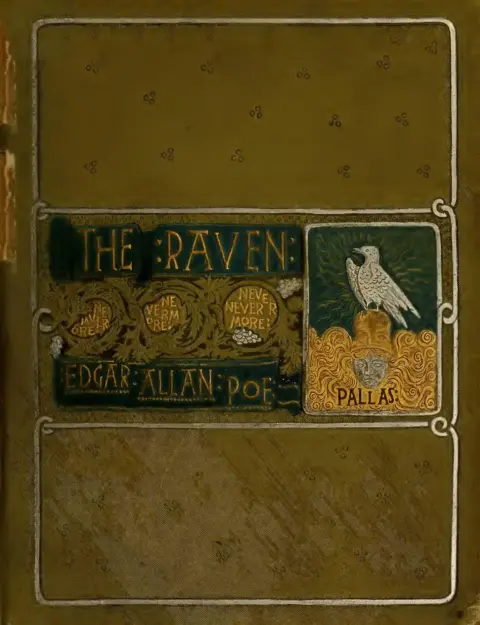
THE CLASSIC COLLECTION · 1845
"The Works of Edgar Allan Poe, The Raven Edition" by Edgar Allan Poe is a comprehensive collection of his literary output, likely compiled in the late 19th century. This collection spans various genres, including poetry, essays, and gothic tales, showcasing Poe's distinctive style and exploration of themes like love, death, and the macabre. The book presents significant works such as "The Raven," "The Tell-Tale Heart," "The Fall of the House of Usher," and many others, illustrating Poe's profound influence on American literature and his mastery of suspense and psychological depth. At the start of this collection, the reader is introduced to a preface that sets the stage for understanding Poe's life and literary journey, giving insights into the struggles he faced, both personally and professionally. The subsequent sections outline key works and achievements in his career, detailing his early poetry, notable prose tales, and his lasting impact on both poetry and fiction. The opening expresses deep admiration for Poe's unique genius, highlighting the interplay between his troubled life and his art, thus creating an engaging entry point for readers new to Poe's work or revisiting it with a fresh perspective.
Introduction adapted from the source catalogue; source summaries may be automatically generated.
Free to read · English · 450,336 words · No account needed
MAKE TIME FOR A GOOD BOOK
On by default. Untick to stop anonymous reading totals. Each page counts after 10 seconds in view. How this works.
Anonymous counting is on unless you have switched it off.
The intense effect produced by this sudden apparition is not at all to be wondered at when the various circumstances are taken into consideration. Usually, in cases of a similar nature, there is left in the mind of the spectator some glimmering of doubt as to the reality of the vision before his eyes; a degree of hope, however feeble, that he is the victim of chicanery, and that the apparition is not actually a visitant from the old world of shadows. It is not too much to say that such remnants of doubt have been at the bottom of almost every such visitation, and that the appalling horror which has sometimes been brought about, is to be attributed, even in the cases most in point, and where most suffering has been experienced, more to a kind of anticipative horror, lest the apparition might possibly be real, than to an unwavering belief in its reality. But, in the present instance, it will be seen immediately, that in the minds of the mutineers there was not even the shadow of a basis upon which to rest a doubt that the apparition of Rogers was indeed a revivification of his disgusting corpse, or at least its spiritual image. The isolated situation of the brig, with its entire inaccessibility on account of the gale, confined the apparently possible means of deception within such narrow and definite limits, that they must have thought themselves enabled to survey them all at a glance. They had now been at sea twenty-four days, without holding more than a speaking communication with any vessel whatever. The whole of the crew, too—at least all whom they had the most remote reason for suspecting to be on board—were assembled in the cabin, with the exception of Allen, the watch; and his gigantic stature (he was six feet six inches high) was too familiar in their eyes to permit the notion that he was the apparition before them to enter their minds even for an instant. Add to these considerations the awe-inspiring nature of the tempest, and that of the conversation brought about by Peters; the deep impression which the loathsomeness of the actual corpse had made in the morning upon the imaginations of the men; the excellence of the imitation in my person, and the uncertain and wavering light in which they beheld me, as the glare of the cabin lantern, swinging violently to and fro, fell dubiously and fitfully upon my figure, and there will be no reason to wonder that the deception had even more than the entire effect which we had anticipated. The mate sprang up from the mattress on which he was lying, and, without uttering a syllable, fell back, stone dead, upon the cabin floor, and was hurled to the leeward like a log by a heavy roll of the brig. Of the remaining seven, there were but three who had at first any degree of presence of mind. The four others sat for some time rooted apparently to the floor, the most pitiable objects of horror and utter despair my eyes ever encountered. The only opposition we experienced at all was from the cook, John Hunt, and Richard Parker; but they made but a feeble and irresolute defence. The two former were shot instantly by Peters, and I felled Parker with a blow on the head from the pump-handle which I had brought with me. In the meantime, Augustus seized one of the muskets lying on the floor and shot another mutineer Wilson through the breast. There were now but three remaining; but by this time they had become aroused from their lethargy, and perhaps began to see that a deception had been practised upon them, for they fought with great resolution and fury, and, but for the immense muscular strength of Peters, might have ultimately got the better of us. These three men were—Jones, Greely, and Absolom Hicks. Jones had thrown Augustus to the floor, stabbed him in several places along the right arm, and would no doubt have soon dispatched him (as neither Peters nor myself could immediately get rid of our own antagonists), had it not been for the timely aid of a friend, upon whose assistance we, surely, had never depended. This friend was no other than Tiger. With a low growl, he bounded into the cabin, at a most critical moment for Augustus, and throwing himself upon Jones, pinned him to the floor in an instant. My friend, however, was now too much injured to render us any aid whatever, and I was so encumbered with my disguise that I could do but little. The dog would not leave his hold upon the throat of Jones—Peters, nevertheless, was far more than a match for the two men who remained, and would, no doubt, have dispatched them sooner, had it not been for the narrow space in which he had to act, and the tremendous lurches of the vessel. Presently he was enabled to get hold of a heavy stool, several of which lay about the floor. With this he beat out the brains of Greely as he was in the act of discharging a musket at me, and immediately afterward a roll of the brig throwing him in contact with Hicks, he seized him by the throat, and, by dint of sheer strength, strangled him instantaneously. Thus, in far less time than I have taken to tell it, we found ourselves masters of the brig.
Your reading position is saved on this browser. Take it to another device with a library code. Reading pages adapt to text, rather than matching a printed edition.
Edgar Allan Poe

Rebecca Harding Davis & Thomas De Quincey & Charles Dickens & Nathaniel Hawthorne & Edward Bulwer Lytton, Baron Lytton & Edgar Allan Poe & Harriet Elizabeth Prescott Spofford
Edgar Allan Poe
Edgar Allan Poe
BEHIND THE BOOK
This eBook is for the use of anyone anywhere in the United States and most other parts of the world at no cost and with almost no restrictions whatsoever. You may copy it, give it away or re-use it under the terms of the Project Gutenberg License included with this eBook or online at www.gutenberg.org. If you are not located in the United States, you will have to check the laws of the country where you are located before using this eBook. Read the source licence.
The original source file, including credits and licence, is retained by this library. Request an original-format copy at no charge. Please include the book title and Project Gutenberg identifier #25525.
KEEP YOUR CURIOSITY GOING

David Patterson (Spirit) Hatch

David Patterson (Spirit) Hatch

David Patterson (Spirit) Hatch
Coulson Kernahan

Ralph Waldo Emerson

Maurice Baring