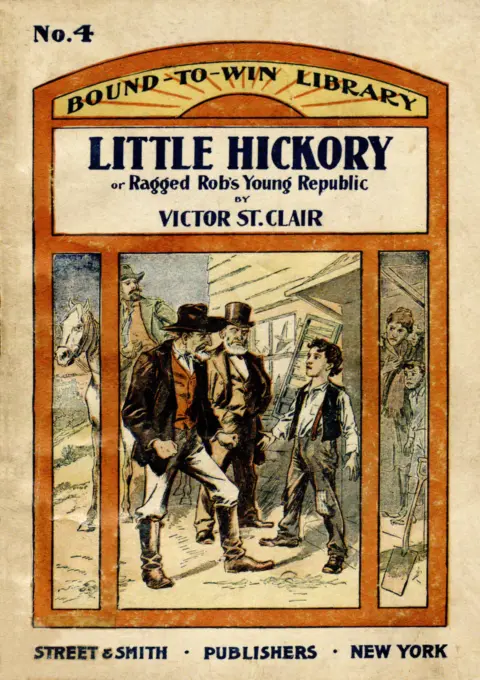
Little Hickory; or, Ragged Rob’s young republic
George Waldo Browne
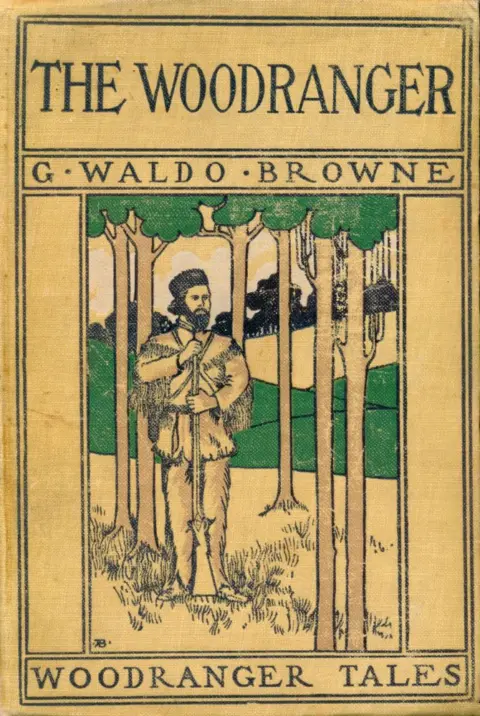
THE CLASSIC COLLECTION · 1899
The Woodranger by George Waldo Browne is a historical adventure novel written in the late 19th century. Set on the colonial frontier along the Merrimack River, it follows the Scotch‑Irish youth Norman McNiel, his foster‑sister Rilma, and their Highland grandfather as they navigate land rivalries between Massachusetts grantees and Londonderry settlers. With the enigmatic Woodranger acting as scout, guide, and moral compass, the story mixes wilderness hunts, frontier justice, and community contests.
The opening of The Woodranger frames the 1740s “debatable grounds” dispute between New Hampshire and Massachusetts before plunging into action: Norman watches a wounded deer leap from Rock Rimmon after a shot by Christo, a lone Pennacook, and is then seized by Gunwad, a zealous deer‑reeve, for killing game out of season. Woodranger intervenes, and a horn from Norman’s grandfather pulls him home, where he saves Rilma from a wildcat attack—finished by a timely shot from young Johnny Stark—then accepts an invite to a coming canoe match. At dawn, Woodranger escorts him to be tried locally by ’Squire Blanchard; along the way a comic stop with Zack Bitlock (who has mistakenly cultivated mullein for tobacco) lightens the mood. In court, Woodranger shows the bullet is Indian‑made and that the deer died from its fall, not Norman’s hand; the dog’s role can’t be proved, and Norman is acquitted. When Gunwad slanders Norman’s lineage, Woodranger silences him, and the crowd shifts to the eagerly awaited shooting‑match—signaling that personal grudges, local pride, and frontier tests will drive the tale forward.
Introduction adapted from the source catalogue; source summaries may be automatically generated.
Free to read · English · 67,249 words · No account needed
MAKE TIME FOR A GOOD BOOK
On by default. Untick to stop anonymous reading totals. Each page counts after 10 seconds in view. How this works.
Anonymous counting is on unless you have switched it off.
“Then, unless objection is raised by the prisoner or the complainant, the case will be opened without further delay. I think there is a little matter several are anxious to attend to,” alluding to the forthcoming shooting-match.
“Th’ sooner th’ better, cap’en,” said Gunwad, showing by his appearance that he was well pleased. “I reckon it won’t take long to salt his gravy.”
“I understand you charge this young man, whose name I believe is
McNiel――”
“A son, cap’en, of thet hated McNiel――”
“Silence, sir, while I am speaking!” commanded ’Squire Blanchard. “You charge this Norman McNiel with shooting deer out of season?”
“I do, sir.”
“You will take oath and then describe what reason you have for considering the prisoner guilty.”
As soon as he had been properly sworn Gunwad went on to describe in his blunt, rough way how he had been attracted to Rock Rimmon by a gun-shot. Upon reaching the spot he had found a dead deer there, while the prisoner and his dog were the only living creatures that he saw in the vicinity. The youth’s gun was empty, and he acknowledged his hound had started and followed the deer.
“I knowed the youngster o’ a furriner,” he concluded, “as the boy livin’ with thet ol’ refugee o’ a MacDonald at the Falls, so I lost no time in clappin’ my hands on him.”
These allusions to Norman’s father and grandfather it could be seen were given to antagonise, as much as possible, the Scotch-Irish spectators. But ’Squire Blanchard ended, or cut short, his speech by asking if he had witnesses to prove his statements.
“Woodranger here was with me, an’ I reckon his word is erbout as good as enny the youngster can fetch erlong. Woodranger, step this way, an’ tell th’ ’squire whut ye know erbout this young poacher.”
In answer to ’Squire Blanchard’s request, but not to Gunwad’s, the forester took the witness-stand, and, after being duly sworn, answered the questions asked him without hesitation or wavering.
“You were with Gunwad yesterday, Woodranger, when he met the prisoner
at Rock Rimmon?”
“I was, cap’en.”
“And you saw the deer he had shot?”
“I see the carcass o’ a dead deer laying at the foot o’ Rock Rimmon,
cap’en.”
“It was the deer the prisoner is supposed to have shot?” asked ’Squire Blanchard, noticing the Woodranger’s cautious way of replying.
“It was the only deer I see.”
“You saw Gunwad take a bullet from its body?”
“I did. I see, too, that the lead had not found a vital spot.”
“Do you mean to say the deer was not killed by the shot?”
Your reading position is saved on this browser. Take it to another device with a library code. Reading pages adapt to text, rather than matching a printed edition.
George Waldo Browne
George Waldo Browne
George Waldo Browne
George Waldo Browne
BEHIND THE BOOK
This eBook is for the use of anyone anywhere in the United States and most other parts of the world at no cost and with almost no restrictions whatsoever. You may copy it, give it away or re-use it under the terms of the Project Gutenberg License included with this eBook or online at www.gutenberg.org. If you are not located in the United States, you will have to check the laws of the country where you are located before using this eBook. Read the source licence.
The original source file, including credits and licence, is retained by this library. Request an original-format copy at no charge. Please include the book title and Project Gutenberg identifier #77515.
KEEP YOUR CURIOSITY GOING
Cécile Tormay

Moritz Busch
Coulson Kernahan
John L. Ransom

Maurice Baring
Frances Wright