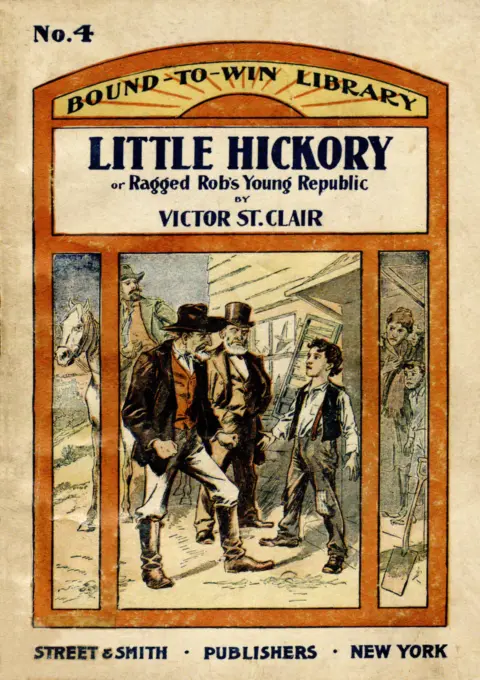
Little Hickory; or, Ragged Rob’s young republic
George Waldo Browne
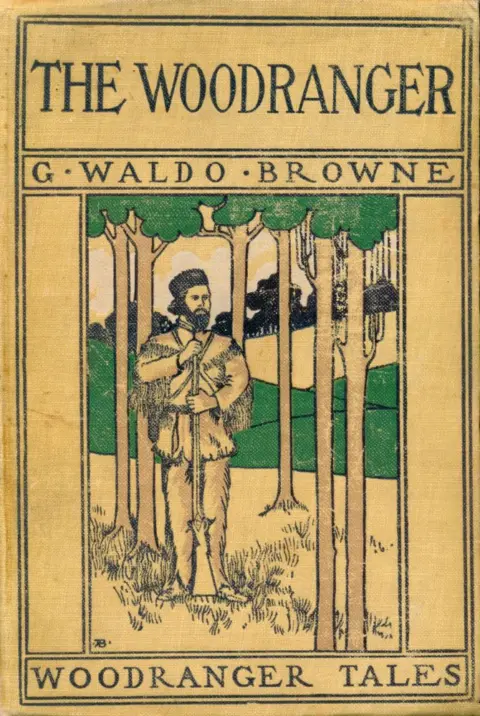
THE CLASSIC COLLECTION · 1899
The Woodranger by George Waldo Browne is a historical adventure novel written in the late 19th century. Set on the colonial frontier along the Merrimack River, it follows the Scotch‑Irish youth Norman McNiel, his foster‑sister Rilma, and their Highland grandfather as they navigate land rivalries between Massachusetts grantees and Londonderry settlers. With the enigmatic Woodranger acting as scout, guide, and moral compass, the story mixes wilderness hunts, frontier justice, and community contests.
The opening of The Woodranger frames the 1740s “debatable grounds” dispute between New Hampshire and Massachusetts before plunging into action: Norman watches a wounded deer leap from Rock Rimmon after a shot by Christo, a lone Pennacook, and is then seized by Gunwad, a zealous deer‑reeve, for killing game out of season. Woodranger intervenes, and a horn from Norman’s grandfather pulls him home, where he saves Rilma from a wildcat attack—finished by a timely shot from young Johnny Stark—then accepts an invite to a coming canoe match. At dawn, Woodranger escorts him to be tried locally by ’Squire Blanchard; along the way a comic stop with Zack Bitlock (who has mistakenly cultivated mullein for tobacco) lightens the mood. In court, Woodranger shows the bullet is Indian‑made and that the deer died from its fall, not Norman’s hand; the dog’s role can’t be proved, and Norman is acquitted. When Gunwad slanders Norman’s lineage, Woodranger silences him, and the crowd shifts to the eagerly awaited shooting‑match—signaling that personal grudges, local pride, and frontier tests will drive the tale forward.
Introduction adapted from the source catalogue; source summaries may be automatically generated.
Free to read · English · 67,249 words · No account needed
MAKE TIME FOR A GOOD BOOK
On by default. Untick to stop anonymous reading totals. Each page counts after 10 seconds in view. How this works.
Anonymous counting is on unless you have switched it off.
“It is a cry for help from some one,” said Norman, and the others nodded their heads, as they continued to listen.
“It comes from the east shore,” said Rob. “Who can it be and what is
the trouble?”
“We will soon know, lad, we will soon know,” and the Woodranger began to send the canoe over the water at redoubled speed.
“If I only had a paddle,” said Rob.
“Nay, lad, let not that consarn thee. Whoever it be, he has lusty lungs. Keep a sharp lookout, for were it not in peaceful times one might be only called discreet if he looked on sich bawling as lacking common sense.”
The boys needed no urging to maintain a close watch ahead, and it wasn’t long before the blue line of the distant shore loomed up into a rugged breastwork of forest. As the forester continued to ply his paddle with vigorous strokes, they watched with increasing earnestness the scene ahead. To their wonder, the shouts of the person had stopped.
“Look sharp, lads,” were the Woodranger’s words, while he kept at his task with unabated power.
“I see something dark in the top of that maple off to the left, which may be a man,” said Rob, pointing in the direction he was looking.
“So do I,” said Norman. “It is a man, who has climbed into the top, or
I am mistaken.”
As the canoe bore them nearer the boys became certain of this fact, though the person remained perfectly quiet. The tree into which he had climbed was not as high as others standing close at hand, while it grew so near the shore that its branches hung out over the water.
“What does he mean by staying there?” asked Billy. “Hadn’t we better shout to him, Woodranger?”
“Not yet, lad, not yet. Watch him as close as you would a cat, and have your weepons handy. He may be there for a bit o’ an amazement against our peace o’ mind, thinking we are greenies. It is a man sure, and he do lay amazing still, seeing he has clumb so high.”
The Woodranger had himself taken a good view of the mysterious stranger in the tree-top, before he resumed his paddling.
As the canoe continued to approach the spot the man remained without moving, though once Rob believed he was motioning to them.
“He has seen us, that is certain. But what can his queer actions mean? I can see his white face turned toward us.”
“It is Zack Bitlock!” exclaimed Norman, recognising the strange person. “He cannot mean us any harm.”
Your reading position is saved on this browser. Take it to another device with a library code. Reading pages adapt to text, rather than matching a printed edition.
George Waldo Browne
George Waldo Browne
George Waldo Browne
George Waldo Browne
BEHIND THE BOOK
This eBook is for the use of anyone anywhere in the United States and most other parts of the world at no cost and with almost no restrictions whatsoever. You may copy it, give it away or re-use it under the terms of the Project Gutenberg License included with this eBook or online at www.gutenberg.org. If you are not located in the United States, you will have to check the laws of the country where you are located before using this eBook. Read the source licence.
The original source file, including credits and licence, is retained by this library. Request an original-format copy at no charge. Please include the book title and Project Gutenberg identifier #77515.
KEEP YOUR CURIOSITY GOING
Cécile Tormay

Moritz Busch
Coulson Kernahan
John L. Ransom

Maurice Baring
Frances Wright