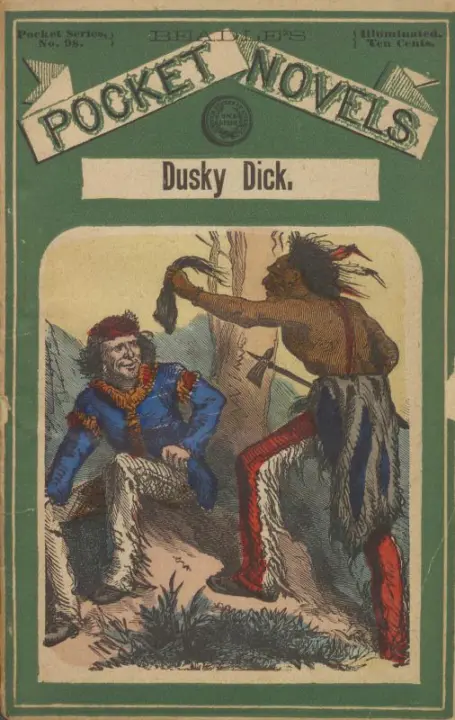
Dusky Dick: or, Old Toby Castor’s great campaign A story of the last Sioux outbreak
Jos. E. (Joseph Edward) Badger
THE CLASSIC COLLECTION · 1884
"The Wood King; or, Daniel Boone's Last Trail" by Jos. E. Badger, Jr. is a historical romance novel written in the late 19th century. Set against the backdrop of the Osage Country, the story follows the legendary frontiersman Daniel Boone as he navigates the dangers of the wilderness and confronts conflicts between Native American tribes and early settler communities. Central to the plot is Boone’s relationship with a Kickapoo chief named Lightfoot, highlighting themes of friendship, loyalty, and the complexities of tribal alliances during turbulent times. The opening portion of the novel introduces us to a tense scene where Boone, referred to as the "Wood King," witnesses a skirmish involving a Kickapoo warrior fleeing Osage pursuers. Upon recognizing the injured warrior as his friend, Boone resolves to help the fugitive as they both navigate danger and threats from various tribes. As Boone and Lightfoot evade the attackers, the narrative builds suspense around potential tribal conflicts and hints at larger dangers looming for both the settlers and Native Americans alike. The interplay between friendship and survival against the backdrop of a brutal wilderness sets the stage for the unfolding drama, capturing the essence of frontier life and the complexities of human relationships in that era.
Introduction adapted from the source catalogue; source summaries may be automatically generated.
Free to read · English · 34,606 words · No account needed
MAKE TIME FOR A GOOD BOOK
On by default. Untick to stop anonymous reading totals. Each page counts after 10 seconds in view. How this works.
Anonymous counting is on unless you have switched it off.
Still, though age and sorrow had sapped his strength, the Wood King raised himself to the top of the trunk, where he clung, panting and exhausted, shaking the vine as a signal to Lightfoot. As the vine tightened Boone peered keenly downward.
Though the tree-top had been broken off at some thirty feet from the ground, its limbs were still vigorous, rising far above the stub, thickly covered with leaves and twigs. Parting them, Boone gazed downward and around, as well as the increasing gloom would permit.
The hill was nearly bare of trees, with but scant underbrush, a notable exception to the larger hills that rose around, in this respect, since they were densely wooded.
All was still below. Boone could hear nothing to rouse his suspicions, and he believed that their trail was as yet unobstructed.
Beyond a doubt the Osages were ignorant of this unique passage, and so would only think of guarding the cave by the river side. It was but natural to think that, under cover of the darkness, the two scouts would endeavor to escape there by swimming and diving, and their whole attention would be turned toward frustrating this.
Thus Boone reasoned, and events proved that he was right.
Lightfoot completed the ascent easily, and then Boone led the way down the matted mass of grape-vines, using every caution to avoid making any noise that might alarm the Osages. Five minutes later the scouts stood side by side at the foot of the tree.
"Come," muttered Boone, "we must strike out for our friends. They don't dream of the danger brewin'."
"Mus' go tell Yellow-hair fust," doggedly replied Lightfoot.
Yellow-hair, as the Kickapoo called her, was the only daughter of Edward Mordaunt, who, on one of his hunting-trips, had found the Kickapoo senseless, almost dead, beside the body of a panther. With a kindness almost foreign to the borderer in general, Mordaunt carried the savage to his cabin, where Edith and her mother nursed him back to life. By this act of kindness they gained his undying gratitude, and it was mainly his love for them that induced him to fight against the Indian uprising, since they too were numbered among those to be massacred.
"Mordaunt has bin the Osages' fri'nd--surely they won't hurt him?"
"Injun don't know fri'nd now--only see white scalp. Kill, sure--all but Yellow-hair. White Wolf say she be his squaw!"
"The black-hearted devil! But never mind. The time 'll come when he'll stand afore my rifle, an' then he won't need no more squaws," gritted Boone, with an anger that he rarely displayed.
"No--his scalp Lightfoot's," doggedly replied the Kickapoo.
Your reading position is saved on this browser. Take it to another device with a library code. Reading pages adapt to text, rather than matching a printed edition.
Jos. E. (Joseph Edward) Badger
Jos. E. (Joseph Edward) Badger
Jos. E. (Joseph Edward) Badger
Jos. E. (Joseph Edward) Badger
BEHIND THE BOOK
This eBook is for the use of anyone anywhere in the United States and most other parts of the world at no cost and with almost no restrictions whatsoever. You may copy it, give it away or re-use it under the terms of the Project Gutenberg License included with this eBook or online at www.gutenberg.org. If you are not located in the United States, you will have to check the laws of the country where you are located before using this eBook. Read the source licence.
The original source file, including credits and licence, is retained by this library. Request an original-format copy at no charge. Please include the book title and Project Gutenberg identifier #69490.
KEEP YOUR CURIOSITY GOING
Cécile Tormay

Moritz Busch
Coulson Kernahan
John L. Ransom

Maurice Baring
Frances Wright