The Riddle of the Universe at the close of the nineteenth century
Ernst Haeckel
THE CLASSIC COLLECTION · 1904
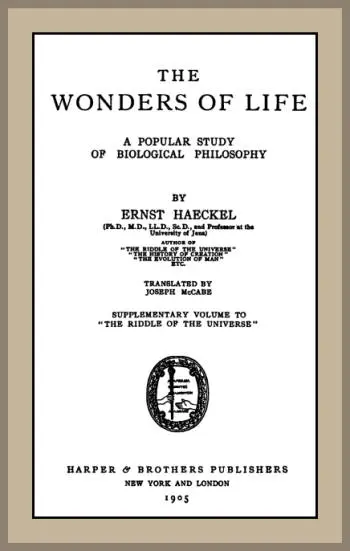
"The Wonders of Life: A Popular Study of Biological Philosophy" by Ernst Haeckel is a scientific publication written in the early 20th century. This work serves as a comprehensive exploration of biological philosophy, building upon the author's earlier work, "The Riddle of the Universe." Haeckel delves into the intricacies of life, the nature of living organisms, and the principles of monistic philosophy, providing insight into biological phenomena and their underpinnings. The beginning of the book introduces the central themes of truth and the pursuit of knowledge, positioning biology within the larger framework of natural philosophy. Haeckel discusses the relationship between science and philosophy, asserting that true understanding emerges from a blend of empirical observation and rational thought. He critiques dualistic theories and emphasizes a monistic approach, promoting the idea that knowledge is inherently tied to physiological processes within the brain. In doing so, he sets the stage for a detailed examination of life, its definitions, and its complexities throughout the remainder of the text.
Introduction adapted from the source catalogue; source summaries may be automatically generated.
Free to read · English · 146,945 words · No account needed
MAKE TIME FOR A GOOD BOOK
On by default. Untick to stop anonymous reading totals. Each page counts after 10 seconds in view. How this works.
Anonymous counting is on unless you have switched it off.
Veddahs, the, 393.
Vegetal diet, 227.
Vertebrates, mind in the, 328;
motor apparatus of the, 283, 284;
succession of the, 327.
Verworn, Max. on enzyma, 46;
on the nature of life, 28;
on the origin of life, 348.
Vibratory movement, 271.
Virchow and evolution, 322;
on the aim of science, 5.
Vital force, the, 47-51.
---- movement, 266-286.
Vitalism, 47-51, 459.
Voluntary movement mechanical, 262-264.
War, 400, 409.
Watch compared with organism, 30.
Water-feet, 280.
Water-vessels, 230.
Weismann on immortality, 90-101;
on selection, 364;
on the structure of plasm, 137.
Will, freedom of the, 263, 265, 286.
Wind-pipe, the, 232.
Woman, improvement in position of, 402.
Zehnder on the origin of life, 344.
Ziegler on instinct, 418.
Zoomonera, 193, 219.
Zooplasm, 213.
[1] The English translation met with almost equal success. Nearly one hundred thousand copies of the cheap edition have already been sold.--TRANS.
[2] Further particulars about the relations of the thought-centres to the sense-centres will be found in the tenth chapter of The Riddle of the Universe.
[3] English readers who are acquainted with Romanes's posthumous Thoughts on Religion will recognize the justice of this analysis. Romanes speaks expressly of the acceptance of Christianity entailing "the sacrifice of his intellect."--TRANS.
[4] This refers almost entirely to Germany. The reader will remember that, when Lord Kelvin endeavored to make theosophic capital out of this temporary confusion in German science, he was immediately silenced by the leading biologists of this country, Professor E. Ray-Lankester (for zoology), Sir W. T. Thiselton-Dyer (for botany), and Sir J. Burdon-Sanderson (for physiology), who sharply rejected vitalism.--TRANS.
[5] The German word wunder corresponds equally to the English "miracle" and "wonder." It has seemed necessary to translate it "wonder" in the title of the work, but frequently as "miracle" in this chapter.--TRANS.
[6] The English reader may usefully be reminded that Professor Loofs, Haeckel's chief critic, and one of the foremost German theologians, rejects these articles of the Creed no less than Haeckel does. A glance at the pertinent articles in the Encyclopædia Biblica will show how widely theologians now discard these beliefs.--TRANS.
[7] Compare the opinion of the distinguished American psychologist, Münsterberg "Science opposes to any doctrine of individual immortality an unbroken and impregnable barrier" (Psychology and Life, p. 85).--TRANS.
[8] A translation of the latest edition of the Anthropogenie, with the full number of fresh illustrations (thirty plates and five hundred and twelve wood-cuts), will be issued very shortly by the Rationalist Press Association, under the title of The Evolution of Man.
[9] I may remind the English reader that the chosen ecclesiastical champion against Haeckel in this country, the Rev. F. Ballard, made this extraordinary fallacy the very pith of his "scientific" attack on monism.--TRANS.
[10] As already stated, it will presently appear in England with the title, The Evolution of Man.--TRANS.
Your reading position is saved on this browser. Take it to another device with a library code. Reading pages adapt to text, rather than matching a printed edition.
BEHIND THE BOOK
This eBook is for the use of anyone anywhere in the United States and most other parts of the world at no cost and with almost no restrictions whatsoever. You may copy it, give it away or re-use it under the terms of the Project Gutenberg License included with this eBook or online at www.gutenberg.org. If you are not located in the United States, you will have to check the laws of the country where you are located before using this eBook. Read the source licence.
The original source file, including credits and licence, is retained by this library. Request an original-format copy at no charge. Please include the book title and Project Gutenberg identifier #46652.
KEEP YOUR CURIOSITY GOING

David Patterson (Spirit) Hatch
Coulson Kernahan

Ralph Waldo Emerson
Frances Wright

Edwin Abbott Abbott

Joseph Droz