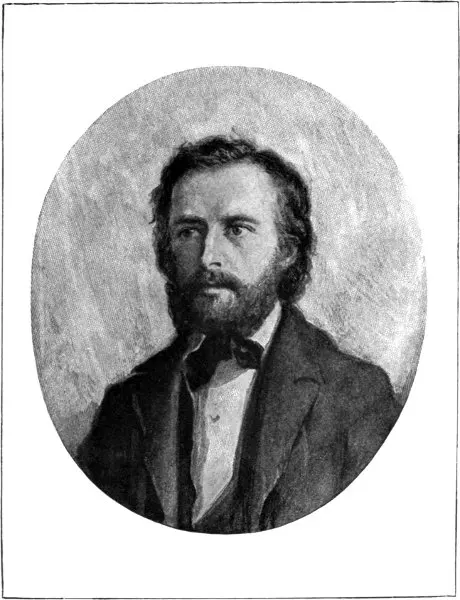
The Riddle of the Universe at the close of the nineteenth century
Ernst Haeckel
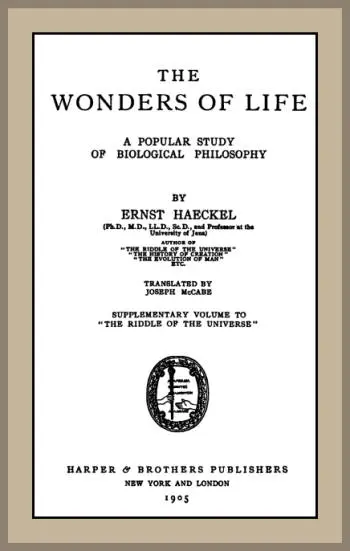
THE CLASSIC COLLECTION · 1904
"The Wonders of Life: A Popular Study of Biological Philosophy" by Ernst Haeckel is a scientific publication written in the early 20th century. This work serves as a comprehensive exploration of biological philosophy, building upon the author's earlier work, "The Riddle of the Universe." Haeckel delves into the intricacies of life, the nature of living organisms, and the principles of monistic philosophy, providing insight into biological phenomena and their underpinnings. The beginning of the book introduces the central themes of truth and the pursuit of knowledge, positioning biology within the larger framework of natural philosophy. Haeckel discusses the relationship between science and philosophy, asserting that true understanding emerges from a blend of empirical observation and rational thought. He critiques dualistic theories and emphasizes a monistic approach, promoting the idea that knowledge is inherently tied to physiological processes within the brain. In doing so, he sets the stage for a detailed examination of life, its definitions, and its complexities throughout the remainder of the text.
Introduction adapted from the source catalogue; source summaries may be automatically generated.
Free to read · English · 146,945 words · No account needed
MAKE TIME FOR A GOOD BOOK
On by default. Untick to stop anonymous reading totals. Each page counts after 10 seconds in view. How this works.
Anonymous counting is on unless you have switched it off.
The higher groups of the animal kingdom in which a characteristic solid skeleton is developed and forms an important starting-point for the muscles, as well as a support and protection for the whole body, are the three stems of the echinoderms, articulates, and vertebrates. All three groups are very rich in forms, and far surpass all the other stems of the animal world in the perfection of their locomotive apparatus. However, the disposition and development of the skeleton as a passive support, and the correlation of the muscles to it as active pulling-organs, differ very much in the three classes, and are the chief factors in determining their characteristic types; they show clearly (even apart from other radical differences) that the three stems have arisen independently of each other from three different roots in the vermalia-stem. In the echinoderms the calcareous skeleton is formed from chalky deposits in the corium, in the articulates from chitine secretions of the epidermis, and in the vertebrates from cartilage of an internal chord-sheath (cf. Anthropogeny, chapter xxvi.).
The remarkable stem of the sea-dwelling echinoderms or "prickly skins" is distinguished from all the other animal groups by a number of striking peculiarities; prominent among these are the special formation of their active and passive motor organs and the curious form of their individual development. In this ontogenesis two totally different forms appear successively--the simple astrolarva and the elaborately organized and sexually mature astrozoon. The small, free-swimming astrolarva has the general structural features of the rotatoria, and so shows, in accordance with the biogenetic law, that the original stem-form of the echinoderms (the amphoridea) belonged to this group of the vermalia. I have briefly explained these structures in the History of Creation (chapter xxii.), and more fully in my essay on the amphoridea and cystoidea (1896). The little astrolarva has no muscles, and no water-vessels or blood-vessels. It moves by means of vibratory lashes or bands, which are attached to special armlike processes at the surface. These arms are regularly developed to the right and left of the bilateral symmetrical larva (which as yet shows no trace of the five-rayed structure). By a very curious modification the small bilateral astrolarva is transformed into the totally different pentaradial astrozoon, the large sexually mature echinoderm with a pronounced five-rayed structure. (See Art-forms in Nature, plates 10, 20, 30, 40, 60, 70, 80, 90, and 95.) It has a most elaborate organization, with muscles and cuticular skeleton, blood-vessels and water-vessels, etc. A section of the astrozoa--the living crinoidea, or sea-lilies, and the extinct classes of blastoidea (sea-buds), cystoidea (sea-apples), and amphoridea (sea-urns)--grow in stationary fashion at the bottom of the sea. The other four extant classes creep about in the sea--the sea-gherkins (holothuria), the star-fish (asteridea and ophoidea), and the sea-urchins (echinidea). Their creeping motion is accomplished by two kinds of organs--water-feet and skin-muscles. The latter find their support and attachment in solid calcareous needles, which develop from chalky deposits in the corium. As these calcareous needles (which are particularly conspicuous in the sea-urchin) are set movably in special protuberances of the calcareous plates of the cuticular skeleton, and moved by little muscular needles, the echinoderms walk on them as if they were stilts. Between these, however, a number of water-feet arise from inside--thin tubes like the fingers of a glove, which are filled with water by an internal conduit-system (the so-called ambulacral system) and become stiff. These very extensible ambulacral feet, often provided with a suctorial plate at the closed outer end, serve for creeping, sucking, touching, and grasping. As these distinctive motor organs of the echinoderms--both the ambulacral feet with their complicated water-tubes and the movable needles with their joints and muscles--are found in hundreds, often in thousands, on every individual five-rayed astrozoon, we might say that the echinoderms have the most advanced and complicated motor organs of all animals. Their historical development is perfectly understood from its earliest stages, since Richard Semon found, in his ingenious pentact æatheory (1888), the correct phylogenetic meaning of the curious embryology of the echinoderms discovered in 1845 by Johannes Müller. I endeavored in 1896 to establish it in detail, in relation to paleontological discoveries, in the essay I have mentioned.
Your reading position is saved on this browser. Take it to another device with a library code. Reading pages adapt to text, rather than matching a printed edition.
BEHIND THE BOOK
This eBook is for the use of anyone anywhere in the United States and most other parts of the world at no cost and with almost no restrictions whatsoever. You may copy it, give it away or re-use it under the terms of the Project Gutenberg License included with this eBook or online at www.gutenberg.org. If you are not located in the United States, you will have to check the laws of the country where you are located before using this eBook. Read the source licence.
The original source file, including credits and licence, is retained by this library. Request an original-format copy at no charge. Please include the book title and Project Gutenberg identifier #46652.
KEEP YOUR CURIOSITY GOING

David Patterson (Spirit) Hatch
Coulson Kernahan

Ralph Waldo Emerson
Frances Wright

Edwin Abbott Abbott

Joseph Droz