American nights entertainment
Grant M. (Grant Martin) Overton
THE CLASSIC COLLECTION · 1918
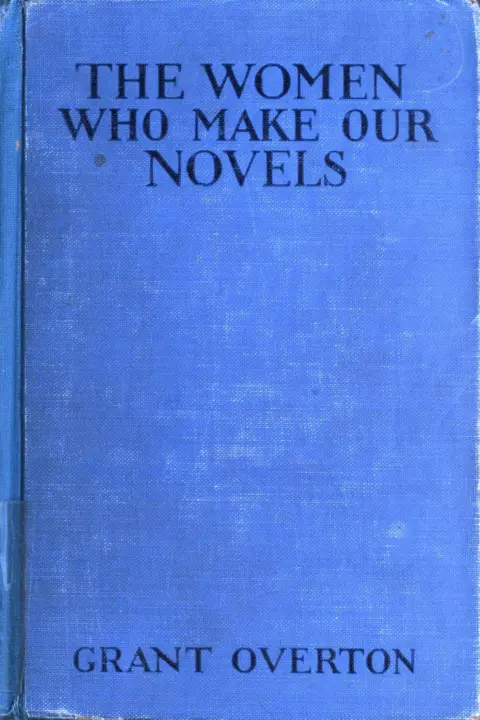
"The Women Who Make Our Novels" by Grant M. Overton is a collection of literary sketches written in the early 20th century. The work focuses on prominent American women novelists, discussing their contributions to literature and delving into their personal stories, creative methods, and influences. Overton aims to present a variety of perspectives on these writers, highlighting their artistic achievements and societal impact during a time where female voices in literature were gaining increasing recognition. At the start of the book, the author sets the stage for this exploration by outlining his intentions and qualifications for writing about women novelists, acknowledging his background as a literary reporter instead of a novelist himself. He establishes a framework that emphasizes the intersection of these women's lives with their literary works. Overton introduces the first subject, Edith Wharton, illustrating her unique position in the literary world and noting her aloneness despite her artistic success. This opening portion effectively immerses the reader in the themes of recognition and the evolution of women's roles in the literary landscape, promising a detailed examination of each author's contributions in the ensuing chapters.
Introduction adapted from the source catalogue; source summaries may be automatically generated.
Free to read · English · 100,636 words · No account needed
MAKE TIME FOR A GOOD BOOK
On by default. Untick to stop anonymous reading totals. Each page counts after 10 seconds in view. How this works.
Anonymous counting is on unless you have switched it off.
“This also, I perceive, answers another question: what is my method of accumulating material? I find I have none. The material seems to present itself or to be gathered up and packed away without conscious effort in some store-house of memory. I can almost always go to this garret, turn over the junk, and haul out what I want. It generally needs some making over, piecing and patching, to be sure, but there is always something there that will serve. I have never had to make a memorandum, as I understand many authors do, of likely phrases, telling words, and so on, never sketched out a scene or plot, never got up in the middle of the night, or hopped off an omnibus to rush after a scrap of paper and pencil in order to ‘jot down’ some immortal thought. The only thing I do sometimes ‘jot down’ is the chronology of the narrative; John McGinnis and Mary Dill are married at such-and-such a date; then, will their son, Dill McGinnis, be fifteen at such-and-such a date? I never know, and have to count up on my fingers, and generally revise the schedule afterwards; and I have been caught up pretty sharply by the unprofessional critics who volunteer criticism in letters to authors, for being as much as twenty years out in my figures, or for making contradictory statements. The sole excuse I have to offer is that I can’t count, and never got any farther than six times eight, which I believe makes forty-eight, in the multiplication-table. Invincible ignorance, in other words, must be my salvation!
“As to my ‘first writings,’ I shared one quality with R. L. S. at any rate; I knew they were trash. They were mostly short stories which went and came between me and the magazine-editors with a pendulum-like regularity; I used to work furiously over these things, and always sent them off with the highest hopes, and yet received them back with no deep disappointment. At the bottom of my heart, I say, I knew they were trash. What I did not know was that, in very truth, I should never write anything but trash, no matter how widely it got printed and published; I was forever expecting some day to ‘do it’ and sit down satisfied; I am still expecting that miracle and all the while I know it will not happen. Some of those far-traveled short stories have since been rewritten and published, and some incorporated in novels, and some are still in the back of my mind waiting their hour of usefulness. When I began, the influence of Stevenson was still very strong, and Mr. Weyman and Mr. Hope-Hawkins, to say nothing of Rider Haggard and the incomparable Sherlock Holmes, were in the middle of their popularity. Where are the roses of yester-year? We will always read Stevenson, but we realize now that he was a writer--just that. And he was a great personality--just that. Everybody, including myself, used strenuously to imitate him, and I think it didn’t do us any harm; he preached better than he practiced, and after some toiling after him, we found that out, but our toil was not thrown away. I will say, in self-glorification, that after I got through imitating Stevenson, I did not start in and imitate O. Henry, or Mr. Rudyard Kipling; and few are the writers who can honestly make that boast! About that time, it became manifest to me that the thing to do was not to muddle around with romance, ancient or modern, but to write about people, and to ‘lie like the truth.’ I remember reading Thackeray, and being struck with the profitable use of the conversational style in ‘lying like the truth’; I don’t mean ‘chatty’ and I don’t mean colloquial, and I don’t mean that easy slinging about of words which the new writers affect; I mean conversational, as conversation is carried on between persons in what I shall call for want of a better term good society. But what puzzled me about Thackeray was that there were occasional passages, of considerable extent, wherein he was not conversational at all; he was writing like somebody else, but it still had the most amazing verisimilitude; it was so plausible that you believed it just as you believe the morning paper. It was in Barry Lyndon that this first struck me, I believe. Who showed him that trick? He is forever talking about Fielding, but upon re-reading the latter I saw it was not Fielding he was imitating. Thackeray, in breezy parlance, can give Fielding cards and spades. After a while, in a moment of illumination, I found him out. The wily old genius was not bothering his head about Fielding; the man he was modeling upon was Daniel Defoe; that’s where he got that simplicity which did not hesitate at times to be prosy, well aware that a plain true narrative has always the defect of its quality, monotony, repetition, a tedious dwelling on detail. There is nothing in fiction better imagined or imagined with more veracity than the pitiful importance which his efforts at braiding baskets, and making pottery vessels, assume to the castaway Robinson in his solitude, and yet it is not vividly interesting reading. There is nothing--also--better imagined than George Warrington’s escape from Fort Duquesne, with the help of the Indian squaw; but it is rather tiresome, on the whole; and the final touch where the poor squaw, instead of turning out a lovely, romantic Pocahontas, becomes a perfect nuisance when they reach the settlements, getting drunk and creating scandal--that is a masterpiece of realism; and we all hate to know about it! Re-reading Defoe, and reading Thackeray more carefully, with side excursions, as it were, into reading Swift and Mr. Thomas Hardy, it seemed to me that I might eventually learn the trick. I take it that I have actually succeeded once or twice by the fact that nobody will believe that I have ever invented a single person or incident! People are eternally wanting to know who was the original of this or that character, or what is worse, identifying characters with somebodies whom, ten to one, I have never laid eyes on! Others have insisted that they knew very well I was cutting the tale out of whole cloth, but that I had no ‘vision,’ was ‘too photographic,’ etc. It may well be so; my cup is very small, and I must drink out of it, willy-nilly. The critics, as I have said, were rather put to it for something to say, when I appeared; most of them adopted a cautious, middle-of-the-road policy; you see I might turn out to be a writer after all, with my bewildering deliberation, my ‘careless fluency’--I have seen this phrase used in description of my writing--my emphasis of the commonplace. Of late years, I think they have got used to me; for that matter, when all’s said and done, my contributions to literature are not of such importance as to arrest a critic long.
Your reading position is saved on this browser. Take it to another device with a library code. Reading pages adapt to text, rather than matching a printed edition.
Grant M. (Grant Martin) Overton
Grant M. (Grant Martin) Overton
Grant M. (Grant Martin) Overton
Grant M. (Grant Martin) Overton
BEHIND THE BOOK
This eBook is for the use of anyone anywhere in the United States and most other parts of the world at no cost and with almost no restrictions whatsoever. You may copy it, give it away or re-use it under the terms of the Project Gutenberg License included with this eBook or online at www.gutenberg.org. If you are not located in the United States, you will have to check the laws of the country where you are located before using this eBook. Read the source licence.
The original source file, including credits and licence, is retained by this library. Request an original-format copy at no charge. Please include the book title and Project Gutenberg identifier #65134.
KEEP YOUR CURIOSITY GOING

David Patterson (Spirit) Hatch

David Patterson (Spirit) Hatch

David Patterson (Spirit) Hatch
John L. Ransom

Ralph Waldo Emerson

Maurice Baring