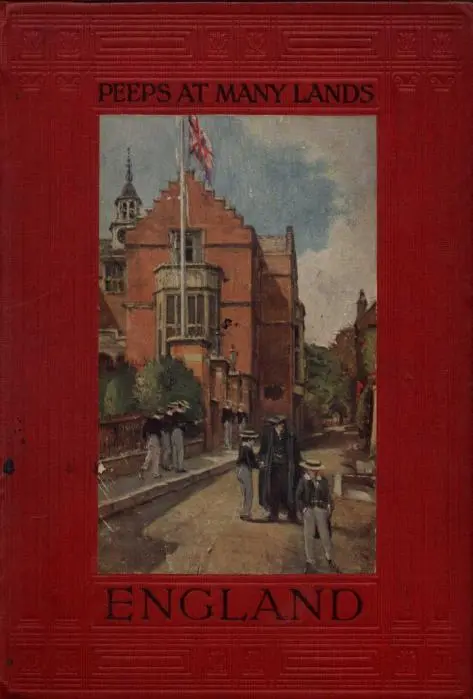
Peeps at Many Lands: England
John Finnemore
THE CLASSIC COLLECTION · 1908
"The Wolf Patrol: A Tale of Baden-Powell's Boy Scouts" by John Finnemore is a historical fiction novel written in the early 20th century. This story revolves around the adventures of a group of schoolboys who form a Boy Scout patrol inspired by the teachings of Lieutenant-General Robert Baden-Powell. With themes of camaraderie, bravery, and fair play, it focuses on the characters Dick Elliott and Chippy Slynn as they navigate their relationships and challenges in the context of scouting. At the start of the story, we are introduced to the setting of Bardon, where a fierce rivalry exists between the boys of the Grammar School and the "wharf-rats" of Skinner's Hole. The narrative captures one of their skirmishes, known as a 'slug,' emphasizing their competitive spirits and playful aggression. Meanwhile, Chippy, the leader of the wharf-rats, becomes intrigued by scouting after accidentally discovering a book by Baden-Powell. As the story unfolds, Dick and his friends decide to establish the Wolf Patrol and engage in various scouting activities, setting the stage for future teamwork and personal growth among the characters. Chippy's desire to pursue scouting also introduces potential for friendship and collaboration between the rival groups.
Introduction adapted from the source catalogue; source summaries may be automatically generated.
Free to read · English · 83,611 words · No account needed
MAKE TIME FOR A GOOD BOOK
On by default. Untick to stop anonymous reading totals. Each page counts after 10 seconds in view. How this works.
Anonymous counting is on unless you have switched it off.
'Wot cheer, mates!' he shouted in his hoarse tones.
''Old 'ard a bit! Lemme come up!'
But the victorious band were deaf to the calls of their
leader, and at this instant they disappeared at a point
where a sloping wharf ran from the quay edge into the
river.
'Bring 'im along to the other end o' the wharf!' commanded the red-haired boy; 'then we'll chuck 'im bang into the mud, an' see 'im scrabble 'is way out!'
'Lemme go, you fellows!' yelled Dick, fighting with
tooth and nail to wrench himself free; but there were
too many for him, and Chippy, who loved fair play, and
practised it, was too far behind. But, luckily for Dick,
other help was at hand, or he would assuredly have
been pitched straight into eighteen inches of foul black
mud.
A boat had been pulled from a ship in mid-stream to
the wharf, and a tall gentleman landed from it as Dick
was dragged past the spot.
'What! you, Dick?' shouted the new-comer. 'What
does this mean?' and, followed by the boatman, he made
a dash at the group.
The wharf-rats threw down their captive and fled, and
the gentleman picked Dick up.
'Thanks, Uncle Jim,' said Dick, puffing like a grampus.
'If you hadn't lent a hand, those wharf-rats would have
tipped me over into the mud.'
'How did you fall into their hands?' asked his uncle.
'They've been a-sluggin', I shouldn't wonder,'
remarked the boatman.
'That was it,' said Dick. 'There was a slug between
our fellows and the wharf-rats out of Skinner's Hole, and
they bagged me.'
His uncle nodded. He had been a Bardon boy in his
time, and knew all about it. He paid the boatman, and
away he and Dick went together, for his house was in the
same road as Dick's home.
'They're a jolly sly lot, those wharf-rats,' said Dick, as they walked along. 'Our fellows sent me ahead as a scout, but I never saw a sign of them, and yet they were waiting for us on the Flat all the time.'
'Seems to me you weren't much of a success as a scout,
Dick,' said his uncle, smiling.
'You're right there, Uncle Jim,' replied Dick, a broad grin on his honest, open face. 'I muffed it that time, and no mistake. Hallo, here's the bobby!'
The constable who had the Quay beat came hurrying
along, looking red and angry.
'You 'ain't seen any o' them young varmints wot have
been a-sluggin', have ye, Mr. Elliott?' he cried to Dick's
uncle.
Your reading position is saved on this browser. Take it to another device with a library code. Reading pages adapt to text, rather than matching a printed edition.
John Finnemore

John Finnemore
BEHIND THE BOOK
This eBook is for the use of anyone anywhere in the United States and most other parts of the world at no cost and with almost no restrictions whatsoever. You may copy it, give it away or re-use it under the terms of the Project Gutenberg License included with this eBook or online at www.gutenberg.org. If you are not located in the United States, you will have to check the laws of the country where you are located before using this eBook. Read the source licence.
The original source file, including credits and licence, is retained by this library. Request an original-format copy at no charge. Please include the book title and Project Gutenberg identifier #30810.
KEEP YOUR CURIOSITY GOING
Cécile Tormay

Moritz Busch
Coulson Kernahan
John L. Ransom

Maurice Baring
Frances Wright