Complete Story of the San Francisco Horror
Richard Linthicum & Samuel Fallows & Trumbull White
THE CLASSIC COLLECTION · 1892
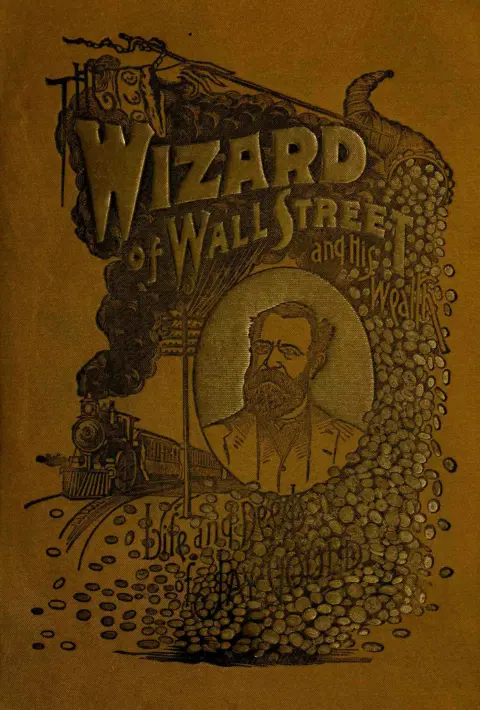
"The Wizard of Wall Street and His Wealth; or, The Life and Deeds of Jay Gould" by Trumbull White is a historical account written in the late 19th century. The book chronicles the life and notable financial exploits of Jay Gould, known as “The Wizard of Wall Street,” who was one of the richest and most controversial financiers of his time. It explores his rise to immense wealth through daring financial strategies and the significant events that defined his career, making it of interest to both general readers and students of financial history. The beginning of this work sets the stage for an in-depth exploration of Jay Gould's character and the dramatic circumstances surrounding his life. The preface highlights Gould's remarkable ability to amass a fortune that was unrivaled by any individual, while also touching on the controversies that accompanied his business practices. In the opening chapters, Gould's upbringing, early ventures in surveying and tanning, and the various challenges he faced are outlined. The narrative illustrates his relentless ambition, early encounters with adversity, and the qualities that propelled him from a humble background in New York to the pinnacle of the financial world, establishing the foundation for the complex and often tumultuous life that follows.
Introduction adapted from the source catalogue; source summaries may be automatically generated.
Free to read · English · 76,790 words · No account needed
MAKE TIME FOR A GOOD BOOK
On by default. Untick to stop anonymous reading totals. Each page counts after 10 seconds in view. How this works.
Anonymous counting is on unless you have switched it off.
There has been no time when it was possible to estimate the wealth of Mr. Gould, and as he was secretive in those early days as in his later, there was no saying what he was worth when in 1860 he came into Wall street. One statement has it that when the firm of Smith, Gould & Martin was organized, Mr. Gould’s possessions amounted to thirty thousand dollars in cash. Another is that when he sold out his holdings in the Rensselaer and Saratoga Consolidation, he was worth seven hundred and fifty thousand dollars.
With a mind peculiarly alert to all the influences which affected the values of railway securities, with habits of great industry, with phenomenal tenacity of purpose, with a fair amount at least of capital to back him, it is not surprising that Mr. Gould profited largely by his speculation in railway stocks and gold during the war of the rebellion. The keen-sighted, intelligent men in “the Street” at that time nearly all made money, and Mr. Gould was at least a millionaire when the Confederacy fell. What his methods were at the time it is useless to speculate about. It was before the day when by absolute mastery of gigantic railway and telegraph systems he could at his will depress the value of almost any institution on which he fixed his eye by setting on foot a ruinous war in rates until he had made it to be his own interest to restore a more normal and healthful condition of affairs by ceasing his antagonism and building up the property which he had acquired cheaply during the period of depression. But the details of his operations were always so subtle as to be shut out from the discovery of either friend or foe.
Gould was now fairly on the way toward his colossal fortune. Though friends warned him against entering into the whirlpool of blasted hopes and ruined fortunes of Wall street, his inclinations in that direction were too strong to be resisted. Gould was a born speculator. It is true that his great fortune was created mainly in hazardous enterprises outside of Wall street, and that in stock speculations, pure and simple, he was not always so successful or so infallible as many have supposed, but by nature and habit Gould was at this time of his life a commercial gambler, and it was as natural that he should enter Wall street as for a duck to take to water. It was in 1859 or 1860 that Gould first entered Wall street. It was not very long before he stepped to the front rank. What a long list of brainy and courageous men do Gould’s contemporaries in the street make! With most of them Gould has been at sword’s point, with a few he has been an ally, with some he has been both ally and enemy. Most of them are no longer powers in the speculative world. Some of them are dead. Not a few have been overwhelmed in the swift, resistless torrent of stock speculation. Three or four yet remain with power in their hands and millions in their vaults. The Vanderbilts--the commodore, his son and grandsons--Daniel Drew, James Fisk, Jr., the Beldens, Commodore Garrison, Henry N. Smith, James R. Keene, William Heath, George I. Seney, Gen. Thomas, Calvin S. Brice, D. O. Mills, Horace F. Clark, Alfred Sully, Addison Cammack, C. F. Woerishoffer, the Rockefellers, S. M. Kneeland, C. J. Osborn, D. P. Morgan, H. S. Ives, C. P. Huntington, Russell Sage, Cyrus W. Field, John W. Garrett, Robert Garrett, J. P. Morgan, the Seligmans, Brown Bros., Jay Cooke, Hugh J. Jewett, Lathrop, Little and Austin Corbin, Henry Clews, Washington E. Connor, Burnham, Gen. E. F. Winslow, Edward S. Stokes, S. V. White, William Dowd, Solon Humphreys, William R. Travers, Rufus Hatch, Samuel Sloan--these were some of the men identified with various Wall street interests with whom Gould has been allied or at enmity, or both, during his long career in the street. That he has been able among all these financial giants to make himself the leader is the highest evidence that can be given of his genius in speculation and railroad financiering. As we read some of these names there arise before our eyes the visions of murder, of suicide, of bankruptcy, of the debtor’s prison, of the felon’s cell, of ruined fortunes and blasted reputations. Others of the men have achieved wealth and honorable names. It is interesting to note that at the time Gould first entered the street one of his fellow-boarders at the Everett House was James Gordon Bennett, the elder, with whose son and successor he became engaged in such bitter business and personal antagonisms.
Your reading position is saved on this browser. Take it to another device with a library code. Reading pages adapt to text, rather than matching a printed edition.
Richard Linthicum & Samuel Fallows & Trumbull White
Trumbull White
BEHIND THE BOOK
This eBook is for the use of anyone anywhere in the United States and most other parts of the world at no cost and with almost no restrictions whatsoever. You may copy it, give it away or re-use it under the terms of the Project Gutenberg License included with this eBook or online at www.gutenberg.org. If you are not located in the United States, you will have to check the laws of the country where you are located before using this eBook. Read the source licence.
The original source file, including credits and licence, is retained by this library. Request an original-format copy at no charge. Please include the book title and Project Gutenberg identifier #66148.
KEEP YOUR CURIOSITY GOING
Cécile Tormay

Moritz Busch
John L. Ransom
Frances Wright
Cécile Tormay

Mabel Potter Daggett