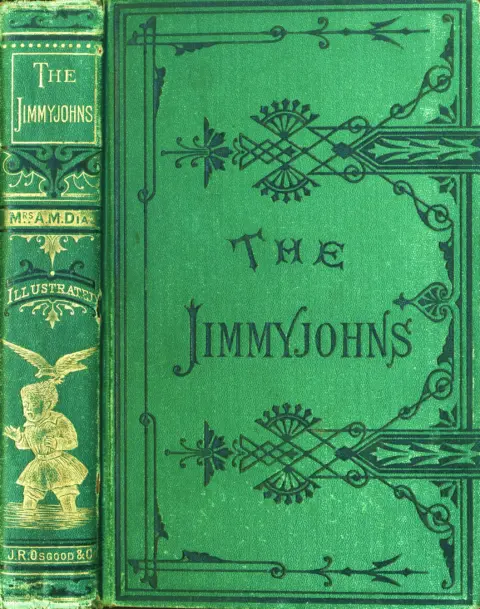
The Jimmyjohns, and other stories
Abby Morton Diaz

THE CLASSIC COLLECTION · 1881
"The William Henry Letters" by Abby Morton Diaz is a collection of letters written in the late 19th century. The narrative centers around a young boy named William Henry as he navigates the ups and downs of childhood, sharing his experiences with his grandmother through amusing and heartfelt letters. The collection paints a picture of familial love and the challenges faced by boys during this period. The opening of the work introduces us to the context in which these letters are being written, with an editor recounting the task of compiling them for publication. As the story progresses, we see William Henry aboard a cart with a friendly stranger, Uncle Jacob, who takes him to his home, Summer Sweeting Place. Through his eyes, we catch glimpses of his family dynamics, his school life, and his endearing personality as he interacts with his playful companions and concerned relatives. William Henry's letters are filled with detailed anecdotes about his life at school and home, his innocent curiosity, and his heartfelt sentiments towards his family, particularly his grandmother, providing readers a nostalgic view of childhood in this era.
Introduction adapted from the source catalogue; source summaries may be automatically generated.
Free to read · English · 73,238 words · No account needed
MAKE TIME FOR A GOOD BOOK
On by default. Untick to stop anonymous reading totals. Each page counts after 10 seconds in view. How this works.
Anonymous counting is on unless you have switched it off.
He didn’t say much more. And we went towards home then. But before we came to the house, he turned off into another path.
A little while after, I heard somebody walking behind me. I looked round, and there was the master. He’d been watching with a sick man all night.
He asked me where I had been so early. I said I had been taking a walk. He asked who the boy was that had just left me. I said ’t was Tom Cush. He asked if I was willing to tell what we had been talking about. I said I would rather not tell.
Says he, “It has a bad look, your being out with that boy so early, after what happened last night.”
Then he asked me where I had found my overjacket. I said, “In my chamber, sir, on a chair-back.”
“And how came it there?” says he.
“I don’t know, sir,” says I.
And, Grandmother, I almost cried; for everything seemed going against me, to make me out a bad boy. I will tell the rest after supper.
Your affectionate grandchild,
Now I will tell you what happened that afternoon.
The school was about half done.
The master gave three loud raps with his ruler.
This made the room very still.
He asked the other teachers to come up to the platform. And they did.
Next, he waved his ruler, and said, “Fold.”
And we all folded our arms.
It was so still that we could hear the clock tick.
He told Tom Cush to close the windows and shut the blinds.
Then he talked to us about stealing and telling lies. Said he didn’t like to punish, but it must be done. He said he had reason to believe that the boy whose name he should call out was not honest, that he took other people’s things and told lies.
Then he told the story, all that he knew about it, and said he hoped
that all concerned in it would have honor enough to speak out and own
it.
Nobody said anything.
Then the master said, “William Henry, you may come to the platform.”
I went up.
Somebody way in the back part shouted out, “Don’t believe it!”
“Silence!” said the master. And he thumped his ruler on the desk.
Then he told me to take off my jacket, and fold it up. And I did.
He told me to hand my collar and ribbon to a teacher. And I did.
Your reading position is saved on this browser. Take it to another device with a library code. Reading pages adapt to text, rather than matching a printed edition.
Abby Morton Diaz
Abby Morton Diaz
Abby Morton Diaz
Abby Morton Diaz
BEHIND THE BOOK
This eBook is for the use of anyone anywhere in the United States and most other parts of the world at no cost and with almost no restrictions whatsoever. You may copy it, give it away or re-use it under the terms of the Project Gutenberg License included with this eBook or online at www.gutenberg.org. If you are not located in the United States, you will have to check the laws of the country where you are located before using this eBook. Read the source licence.
The original source file, including credits and licence, is retained by this library. Request an original-format copy at no charge. Please include the book title and Project Gutenberg identifier #34335.
KEEP YOUR CURIOSITY GOING
Coulson Kernahan

Maurice Baring
Frances Wright
Cécile Tormay

Frederic Jesup Stimson

W. H. P. (William Henry Pope) Jarvis