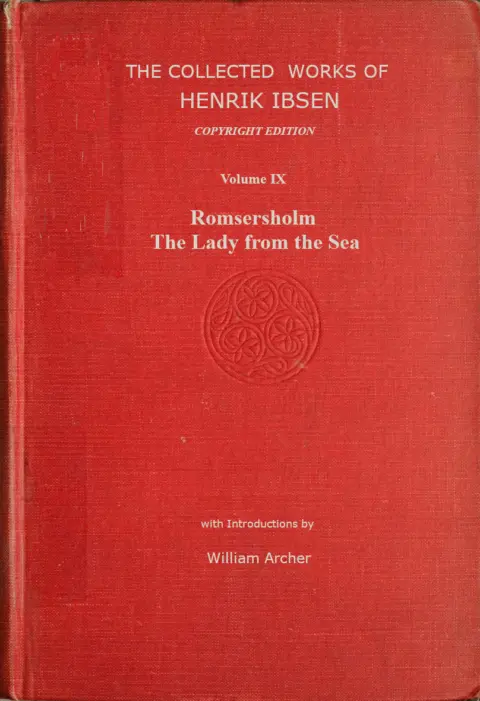
The collected works of Henrik Ibsen, Vol. 11 (of 11)
Henrik Ibsen

THE CLASSIC COLLECTION · 1890
"The Wild Duck" by Henrik Ibsen is a play written in 1884. It follows the Ekdal family, whose fragile domestic peace is destroyed when an idealistic outsider insists on exposing long-buried secrets. Gregers Werle returns from exile determined to reveal the truth about his father's relationship with his friend's wife, believing honesty will liberate them. Instead, his revelations threaten to tear the family apart, forcing them to confront painful questions about love, legitimacy, and the cost of truth versus the comfort of illusion.
Introduction adapted from the source catalogue; source summaries may be automatically generated.
Free to read · English · 32,788 words · No account needed
MAKE TIME FOR A GOOD BOOK
On by default. Untick to stop anonymous reading totals. Each page counts after 10 seconds in view. How this works.
Anonymous counting is on unless you have switched it off.
MRS. SORBY. And tell her that I shall look her up one of these days.
HJALMAR. Oh, thanks. (To GREGERS.) Stop here. I want to slip out
unobserved.
He crosses the room, passes into the other room, and goes out,
right.
MRS. SORBY (aside to the servant, who has returned). Well, did you
give the old man something?
PETTERSEN. Yes, I did. I gave him a bottle of brandy.
MRS. SORBY. Oh, you might have found him something better than that.
PETTERSEN. No, I couldn’t, Mrs. Sorby. Brandy’s the best thing for him.
FAT GENTLEMAN (by the door, with a volume of music in his hand). Shall we play something together, Mrs. Sorby?
MRS. SORBY. Certainly--let us.
GUESTS. Bravo, bravo!
She and all the GUESTS pass out of the room, right. GREGERS remains standing by the fire-place. MR. WERLE looks for something on the writing-table and seems to wish GREGERS to go. As the latter does not move, MR. WERLE goes towards entrance door.
GREGERS. Father, won’t you wait a moment?
WERLE (stopping). What is it?
GREGERS. I must have a word with you.
WERLE. Can’t it wait till we’re alone?
GREGERS. No, it can not, for it may be we never shall be alone.
WERLE (coming nearer). What does that mean?
During the following conversation the playing of a piano is heard
from the music-room.
GREGERS. How could that family be allowed to come to such a wretched
pass?
WERLE. Probably, you mean the Ekdals? I understand.
GREGERS. Yes, I mean the Ekdals. Yet Lieutenant Ekdal was very near to
you once.
WERLE. Unfortunately, he was; he was only too near to me. I felt it and suffered from it many a year. It is him I have to thank that a sort of stain blurred my own good name and fame--yes, mine!
GREGERS (in a low voice). Was he really the only guilty one?
WERLE. Who else do you suppose----
GREGERS. He and you were partners in that big forest business.
WERLE. But wasn’t it Ekdal who drew up the map of the forest--that falsified map? It was he who carried out the illegal felling of trees on the government lands. Why, it was he who managed the whole business up there. I had no idea of what Lieutenant Ekdal was undertaking.
GREGERS. Lieutenant Ekdal himself did not know what he had undertaken.
WERLE. Maybe, but the fact remains that he was sentenced and I was
acquitted.
GREGERS. Yes, I know. Proofs were wanting.
Your reading position is saved on this browser. Take it to another device with a library code. Reading pages adapt to text, rather than matching a printed edition.
BEHIND THE BOOK
This eBook is for the use of anyone anywhere in the United States and most other parts of the world at no cost and with almost no restrictions whatsoever. You may copy it, give it away or re-use it under the terms of the Project Gutenberg License included with this eBook or online at www.gutenberg.org. If you are not located in the United States, you will have to check the laws of the country where you are located before using this eBook. Read the source licence.
The original source file, including credits and licence, is retained by this library. Request an original-format copy at no charge. Please include the book title and Project Gutenberg identifier #73631.
KEEP YOUR CURIOSITY GOING
Maurice Baring
W. B. (William Butler) Yeats
Edward Martyn

John Brougham & Charlotte Brontë
Marguerite Merington
Leonid Andreyev