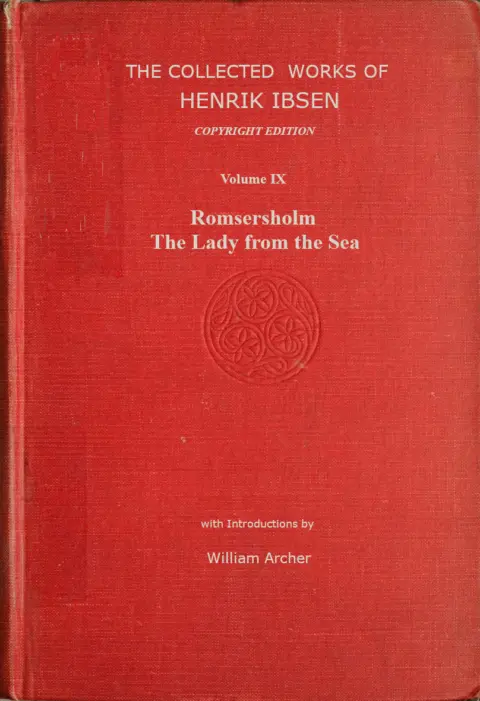
The collected works of Henrik Ibsen, Vol. 11 (of 11)
Henrik Ibsen

THE CLASSIC COLLECTION · 1890
"The Wild Duck" by Henrik Ibsen is a play written in 1884. It follows the Ekdal family, whose fragile domestic peace is destroyed when an idealistic outsider insists on exposing long-buried secrets. Gregers Werle returns from exile determined to reveal the truth about his father's relationship with his friend's wife, believing honesty will liberate them. Instead, his revelations threaten to tear the family apart, forcing them to confront painful questions about love, legitimacy, and the cost of truth versus the comfort of illusion.
Introduction adapted from the source catalogue; source summaries may be automatically generated.
Free to read · English · 32,788 words · No account needed
MAKE TIME FOR A GOOD BOOK
On by default. Untick to stop anonymous reading totals. Each page counts after 10 seconds in view. How this works.
Anonymous counting is on unless you have switched it off.
HEDVIG. Yes, I think he might love me just as much for all that. And even more. Why the wild duck, too, was sent us for a present, and yet I care so much for her.
GREGERS (trying to change the subject). Yes, the wild duck, that’s true! Let’s talk a little about the wild duck, Hedvig.
HEDVIG. The poor wild duck. He can’t bear to see her either. Only think, he wanted to wring her neck!
GREGERS. Oh! he’ll not do that I’m sure.
HEDVIG. No, but he said so. And I think it was so horrid of father, because I say my prayers for the wild duck every night and beg she may be preserved from death, and all that is evil.
GREGERS (looking at her). Do you always say your prayers at night?
HEDVIG. Oh, yes.
GREGERS. Who taught you to do that?
HEDVIG. I myself; it was once when father was so ill, and had leeches on his throat, and then he said he was wrestling with death.
GREGERS. Well?
HEDVIG. So I prayed for him after I had gone to bed. And ever since
I’ve gone on with it.
GREGERS. And now you pray for the wild duck, too?
HEDVIG. I thought it would be best to put the wild duck in too, for she
was so sickly at first.
GREGERS. Do you pray in the morning, too?
HEDVIG. No, I don’t do that.
GREGERS. Why not in the morning as well?
HEDVIG. Oh! it’s light in the morning, and there’s nothing to be afraid
of.
GREGERS. And the wild duck that you’re so very fond of--your father
wanted to wring its neck?
HEDVIG. No, he said it would be best for him if he did, but that he would spare her for my sake; and that was very good of father.
GREGERS (coming a little closer). But if you were to sacrifice the wild duck of your own free will for his sake?
HEDVIG (rising). The wild duck!
GREGERS. If you now freely sacrificed for him the best thing you know
and possess on earth?
HEDVIG. Do you think that would help?
GREGERS. Try it, Hedvig.
HEDVIG (in a low voice and brightening eyes). Yes, I will try.
GREGERS. And do you think you’ve enough strength of mind?
HEDVIG. I will ask grandfather to shoot her for me.
GREGERS. Yes, do so. But not a word of all this to your mother!
HEDVIG. Why not?
GREGERS. She does not understand us.
HEDVIG. The wild duck? I’ll try it early to-morrow.
GINA comes in at the entrance door.
Your reading position is saved on this browser. Take it to another device with a library code. Reading pages adapt to text, rather than matching a printed edition.
BEHIND THE BOOK
This eBook is for the use of anyone anywhere in the United States and most other parts of the world at no cost and with almost no restrictions whatsoever. You may copy it, give it away or re-use it under the terms of the Project Gutenberg License included with this eBook or online at www.gutenberg.org. If you are not located in the United States, you will have to check the laws of the country where you are located before using this eBook. Read the source licence.
The original source file, including credits and licence, is retained by this library. Request an original-format copy at no charge. Please include the book title and Project Gutenberg identifier #73631.
KEEP YOUR CURIOSITY GOING
Maurice Baring
W. B. (William Butler) Yeats
Edward Martyn

John Brougham & Charlotte Brontë
Marguerite Merington
Leonid Andreyev