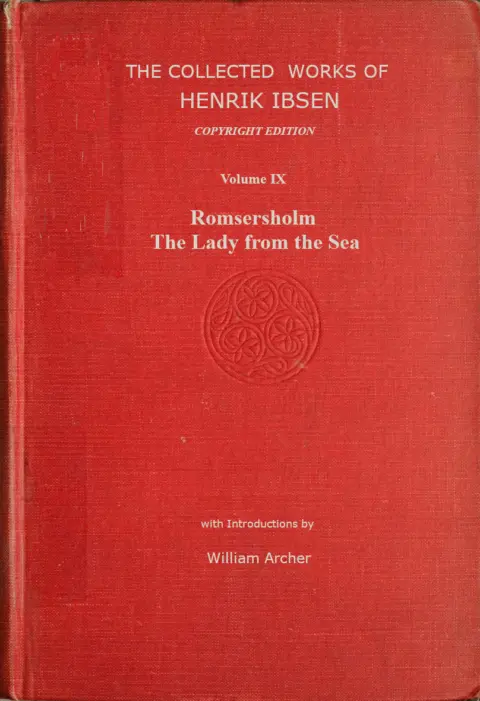
The collected works of Henrik Ibsen, Vol. 11 (of 11)
Henrik Ibsen

THE CLASSIC COLLECTION · 1890
"The Wild Duck" by Henrik Ibsen is a play written in 1884. It follows the Ekdal family, whose fragile domestic peace is destroyed when an idealistic outsider insists on exposing long-buried secrets. Gregers Werle returns from exile determined to reveal the truth about his father's relationship with his friend's wife, believing honesty will liberate them. Instead, his revelations threaten to tear the family apart, forcing them to confront painful questions about love, legitimacy, and the cost of truth versus the comfort of illusion.
Introduction adapted from the source catalogue; source summaries may be automatically generated.
Free to read · English · 32,788 words · No account needed
MAKE TIME FOR A GOOD BOOK
On by default. Untick to stop anonymous reading totals. Each page counts after 10 seconds in view. How this works.
Anonymous counting is on unless you have switched it off.
HJALMAR. Yet you had during the first years.
GREGERS. What first years?
HJALMAR. After the great misfortune. And it was so natural you should have. Why, it was only by a hair’s breadth your father escaped being dragged into this--this horrible affair.
GREGERS. And you thought I had a feeling against you because of this? What can have put such a thing into your head?
HJALMAR. I know you had, Gregers, for I had it from your father himself.
GREGERS (starting). Father! So! H’m! Was that why you never wrote to
me--not a single word?
HJALMAR. Yes.
GREGERS. Not even when you decided to go in for photography?
HJALMAR. Your father said it was no use writing to you about anything.
GREGERS (looking straight in front of him). No, no. Perhaps he was right. But tell me, Hjalmar, do you feel satisfied with your position?
HJALMAR (with a sigh). Oh, yes; certainly. I really can’t say I’m not. At first, as you will understand, it all seemed so strange to me to be placed amid such absolutely new surroundings. But, then, everything else was so changed too. The great, overwhelming misfortune with my father--the shame and the scandal, Gregers.
GREGERS (moved). Yes, yes, I know.
HJALMAR. I couldn’t dream of going on with my studies, there wasn’t a shilling to spare; on the contrary we were rather in debt; mostly to your father, I fancy.
GREGERS. H’m.
HJALMAR. So I thought it best, just with one wrench, you know, to cut myself off from the old conditions and relations. It was your father, principally, who advised me to do this, and as he helped me so much----
GREGERS. Did he?
HJALMAR. Yes, of course; you know he did. Where should I have got the means to learn photography, to set up a studio, and make a start? That costs money, you know.
GREGERS. And father paid for all this?
HJALMAR. Yes, dear friend, didn’t you know? I understood him to say he had written to you about it.
GREGERS. Not a word of what he had done. He must have forgotten it.
We’ve only exchanged business letters with one another. So it was
father?
HJALMAR. Yes, sure enough. He never wished people to know about it, but it was he. And it was he, too, who made it possible for me to get married. But perhaps you don’t know about that either?
Your reading position is saved on this browser. Take it to another device with a library code. Reading pages adapt to text, rather than matching a printed edition.
BEHIND THE BOOK
This eBook is for the use of anyone anywhere in the United States and most other parts of the world at no cost and with almost no restrictions whatsoever. You may copy it, give it away or re-use it under the terms of the Project Gutenberg License included with this eBook or online at www.gutenberg.org. If you are not located in the United States, you will have to check the laws of the country where you are located before using this eBook. Read the source licence.
The original source file, including credits and licence, is retained by this library. Request an original-format copy at no charge. Please include the book title and Project Gutenberg identifier #73631.
KEEP YOUR CURIOSITY GOING
Maurice Baring
W. B. (William Butler) Yeats
Edward Martyn

John Brougham & Charlotte Brontë
Marguerite Merington
Leonid Andreyev