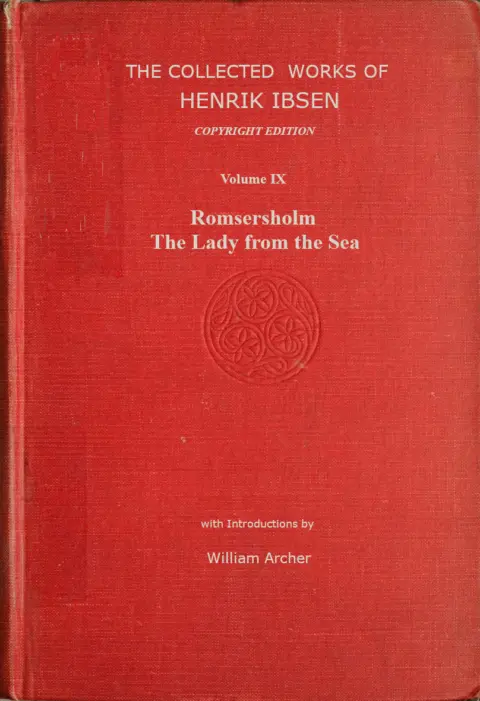
The collected works of Henrik Ibsen, Vol. 11 (of 11)
Henrik Ibsen

THE CLASSIC COLLECTION · 1890
"The Wild Duck" by Henrik Ibsen is a play written in 1884. It follows the Ekdal family, whose fragile domestic peace is destroyed when an idealistic outsider insists on exposing long-buried secrets. Gregers Werle returns from exile determined to reveal the truth about his father's relationship with his friend's wife, believing honesty will liberate them. Instead, his revelations threaten to tear the family apart, forcing them to confront painful questions about love, legitimacy, and the cost of truth versus the comfort of illusion.
Introduction adapted from the source catalogue; source summaries may be automatically generated.
Free to read · English · 32,788 words · No account needed
MAKE TIME FOR A GOOD BOOK
On by default. Untick to stop anonymous reading totals. Each page counts after 10 seconds in view. How this works.
Anonymous counting is on unless you have switched it off.
GREGERS. Listen--just tell me--when you sit in there looking at the
pictures, don’t you want to get out, and see the real great world
itself?
HEDVIG. Oh, no! I want to stop at home always, and help father and
mother.
GREGERS. Finishing photographs?
HEDVIG. No, not only that. What I should like best would be to learn to engrave pictures like those in the English books.
GREGERS. H’m! What does your father say to that?
HEDVIG. I don’t think father likes it, for father’s so odd in some things. Fancy, he talks about my learning basket-making and straw-plaiting! But I don’t think that’s anything much.
GREGERS. Oh, no; neither do I.
HEDVIG. But father’s right about one thing, that if I’d learnt to make baskets, I might have made the new basket for the wild duck myself.
GREGERS. So you might; and you were the right person to have made it.
HEDVIG. Yes, for it’s my wild duck.
GREGERS. Yes, so it is.
HEDVIG. Oh, yes, she belongs to me. But I lend her to father and grandfather as often as ever they like.
GREGERS. Indeed! What do they do with her?
HEDVIG. Oh! they arrange things for her, and build for her, and all
that.
GREGERS. I understand; for I suppose the wild duck’s the most distinguished personage in there.
HEDVIG. Of course she is; for she’s a real wild bird. And it’s a pity about her, too, for she has no one to care for, poor thing.
GREGERS. She hasn’t a family like the rabbits.
HEDVIG. No. The fowls, too, have so many they were chicks with together, but she has been taken right away from all her own. And then it’s all so strange about those wild ducks. No one knows them, and nobody knows where they come from either.
GREGERS. And so she has been to the ocean depths.
HEDVIG (looks up at him for a moment and smiles). Why do you say “the
ocean depths?”
GREGERS. What else should I say?
HEDVIG. You might have said the “bottom of the sea,” or the “sea
bottom.”
GREGERS. Oh! mayn’t I just as well say in the ocean depths?
HEDVIG. Of course, only it sounds so odd to hear people talk of the
depths of the ocean.
GREGERS. Why? Tell me why.
HEDVIG. No, I won’t, for it’s so silly----
GREGERS. I’m sure it’s not. Now, tell me why you smiled?
Your reading position is saved on this browser. Take it to another device with a library code. Reading pages adapt to text, rather than matching a printed edition.
BEHIND THE BOOK
This eBook is for the use of anyone anywhere in the United States and most other parts of the world at no cost and with almost no restrictions whatsoever. You may copy it, give it away or re-use it under the terms of the Project Gutenberg License included with this eBook or online at www.gutenberg.org. If you are not located in the United States, you will have to check the laws of the country where you are located before using this eBook. Read the source licence.
The original source file, including credits and licence, is retained by this library. Request an original-format copy at no charge. Please include the book title and Project Gutenberg identifier #73631.
KEEP YOUR CURIOSITY GOING
Maurice Baring
W. B. (William Butler) Yeats
Edward Martyn

John Brougham & Charlotte Brontë
Marguerite Merington
Leonid Andreyev