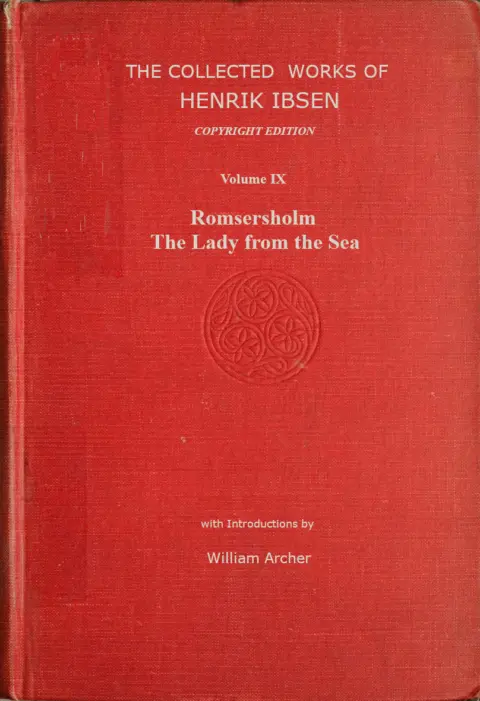
The collected works of Henrik Ibsen, Vol. 11 (of 11)
Henrik Ibsen

THE CLASSIC COLLECTION · 1890
"The Wild Duck" by Henrik Ibsen is a play written in 1884. It follows the Ekdal family, whose fragile domestic peace is destroyed when an idealistic outsider insists on exposing long-buried secrets. Gregers Werle returns from exile determined to reveal the truth about his father's relationship with his friend's wife, believing honesty will liberate them. Instead, his revelations threaten to tear the family apart, forcing them to confront painful questions about love, legitimacy, and the cost of truth versus the comfort of illusion.
Introduction adapted from the source catalogue; source summaries may be automatically generated.
Free to read · English · 32,788 words · No account needed
MAKE TIME FOR A GOOD BOOK
On by default. Untick to stop anonymous reading totals. Each page counts after 10 seconds in view. How this works.
Anonymous counting is on unless you have switched it off.
HJALMAR. Really? So now it’s the copies again! They’ll be ready soon enough. Have there been any fresh orders?
GINA. No, worse luck, to-morrow I’ve nothing but the two portraits you
know of.
HJALMAR. Nothing else? Oh, no, when one makes no effort----
GINA. But what am I to do? I put in all the advertisements I can
afford, I’m sure.
HJALMAR. Yes, advertisements, advertisements. You see how much good they are. And so, I suppose, no one’s been after this room, either?
GINA. No, not yet.
HJALMAR. That was to be expected. When one makes no effort to---- One really must pull oneself together, Gina.
HEDVIG (going up to him). Shall I fetch your flute, father?
HJALMAR. No, no flute. I ask no pleasures here on earth. (Walking up and down.) Yes, yes, I’ll work hard to-morrow, there shall be no lack of that. I’ll work as long as my strength holds out----
GINA. But, dear good Ekdal, I didn’t mean it in that way.
HEDVIG. Father, shall I bring in a bottle of beer?
HJALMAR. No, nothing at all. I want nothing for myself. (Standing still.) Beer?--was it beer you said?
HEDVIG (brightly). Yes, father; lovely, fresh beer.
HJALMAR. Well, if you will insist, you may as well bring in a bottle.
GINA. Yes, do, and then we’ll make ourselves comfortable.
HEDVIG runs towards the kitchen door.
HJALMAR (by the stove; stops her, looks at her, takes her head, and presses her to him). Hedvig! Hedvig!
HEDVIG (gladly, with tears in her eyes). Ah! Dear father!
HJALMAR. No, do not call me that! There have I been sitting at the rich man’s table and taking thought for myself--there have I sat and reveled at the groaning board. And yet I could not----
GINA (sitting by the table). Oh, nonsense, nonsense, Ekdal.
HJALMAR. Yes! But you must not be too hard upon me. You know that I am very fond of you, all the same.
HEDVIG (embracing him). And we are so immensely fond of you!
HJALMAR. And if now and again I should be unreasonable, bear in mind I am a man overwhelmed by a host of worries. No! (Drying his eyes.) No beer at such a moment! Give me the flute.
HEDVIG runs to the book case and fetches it.
HJALMAR. Thanks. Now then. With the flute in my hand, and you two about
me--ah!
Your reading position is saved on this browser. Take it to another device with a library code. Reading pages adapt to text, rather than matching a printed edition.
BEHIND THE BOOK
This eBook is for the use of anyone anywhere in the United States and most other parts of the world at no cost and with almost no restrictions whatsoever. You may copy it, give it away or re-use it under the terms of the Project Gutenberg License included with this eBook or online at www.gutenberg.org. If you are not located in the United States, you will have to check the laws of the country where you are located before using this eBook. Read the source licence.
The original source file, including credits and licence, is retained by this library. Request an original-format copy at no charge. Please include the book title and Project Gutenberg identifier #73631.
KEEP YOUR CURIOSITY GOING
Maurice Baring
W. B. (William Butler) Yeats
Edward Martyn

John Brougham & Charlotte Brontë
Marguerite Merington
Leonid Andreyev