Reflections on the death of a porcupine and other essays
D. H. (David Herbert) Lawrence
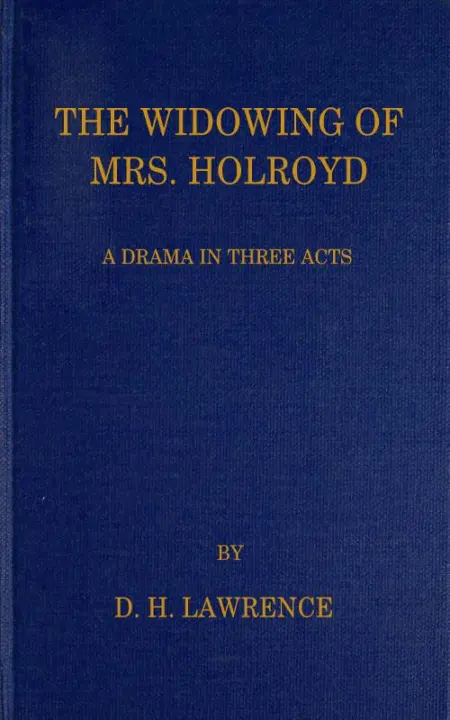
THE CLASSIC COLLECTION · 1914
"The Widowing of Mrs. Holroyd: A Drama in Three Acts" by D. H. Lawrence is a play written in 1911. Mrs. Holroyd endures a difficult marriage to a drunken miner who drinks and brutalizes her. When a gentlemanly neighbor offers romantic attention, she wishes for her husband's death. Her wish comes true when he dies in a mining accident. But as she prepares his body for burial, she discovers something unexpected about their relationship—now that it's too late.
Introduction adapted from the source catalogue; source summaries may be automatically generated.
Free to read · English · 22,742 words · No account needed
MAKE TIME FOR A GOOD BOOK
On by default. Untick to stop anonymous reading totals. Each page counts after 10 seconds in view. How this works.
Anonymous counting is on unless you have switched it off.
Jack!--I never heard such a thing in my life! You mustn't say such
things--it's wicked.
Well, I do.
MRS. HOLROYD (loudly)
I won't have it. He's your father, remember.
JACK (in a high voice)
Well, he's always comin' home an' shoutin' an' bangin' on the table. (He is getting tearful and defiant)
Well, you mustn't take any notice of him.
MINNIE (wistfully)
'Appen if you said something nice to him, mother, he'd happen go to
bed, and not shout.
I'd hit him in the mouth.
Perhaps we'll go to another country, away from him--should we?
In a ship, mother?
In a ship, mam?
Yes, in a big ship, where it's blue sky, and water and palm-trees,
and--
An' dates--?
When should we go?
Some day.
But who'd work for us? Who should we have for father?
You don't want a father. I can go to work for us.
I've got a lot of money now, that your uncle left me.
MINNIE (after a general thoughtful silence)
An' would my father stop here?
Oh, he'd be all right.
But who would he live with?
I don't know--one of his paper bonnets, if he likes.
Then she could have her old bracelet back, couldn't she?
Yes--there it is on the candlestick, waiting for her.
[There is a sound of footsteps--then a knock at the door. The
children start.
MINNIE (in relief)
Here he is.
[Mrs. Holroyd goes to the door. Blackmore enters.
It is foggy to-night--Hello, aren't you youngsters gone to bed?
No, my father's not come home yet.
BLACKMORE (turning to Mrs. Holroyd)
Did he go to work then, after last night?
I suppose so. His pit things were gone when I got up. I never thought
he'd go.
And he took his snap as usual?
Yes, just as usual. I suppose he's gone to the New Inn. He'd say to himself he'd pay me out. That's what he always does say, "I'll pay thee out for that bit--I'll ma'e thee regret it."
We're going to leave him.
So you think he's at the New Inn?
I'm sure he is--and he'll come when he's full. He'll have a bout now,
you'll see.
Go and fetch him, Mr. Blackmore.
My mother says we shall go in a ship and leave him.
BLACKMORE (after looking keenly at Jack: to Mrs. Holroyd) Shall I go and see if he's at the New Inn?
No--perhaps you'd better not--
Your reading position is saved on this browser. Take it to another device with a library code. Reading pages adapt to text, rather than matching a printed edition.
D. H. (David Herbert) Lawrence
D. H. (David Herbert) Lawrence
D. H. (David Herbert) Lawrence
D. H. (David Herbert) Lawrence
BEHIND THE BOOK
This eBook is for the use of anyone anywhere in the United States and most other parts of the world at no cost and with almost no restrictions whatsoever. You may copy it, give it away or re-use it under the terms of the Project Gutenberg License included with this eBook or online at www.gutenberg.org. If you are not located in the United States, you will have to check the laws of the country where you are located before using this eBook. Read the source licence.
The original source file, including credits and licence, is retained by this library. Request an original-format copy at no charge. Please include the book title and Project Gutenberg identifier #55877.
KEEP YOUR CURIOSITY GOING
Maurice Baring
W. B. (William Butler) Yeats
Edward Martyn

John Brougham & Charlotte Brontë
Marguerite Merington
Leonid Andreyev