THE CLASSIC COLLECTION✦Love Letters of Nathaniel Hawthorne, Volume 2 (of 2)CLASSIC FREE BOOKS
Love Letters of Nathaniel Hawthorne, Volume 2 (of 2)
Nathaniel Hawthorne
THE CLASSIC COLLECTION · 1840
"The Whole History of Grandfather's Chair" by Nathaniel Hawthorne is a historical account written during the early 19th century. The book intertwines the fictional narrative of a grandfather narrating history to his grandchildren with the genuine events and prominent figures of New England's early days, from 1620 to 1808. The chair serves as a central symbol, supposedly witnessing pivotal moments and characters in American history, making it a unique vehicle for storytelling that seeks to engage young readers in their own heritage. The opening of the narrative introduces Grandfather, who is depicted as a loving figure reminiscing about the historical importance of his old oak chair as he tells stories to his eager grandchildren. Focusing on familial affection, the scene bathes the children in the joys of innocence and imagination, setting a warm, inviting backdrop for future tales. As the children request stories about the chair itself, Grandfather hints at its rich past, promising to relate significant events and figures tied to its history. The tone suggests a blend of earnest storytelling with historical education intended to resonate with young minds, encouraging them to explore their roots and the fabric of their nation's past.
Introduction adapted from the source catalogue; source summaries may be automatically generated.
Free to read · English · 57,503 words · No account needed
MAKE TIME FOR A GOOD BOOK
On by default. Untick to stop anonymous reading totals. Each page counts after 10 seconds in view. How this works.
Anonymous counting is on unless you have switched it off.
In short, so operative were the terrors that surrounded them, that of twenty-four young men, who deserted from a transport, twenty-two were glad to return of themselves, the others being shot by sentinels; and one of their friends, who was supposed to have been accessory to their escape, was carried on shore to behold the destruction of his house and effects, which were burned in his presence, as a punishment for his temerity and perfidious aid to his comrades. The prisoners expressed the greatest concern at having incurred his Majesty’s displeasure, and in a petition addressed to Colonel Winslow intreated him to detain a part of them as sureties for the appearance of the rest, who were desirous of visiting their families, and consoling them in their distress and misfortunes. To comply with this request of holding a few as hostages for the surrender of the whole body, was deemed inconsistent with his instructions; but, as there could be no objection to allow a small number of them to return to their homes, permission was given to them to choose ten for the District of Minas (Horton) and ten for the District of Canard (Cornwallis) to whom leave of absence was given for one day, and on whose return a similar number were indulged in the same manner. They bore their confinement, and received their sentence with a fortitude and resignation altogether unexpected; but when the hour of embarkation arrived, in which they were to leave the land of their nativity forever--to part with their friends and relatives, without the hope of ever seeing them again, and to be dispersed among strangers, whose language, customs and religion were opposed to their own, the weakness of human nature prevailed, and they were overpowered with the sense of their miseries. The preparations having been all completed, the 10th of September was fixed upon as the day of departure. The prisoners were drawn up six deep, and the young men, one hundred and sixty-one in number, were ordered to go first on board of the vessels. This they instantly and peremptorily refused to do, declaring that they would not leave their parents; but expressed a willingness to comply with the order, provided they were permitted to embark with their families. This request was immediately rejected, and the troops were ordered to fix bayonets and advance towards the prisoners, a motion which had the effect of producing obedience on the part of the young men, who forthwith commenced their march. The road from the chapel to the shore, just one mile in length, was crowded with women and children; who, on their knees, greeted them as they passed with their tears and their blessings, while the prisoners advanced with slow and reluctant steps, weeping, praying, and singing hymns. This detachment was followed by the seniors, who passed through the same scene of sorrow and distress. In this manner was the whole male part of the population of the District of Minas put on board the five transports, stationed in the river Gaspereaux, each vessel being guarded by six non-commissioned officers, and eighty privates. As soon as the other vessels arrived, their wives and children followed, and the whole were transported from Nova Scotia. The haste with which these measures were carried into execution did not admit of those preparations for their comfort, which, if unmerited by their disloyalty, were at least due in pity to the severity of their punishment. The hurry, confusion, and excitement connected with the embarkation had scarcely subsided, when the Provincials were appalled by the work of their own hands The novelty and peculiarity of their situation could not but force itself upon the attention of even the unreflecting soldiery; stationed in the midst of a beautiful and fertile country, they suddenly found themselves without a foe to subdue, and without a population to protect. The volumes of smoke which the half expiring embers emitted, while they marked the site of the peasant’s humble cottage, bore testimony to the extent of the work of destruction. For several successive evenings the cattle assembled round the smouldering ruins, as if in anxious expectation of the return of their masters, while all night long the faithful watchdogs of the Neutrals howled over the scene of desolation, and mourned alike the hand that had fed, and the house that had sheltered them.
Your reading position is saved on this browser. Take it to another device with a library code. Reading pages adapt to text, rather than matching a printed edition.
Nathaniel Hawthorne
Nathaniel Hawthorne
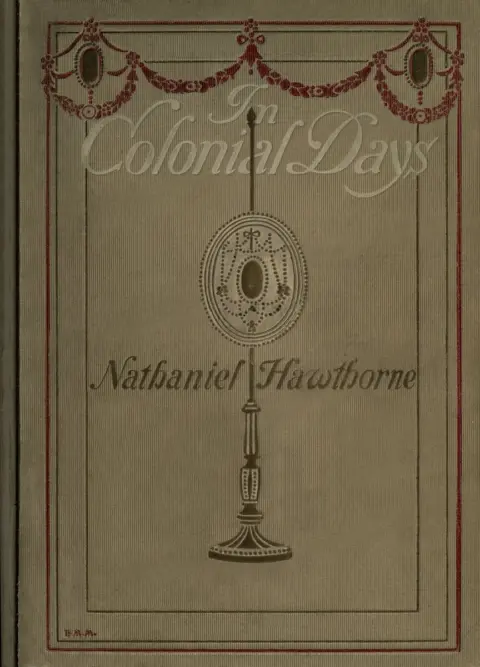
Nathaniel Hawthorne

Rebecca Harding Davis & Thomas De Quincey & Charles Dickens & Nathaniel Hawthorne & Edward Bulwer Lytton, Baron Lytton & Edgar Allan Poe & Harriet Elizabeth Prescott Spofford
BEHIND THE BOOK
This eBook is for the use of anyone anywhere in the United States and most other parts of the world at no cost and with almost no restrictions whatsoever. You may copy it, give it away or re-use it under the terms of the Project Gutenberg License included with this eBook or online at www.gutenberg.org. If you are not located in the United States, you will have to check the laws of the country where you are located before using this eBook. Read the source licence.
The original source file, including credits and licence, is retained by this library. Request an original-format copy at no charge. Please include the book title and Project Gutenberg identifier #1926.
KEEP YOUR CURIOSITY GOING
Cécile Tormay

Moritz Busch
John L. Ransom
Frances Wright
Cécile Tormay

Mabel Potter Daggett