THE CLASSIC COLLECTION✦The Moccasin MakerCLASSIC FREE BOOKS
The Moccasin Maker
E. Pauline Johnson
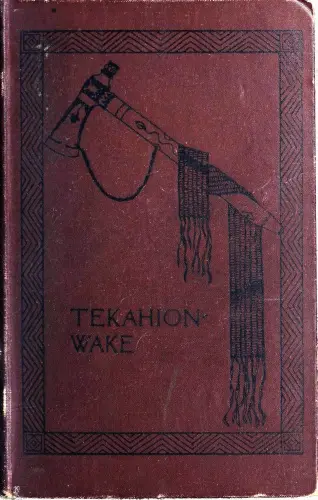
THE CLASSIC COLLECTION · 1895
"The White Wampum" by E. Pauline Johnson is a collection of poems written in the late 19th century. The work reflects the rich heritage and traditions of Indigenous people, particularly the Iroquois and Mohawk tribes, as it explores themes of love, identity, and the impact of colonization on Native life. Johnson, who was of mixed heritage, uses her poetry to convey both the beauty and the struggles of her cultural background. In this collection, Johnson crafts vivid imagery and emotional depth as she delves into various subjects, from the relationship between Indigenous people and nature to the conflicts arising from colonialism. The poems feature powerful figures such as warriors, lovers, and mothers, each expressing their joys, sorrows, and a longing for peace and understanding amidst the turbulence of their times. Johnson’s voice emerges as a bridge between cultures, celebrating her Indigenous roots while highlighting the profound challenges faced by her community, ultimately calling for empathy and recognition of their struggles.
Introduction adapted from the source catalogue; source summaries may be automatically generated.
Free to read · English · 13,314 words · No account needed
MAKE TIME FOR A GOOD BOOK
On by default. Untick to stop anonymous reading totals. Each page counts after 10 seconds in view. How this works.
Anonymous counting is on unless you have switched it off.
Could I but live just here in Freedom’s arms, A kingly life without a sovereign’s care! Vain dreams! Day hides with closing wings her charms, And all is cradled in repose, save where Yon band of black, belated crows still frets the evening air.
Idles the night wind through the dreaming firs,
That waking murmur low,
As some lost melody returning stirs
The love of long ago;
And through the far, cool distance, zephyr fanned,
The moon is sinking into shadow land.
The troubled night-bird, calling plaintively,
Wanders on restless wing;
The cedars, chanting vespers to the sea,
Await its answering,
That comes in wash of waves along the strand,
The while the moon slips into shadow-land,
O! soft responsive voices of the night
I join your minstrelsy,
And call across the fading silver light
As something calls to me;
I may not all your meaning understand,
But I have touched your soul in shadow-land.
A thin wet sky, that yellows at the rim,
And meets with sun-lost lip the marsh’s brim.
The pools low lying, dank with moss and mould, Glint through their mildews like large cups of gold
Among the wild rice in the still lagoon,
In monotone the lizard shrills his tune.
The wild goose, homing, seeks a sheltering,
Where rushes grow, and oozing lichens cling.
Late cranes with heavy wing, and lazy flight,
Sail up the silence with the nearing night.
And like a spirit, swathed in some soft veil, Steals twilight and its shadows o’er the swale.
Hushed lie the sedges, and the vapours creep, Thick, grey and humid, while the marshes sleep.
A Meadow brown; across the yonder edge
A zigzag fence is ambling; here a wedge
Of underbush has cleft its course in twain,
Till where beyond it staggers up again;
The long, grey rails stretch in a broken line
Their ragged length of rough, split forest pine,
And in their zigzag tottering have reeled
In drunken efforts to enclose the field,
Which carries on its breast, September born,
A patch of rustling, yellow, Indian corn.
Beyond its shrivelled tassels, perched upon
The topmost rail, sits Joe, the settler’s son,
A little semi-savage boy of nine.
Now dozing in the warmth of Nature’s wine,
His face the sun has tampered with, and wrought,
By heated kisses, mischief, and has brought
Some vagrant freckles, while from here and there
A few wild locks of vagabond brown hair
Escape the old straw hat the sun looks through,
And blinks to meet his Irish eyes of blue.
Barefooted, innocent of coat or vest,
His grey checked shirt unbuttoned at his chest,
Both hardy hands within their usual nest--
His breeches pockets--so, he waits to rest
His little fingers, somewhat tired and worn,
That all day long were husking Indian corn.
His drowsy lids snap at some trivial sound,
With lazy yawns he slips towards the ground,
Then with an idle whistle lifts his load
And shambles home along the country road
That stretches on fringed out with stumps and weeds,
And finally unto the backwoods leads,
Where forests wait with giant trunk and bough
The axe of pioneer, the settler’s plough.
Your reading position is saved on this browser. Take it to another device with a library code. Reading pages adapt to text, rather than matching a printed edition.
E. Pauline Johnson
E. Pauline Johnson
E. Pauline Johnson
E. Pauline Johnson
BEHIND THE BOOK
This eBook is for the use of anyone anywhere in the United States and most other parts of the world at no cost and with almost no restrictions whatsoever. You may copy it, give it away or re-use it under the terms of the Project Gutenberg License included with this eBook or online at www.gutenberg.org. If you are not located in the United States, you will have to check the laws of the country where you are located before using this eBook. Read the source licence.
The original source file, including credits and licence, is retained by this library. Request an original-format copy at no charge. Please include the book title and Project Gutenberg identifier #52988.
KEEP YOUR CURIOSITY GOING

Eric Mackay
Edmund Gosse
Sophia Margaretta Hensley
Gilbert Parker
George MacDonald

Elizabeth Bibesco