
Mother of Pearl
Anatole France
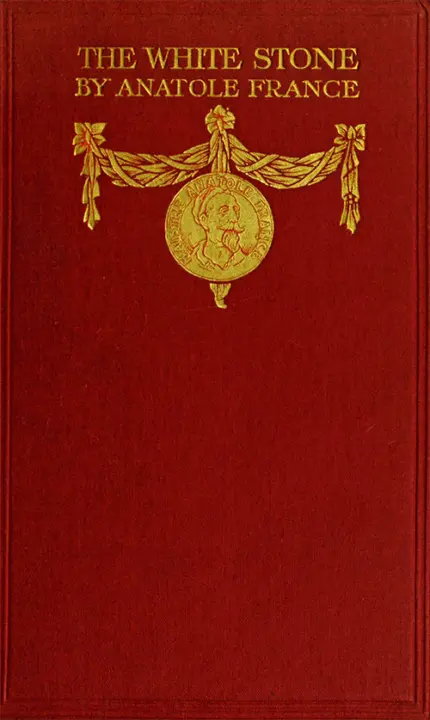
THE CLASSIC COLLECTION · 1925
"The White Stone" by Anatole France is a novel written in the late 19th century. The story centers around a group of French expatriates, exploring themes of friendship, history, and the clash between past grandeur and present decay, set against the backdrop of Rome and its classical ruins. The characters include Joséphin Leclerc, M. Goubin, Nicole Langelier, and others, who engage in discussions about the significance of the historical monuments they encounter and the essence of Roman culture. At the start of the book, the characters gather in the ruins of the Roman Forum, expressing reflections on the historical significance of the surroundings. As they admire the ancient structures, their dialogue delves into various topics, from the architectural beauty of Rome to philosophical musings about the nature of the gods and the evolution of human civilization. Each character contributes to the conversation, revealing their backgrounds and perspectives as they grapple with the complexities of contemporary society versus the ideals of the past. This opening sets the tone for a deeper exploration of historical and cultural themes throughout the novel.
Introduction adapted from the source catalogue; source summaries may be automatically generated.
Free to read · English · 51,594 words · No account needed
MAKE TIME FOR A GOOD BOOK
On by default. Untick to stop anonymous reading totals. Each page counts after 10 seconds in view. How this works.
Anonymous counting is on unless you have switched it off.
“As I am falling asleep, a few almost imperceptible phrases of Mozart still reach my ears now and then, and make me dream of temples of marble standing amid a blue foliage.
“It was broad daylight when I awoke. I dressed myself much more quickly than it is my wont. Unconscious of the cause for this haste, I found myself in the street without knowing how I had got there. What I now saw about me was to me the cause of a surprise which suspended all my faculties of reflection; and it is owing to this impossibility to reflect that my surprise did not increase, but remained stationary and calm. It would doubtless soon have become immoderate, and would have changed to stupor and terror, had I retained the use of my mind, so greatly was the scene which I was witnessing different from what it should be. Everything about me was to me new, unknown, and foreign. The trees and the lawns which I was in the habit of seeing daily had vanished. Where, on the day before, the tall grey buildings of the avenue stood out against the sky, there now stretched a fanciful line of brick cottages surrounded by gardens. I dared not look round to ascertain whether my own house still existed, and so I went straight towards the Porte Dauphine. I found it not. I took a street which was, so it seemed to me, the old road to Suresnes. The houses flanking it, of strange style and new form, too small to be occupied by rich people, were nevertheless embellished with pictures, sculptures, and brilliant potteries. A covered terrace surmounted them. I followed this rural road, whose curves produced enchanting perspectives. It was crossed obliquely by other sinuous ways. Neither trains, nor automobiles, nor vehicles of any kind went by. Shadows flitted over the soil. I looked upwards and saw masses of huge birds and enormous fishes glide rapidly through the upper atmosphere, which seemed to be a combination of heaven and ocean. Near the Seine, the course of which was altered, I came across a crowd of men clad in short blouses knotted at the waist, and wearing long gaiters. To all appearance they were in their working clothes. But their gait was lighter and more elegant than that of our workmen. I noticed women among them. What had heretofore prevented my recognising them as such was that they were dressed like the men, that they had long and straight legs, and, so it seemed to me, the narrow hips of American women. Although these folk did not present a savage appearance, I looked at them with fright. They presented to my gaze a more foreign appearance than any of the numerous strangers I had so far met upon the earth. In order to avoid seeing another human face, I turned down a deserted lane. Very soon I came to a circus planted with masts from which flew crimson oriflammes bearing in letters of gold the words: EUROPEAN FEDERATION. Placards in large frames ornamented with emblems of peace hung at the foot of the masts. They embodied announcements regarding popular festivals, legal injunctions, and works of public interest. In addition to balloon time-tables was a chart of the atmospheric currents drawn on the 28th of June of the year 220 of the Federation of Nations. All these texts were printed in characters new to me, and in a language of which I did not understand all the words. The while I was attempting to decipher them, the shadows of the countless machines cleaving the air flitted across my vision. Once more did I gaze upwards, and in this sky altered beyond recognition, more densely populated than the earth, cloven by rudders and threshed by screws, towards which a circle of smoke rose from the horizon, I perceived the sun. I felt like crying on seeing it. It was the only familiar figure which I had come across since morning. From its altitude I judged that it was about ten o’clock of the forenoon. Of a sudden I was surrounded by a second crowd of men and women, similar in appearance and in costume to the first. I was confirmed in the impression that the women, although some of them were very plump, others very skinny, and many beggared description, were on the whole androgynous in appearance. The crowd went its way. The open space once more was desert, just as our suburban quarters, which only come to life on the exodus from the workshops. I remained behind in front of the placards and read once more the date--the 28th of June of the year 220 of the European Federation. What did it mean! A proclamation by the Federal Committee, on the occasion of the festival of the Earth, furnished me with timely and useful data for comprehension of that date. This is what I read: ‘Comrades, you are aware how, in the last year of the twentieth century, the old order collapsed in a fearful cataclysm, and how, after fifty years of anarchy, the federation of the peoples of Europe was organised....” The year 220 of the federation of peoples was therefore the year 2270 of the Christian Era; this was certainly a fact which remained to be explained. How came it that of a sudden I found myself transported to the year 2270?
Your reading position is saved on this browser. Take it to another device with a library code. Reading pages adapt to text, rather than matching a printed edition.
Anatole France

Anatole France

Anatole France
Anatole France
BEHIND THE BOOK
This eBook is for the use of anyone anywhere in the United States and most other parts of the world at no cost and with almost no restrictions whatsoever. You may copy it, give it away or re-use it under the terms of the Project Gutenberg License included with this eBook or online at www.gutenberg.org. If you are not located in the United States, you will have to check the laws of the country where you are located before using this eBook. Read the source licence.
The original source file, including credits and licence, is retained by this library. Request an original-format copy at no charge. Please include the book title and Project Gutenberg identifier #49092.
KEEP YOUR CURIOSITY GOING
Coulson Kernahan

Maurice Baring
Frances Wright
Cécile Tormay

Frederic Jesup Stimson

W. H. P. (William Henry Pope) Jarvis