
Mother of Pearl
Anatole France
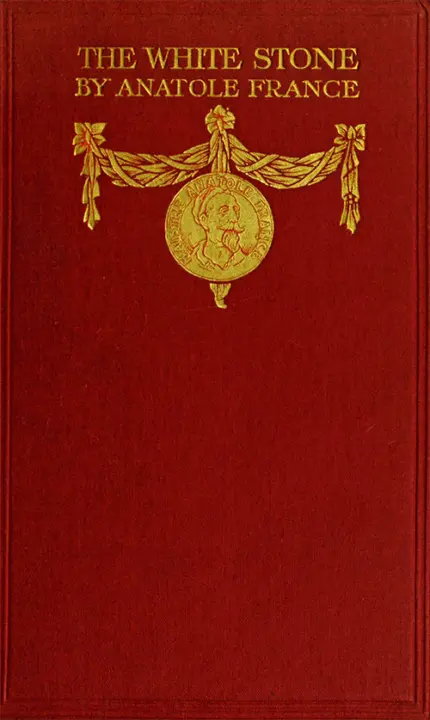
THE CLASSIC COLLECTION · 1925
"The White Stone" by Anatole France is a novel written in the late 19th century. The story centers around a group of French expatriates, exploring themes of friendship, history, and the clash between past grandeur and present decay, set against the backdrop of Rome and its classical ruins. The characters include Joséphin Leclerc, M. Goubin, Nicole Langelier, and others, who engage in discussions about the significance of the historical monuments they encounter and the essence of Roman culture. At the start of the book, the characters gather in the ruins of the Roman Forum, expressing reflections on the historical significance of the surroundings. As they admire the ancient structures, their dialogue delves into various topics, from the architectural beauty of Rome to philosophical musings about the nature of the gods and the evolution of human civilization. Each character contributes to the conversation, revealing their backgrounds and perspectives as they grapple with the complexities of contemporary society versus the ideals of the past. This opening sets the tone for a deeper exploration of historical and cultural themes throughout the novel.
Introduction adapted from the source catalogue; source summaries may be automatically generated.
Free to read · English · 51,594 words · No account needed
MAKE TIME FOR A GOOD BOOK
On by default. Untick to stop anonymous reading totals. Each page counts after 10 seconds in view. How this works.
Anonymous counting is on unless you have switched it off.
Posocharis took the coin. Then he hurled coarse invectives at Annæus Mela and his companions, stigmatising them as arrogant and as debauchees, and referring them to the jugglers and harlots who walked past them with undulating hips. Then, baring to the navel his hairy body, and drawing over his face his tattered cloak, he once more stretched himself out at full length on the pavement.
“Would it not interest you,” asked Lollius of his companions, “to hear those Jews expound their dispute in the prætorium?”
They replied that they entertained no such curiosity, preferring to stroll under the portico, while waiting for the proconsul, who would doubtless not be long in coming out.
“I am with you, my friends,” said Lollius. “We shall not miss anything very interesting.”
“Moreover,” he went on to say, “the Jews who have come from Cenchreæ to accompany the suitors are not all in the basilica. Here comes one who is recognisable by his beaked nose and his forked beard. He is in as fine a state of frenzy as Pythia herself.”
Lollius was pointing with both look and finger at a lean stranger, poorly clad, who was vociferating under the portico, in the midst of a railing mob.
“Men of Corinth, you place a vain trust in your wisdom, which is naught but madness. You follow blindly the precepts of your philosophers who teach you death, and not life. You do not observe the natural law, and in order to punish you, God has delivered you unto unnatural vices....”
A sailor, who had just joined the group of spectators, recognised the man, for, with a shrug of the shoulders, he muttered:
“Why, ’tis Stephanas, the Jew of Cenchreæ, who brings once more some extraordinary piece of news from his trip to the skies, into which he ascended, if we are to credit him.”
And Stephanas was teaching the people.
“The Christian is not bound by law and concupiscence. He is exempt from damnation through the mercy of God, who sent his only son to assume a sinful body, in order to destroy sin. But ye shall only be delivered if, breaking with the flesh, you live according to the spirit.
“The Jews observe the laws, and believe that they are saved by their works. But it is their faith which saves them, and not their works. Of what use is it to them to be circumcised in fact, if their heart is uncircumcised?
“Men of Corinth, glory in the faith, and ye shall be incorporated into the family of Abraham.”
Your reading position is saved on this browser. Take it to another device with a library code. Reading pages adapt to text, rather than matching a printed edition.
Anatole France

Anatole France

Anatole France
Anatole France
BEHIND THE BOOK
This eBook is for the use of anyone anywhere in the United States and most other parts of the world at no cost and with almost no restrictions whatsoever. You may copy it, give it away or re-use it under the terms of the Project Gutenberg License included with this eBook or online at www.gutenberg.org. If you are not located in the United States, you will have to check the laws of the country where you are located before using this eBook. Read the source licence.
The original source file, including credits and licence, is retained by this library. Request an original-format copy at no charge. Please include the book title and Project Gutenberg identifier #49092.
KEEP YOUR CURIOSITY GOING
Coulson Kernahan

Maurice Baring
Frances Wright
Cécile Tormay

Frederic Jesup Stimson

W. H. P. (William Henry Pope) Jarvis