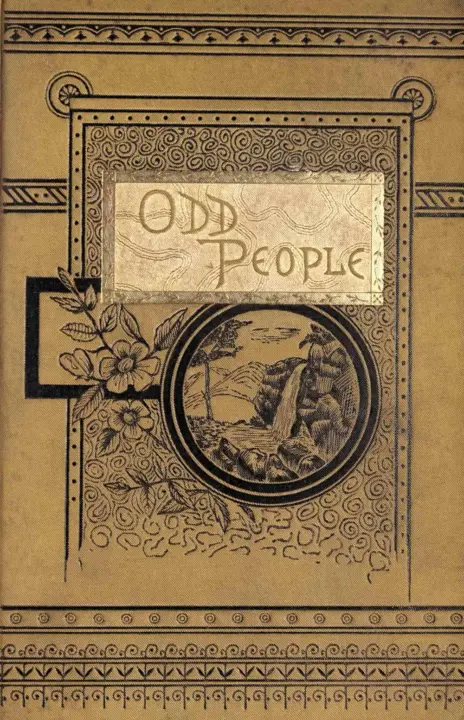
The man-eaters and other odd people
Mayne Reid
THE CLASSIC COLLECTION · 1873
"The White Squaw" by Captain Mayne Reid is a novel written in the late 19th century. Set against the backdrop of Tampa Bay, the story presents a blend of adventure, intrigue, and the contrasting cultures of Native Americans and European settlers. The narrative focuses on characters such as Warren, a young white man, and Nelatu, a Seminole Indian youth, who becomes embroiled in conflict and friendship, hinting at themes of loyalty and betrayal. The opening of the book introduces readers to a tense encounter in the twilight of Tampa Bay, where Warren hears a cry for help and rushes into the woods, discovering an Indian youth, Nelatu, who has been attacked. After saving him from a would-be assassin named Red Wolf, the two forge an alliance. The narrative quickly establishes a tension between settlers and Native Americans, and the complexities of their relationships, especially as Warren appears to harbor secret motives regarding Nelatu's sister, Sansuta. This initial chapter sets the stage for a story rich in conflict and character development in a vivid and natural setting.
Introduction adapted from the source catalogue; source summaries may be automatically generated.
Free to read · English · 46,831 words · No account needed
MAKE TIME FOR A GOOD BOOK
On by default. Untick to stop anonymous reading totals. Each page counts after 10 seconds in view. How this works.
Anonymous counting is on unless you have switched it off.
The last golden gleams of the setting sun sparkled across the translucent waters of Tampa Bay. This fading light fell upon shores fringed with groves of oak and magnolia, whose evergreen leaves became gradually darkened by the purple twilight.
A profound silence, broken by the occasional notes of a tree-frog, or the flapping of the night-hawk's wings, was but the prelude to that wonderful concert of animated nature heard only in the tropical forest.
A few moments, and the golden lines of trembling light had disappeared, while darkness almost palpable overshadowed the scene.
Then broke forth in full chorus the nocturnal voices of the forest.
The mocking-bird, the whip-poor-will, the bittern, the bell-frog, grasshoppers, wolves, and alligators, all joined in the harmony incident to the hour of night, causing a din startling to the ear of a stranger.
Now and then would occur an interval of silence, which rendered the renewal of the voices all the more observable.
During one of these pauses a cry might have been heard differing from
all the other sounds.
It was the voice of a human being, and there was one who heard it.
Making his way through the woods was a young man, dressed in half-hunter costume, and carrying a rifle in his hand. The cry had caused him to stop suddenly in his tracks.
After glancing cautiously around, as if endeavouring to pierce the thick darkness, he again advanced, again came to a stop, and remained listening. Once more came that cry, in which accents of anger were strangely commingled with tones appealing for help.
This time the sound indicated the direction, and the listener's
resolution was at once taken.
Thrusting aside the undergrowth, and trampling under foot the tall grass, he struck into a narrow path running parallel to the shore, and which led in the direction whence the cry appeared to have come.
Though it was now quite dark, he seemed easily to avoid impediments, which even in broad daylight would have been difficult to pass.
The darkness appeared no barrier to his speed, and neither the overhanging branches, nor the wood-bine roots stayed his progress.
About a hundred paces further on, the path widened into a rift that led to an opening, sloping gradually down to the beach.
On reaching its edge, he paused once more to listen for a renewal of the
sound.
Nothing save the familiar noises of the night greeted his ear.
After a short pause, he kept on for the water's edge, with head well forward, and eyes strained to penetrate the gloom.
Your reading position is saved on this browser. Take it to another device with a library code. Reading pages adapt to text, rather than matching a printed edition.
Mayne Reid
Mayne Reid
Mayne Reid
Mayne Reid
BEHIND THE BOOK
This eBook is for the use of anyone anywhere in the United States and most other parts of the world at no cost and with almost no restrictions whatsoever. You may copy it, give it away or re-use it under the terms of the Project Gutenberg License included with this eBook or online at www.gutenberg.org. If you are not located in the United States, you will have to check the laws of the country where you are located before using this eBook. Read the source licence.
The original source file, including credits and licence, is retained by this library. Request an original-format copy at no charge. Please include the book title and Project Gutenberg identifier #36604.
KEEP YOUR CURIOSITY GOING
Coulson Kernahan

Maurice Baring
Frances Wright
Cécile Tormay

Frederic Jesup Stimson

W. H. P. (William Henry Pope) Jarvis