THE CLASSIC COLLECTION✦A dead man’s diaryCLASSIC FREE BOOKS
A dead man’s diary
Coulson Kernahan
THE CLASSIC COLLECTION · 1881
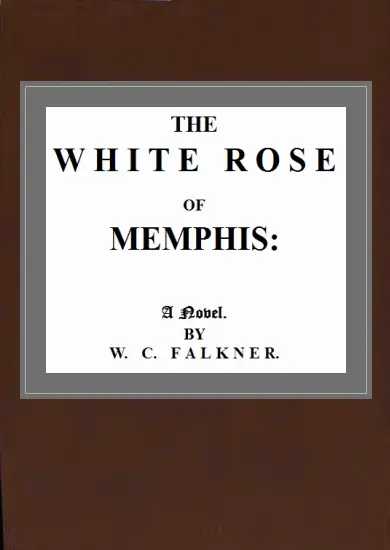
"The White Rose of Memphis" by William C. Falkner is a novel written in the late 19th century. The story centers around Captain Oliver Quitman and Samuel Brazzleman, two steamboat operators in Memphis, as they prepare for a grand inaugural trip of their newly chartered boat, the "White Rose of Memphis." The narrative elegantly unfolds the themes of adventure, romance, and the vibrant social scene of the time, promising an entertaining exploration of life on the Mississippi River." "The opening of the novel sets the stage for an exciting journey as Captain Quitman and Brazzleman discuss their plans for the steamboat's first voyage to New Orleans. They plan to make a splash with a masquerade ball aboard the boat to attract attention and fill the passenger list. As the festivities begin, the atmosphere is electric with anticipation, and various characters, all masked and adorned in splendid costumes, gather to celebrate. Amidst the excitement, a mysterious queen, who captures the interest of many attendees, piques the curiosity of the male maskers. The narrative hints at playful intrigue, romantic pursuits, and the social dynamics of the guests, leaving readers eager to discover how the festivities will unfold aboard the "White Rose."
Introduction adapted from the source catalogue; source summaries may be automatically generated.
Free to read · English · 207,018 words · No account needed
MAKE TIME FOR A GOOD BOOK
On by default. Untick to stop anonymous reading totals. Each page counts after 10 seconds in view. How this works.
Anonymous counting is on unless you have switched it off.
“‘I declare, I don’t remember; the names, however, seem familiar to me, but I can’t exactly call to mind any acquaintance of that name.’
“‘Perhaps I can assist your memory a little. Did you know the widow Totten, who resided three or four miles from Vicksburg, Mississippi, who had a daughter named Victoria?’
“‘I don’t think I did.’
“That answer was made by Bowles in a tremulous tone, while he showed signs of great uneasiness.
“‘Have you ever been married, Mr. Bowles?’
“‘No.’
“‘Did you ever live in New Orleans with a woman whom you represented to
be your wife?’
“‘Yes.’
“‘If the court please,’ said Mr. Quillet, as he sprang quickly to his feet, ‘I must confess I cannot see wherein this kind of evidence can have any connection whatever with this case.’
“I heard Lottie whisper to Mr. Rockland, as I was sitting near her:
“‘Tell the court, papa,’ said she, ‘that we will connect it with the
case very soon.’
“The iron lawyer then said to the court:
“‘We think we will be able to connect this testimony with this case, and if we fail, then your Honor can rule it out.’
“‘The court cannot see the applicability of the evidence to the case now on trial, but the defendant has a right to introduce evidence in the order chosen by her attorney. I will not give any opinion just now, but will decide upon it when all the testimony has been put before the court. Proceed with the examination.’
“‘What was the name of the woman whom you represented to be your wife?’
“‘I had rather not answer that question, as it might compromise a lady’s
character.’
“‘We object to the question,’ said Quillet.
“‘We insist on an answer,’ said Mr. Rockland; while Bowles changed from a deep red color to a deathly pallor.
“‘The court will not permit such questions to be propounded, unless the attorney for the defense can state some reasons for inquiring into the private history of a woman residing in New Orleans.’
“‘The woman alluded to,’ said Mr. Rockland, ‘does not reside in New Orleans at this time; but she is here in the city of Memphis; and Miss Wallingford informs me that we will connect all this proof directly with the case now on trial.’
“‘In view of that statement, the court will permit the question to be
asked.’
“Bowles moved uneasily backward and forward in his seat, wiped the big drops of perspiration from his brow and coughed several times. As he played with his watch chain I could see that his hands were trembling and his face became deathly in its pallor.
Your reading position is saved on this browser. Take it to another device with a library code. Reading pages adapt to text, rather than matching a printed edition.
BEHIND THE BOOK
This eBook is for the use of anyone anywhere in the United States and most other parts of the world at no cost and with almost no restrictions whatsoever. You may copy it, give it away or re-use it under the terms of the Project Gutenberg License included with this eBook or online at www.gutenberg.org. If you are not located in the United States, you will have to check the laws of the country where you are located before using this eBook. Read the source licence.
The original source file, including credits and licence, is retained by this library. Request an original-format copy at no charge. Please include the book title and Project Gutenberg identifier #41134.
KEEP YOUR CURIOSITY GOING
Coulson Kernahan

Maurice Baring
Frances Wright
Cécile Tormay

Frederic Jesup Stimson

W. H. P. (William Henry Pope) Jarvis