THE CLASSIC COLLECTION✦A dead man’s diaryCLASSIC FREE BOOKS
A dead man’s diary
Coulson Kernahan
THE CLASSIC COLLECTION · 1881
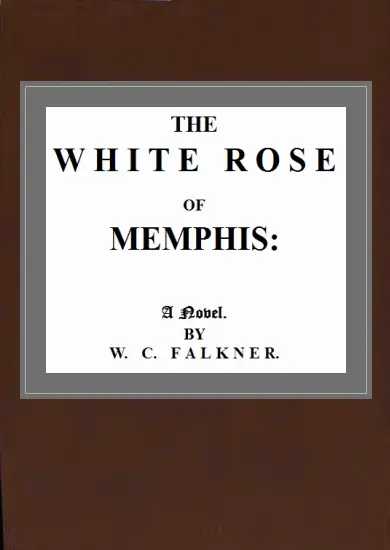
"The White Rose of Memphis" by William C. Falkner is a novel written in the late 19th century. The story centers around Captain Oliver Quitman and Samuel Brazzleman, two steamboat operators in Memphis, as they prepare for a grand inaugural trip of their newly chartered boat, the "White Rose of Memphis." The narrative elegantly unfolds the themes of adventure, romance, and the vibrant social scene of the time, promising an entertaining exploration of life on the Mississippi River." "The opening of the novel sets the stage for an exciting journey as Captain Quitman and Brazzleman discuss their plans for the steamboat's first voyage to New Orleans. They plan to make a splash with a masquerade ball aboard the boat to attract attention and fill the passenger list. As the festivities begin, the atmosphere is electric with anticipation, and various characters, all masked and adorned in splendid costumes, gather to celebrate. Amidst the excitement, a mysterious queen, who captures the interest of many attendees, piques the curiosity of the male maskers. The narrative hints at playful intrigue, romantic pursuits, and the social dynamics of the guests, leaving readers eager to discover how the festivities will unfold aboard the "White Rose."
Introduction adapted from the source catalogue; source summaries may be automatically generated.
Free to read · English · 207,018 words · No account needed
MAKE TIME FOR A GOOD BOOK
On by default. Untick to stop anonymous reading totals. Each page counts after 10 seconds in view. How this works.
Anonymous counting is on unless you have switched it off.
“Flipout dropped his head on his hands and remained silent for several moments, evidently bewildered and confused by the vast waves of learning that had rolled over him. At length he rose up, rubbed both sides of his nose with his fingers, re-adjusted his spectacles, coughed two or three times, looked up at the ceiling as if he thought it were going to fall down on his head, then delivered the following learned opinion:
“‘The court has listened with exquisite pleasure to the lucid and learned argument made by the attorneys, and it feels profoundly thankful to those wise gentlemen for the valuable assistance which they have rendered in that respect. This case presents many strange and difficult features, such as we very seldom meet with in this country. The court is seriously impressed with the importance of this very peculiar case, because it involves the fortunes of many poor, destitute widows and starving orphans. The defendant is charged with the embezzlement of large sums of money belonging to a class of unfortunate people whose helpless condition cries aloud to the court for protection. The law is made to restrain the strong and to protect the helpless, and it is the duty of the court to enforce the law in such a manner as to attain the end which the makers had in view when the statutes were passed. Unscrupulous men who wantonly trample on the law should have the severest penalties pronounced against them; but we must not lose sight of the fact that no man can be compelled to answer for a felony except upon an indictment presented in open court by a grand jury. The law presumes every man to be innocent until such presumption is overthrown by competent proof; and we all remember the Scriptural maxim that declares it is better that ninety-and-nine guilty persons should escape than that one innocent man should suffer. This being the case, it behooves us to exercise great caution in the administration of the laws. It is contended by the able counsel for the defense that this indictment is fatally defective, because the letter t has no cross, and many learned decisions have been cited to sustain that view. The court had occasion, at a former term, to examine the authorities touching this identical question, and it considers that a very fortunate circumstance, as it will greatly aid the court in arriving at a correct conclusion in regard to the case now under consideration. In the celebrated case of Hikokolochuckle vs. Lokoklohichuckle, it was held that all the letters necessary to spell the defendant’s name must appear plainly written, so that a man of ordinary understanding could easily determine what name was intended. Chief-justice Wangdoodle, in delivering the opinion in that case, said that it was a deplorable fact that men of learning very frequently fell into the despicable habit of neglecting to cross their t’s and dot their i’s. In the case of Changtookoo vs. Ronder-bangtookoo, which was tried in the Celestial Empire, before the eminent Chief-justice Shooflytoto, it was held that the twelfth letter in the alphabet was entitled to ten tails and seven horns, and that it could not be considered complete if either of those tails or horns was left off. The points decided in that case appear to have a direct bearing on the one now before this court. The letter referred to in that famous case is not made with a pen, as it is in this country, but by drowning a large battle spider in black ink, and then carefully setting him down on white paper. The legs of the spider correspond exactly with the number of tails and horns necessary to constitute the letter. In the case referred to, it appeared that the spider which was used in making the letter had unfortunately lost a leg in a combat with a bumblebee, which was not discovered by the writer, consequently the letter had only six tails, when it should have had seven. Owing to that fatal defect, the plaintiff lost his case, which involved an immense fortune. Now, if the failure to make all the tails and horns rendered that letter defective, it would seem that a failure to cross the letter t in this case would be fatal. Spotted Tail, the renowned Indian chief, in his remarkable communications to the President of the United States, was very careful to cross his t’s and dot his i’s; therefore it is the opinion of this court that if an ignorant savage can afford to dot his i’s and cross his t’s the attorney for the State should be required to do likewise. Entertaining this view of the case, the court feels conscientiously bound to sustain the motion. Let the indictment be quashed.’
Your reading position is saved on this browser. Take it to another device with a library code. Reading pages adapt to text, rather than matching a printed edition.
BEHIND THE BOOK
This eBook is for the use of anyone anywhere in the United States and most other parts of the world at no cost and with almost no restrictions whatsoever. You may copy it, give it away or re-use it under the terms of the Project Gutenberg License included with this eBook or online at www.gutenberg.org. If you are not located in the United States, you will have to check the laws of the country where you are located before using this eBook. Read the source licence.
The original source file, including credits and licence, is retained by this library. Request an original-format copy at no charge. Please include the book title and Project Gutenberg identifier #41134.
KEEP YOUR CURIOSITY GOING
Coulson Kernahan

Maurice Baring
Frances Wright
Cécile Tormay

Frederic Jesup Stimson

W. H. P. (William Henry Pope) Jarvis