READ · DISCOVER · ENJOYClassic literature · Always free
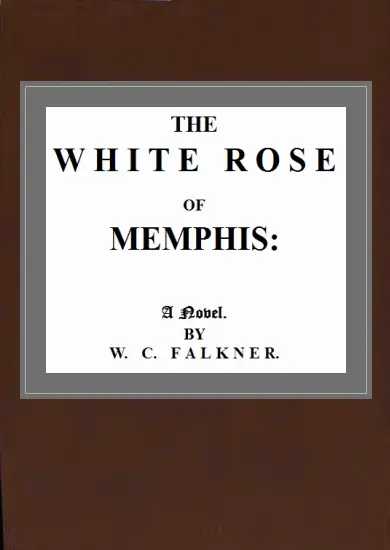
The White Rose of Memphis — digital edition cover

THE CLASSIC COLLECTION · 1881

The White Rose of Memphis

"The White Rose of Memphis" by William C. Falkner is a novel written in the late 19th century. The story centers around Captain Oliver Quitman and Samuel Brazzleman, two steamboat operators in Memphis, as they prepare for a grand inaugural trip of their newly chartered boat, the "White Rose of Memphis." The narrative elegantly unfolds the themes of adventure, romance, and the vibrant social scene of the time, promising an entertaining exploration of life on the Mississippi River." "The opening of the novel sets the stage for an exciting journey as Captain Quitman and Brazzleman discuss their plans for the steamboat's first voyage to New Orleans. They plan to make a splash with a masquerade ball aboard the boat to attract attention and fill the passenger list. As the festivities begin, the atmosphere is electric with anticipation, and various characters, all masked and adorned in splendid costumes, gather to celebrate. Amidst the excitement, a mysterious queen, who captures the interest of many attendees, piques the curiosity of the male maskers. The narrative hints at playful intrigue, romantic pursuits, and the social dynamics of the guests, leaving readers eager to discover how the festivities will unfold aboard the "White Rose."

Introduction adapted from the source catalogue; source summaries may be automatically generated.

Start reading ↓

Free to read · English · 207,018 words · No account needed

MAKE TIME FOR A GOOD BOOK

The White Rose of Memphis

On by default. Untick to stop anonymous reading totals. Each page counts after 10 seconds in view. How this works.

Anonymous counting is on unless you have switched it off.

The White Rose of Memphis

“That is all very true, but that lady is distressed about something that has happened on this boat, because she was weeping before the queen sang the sweet song. She did not go to the table at lunch, and she has been continually passing among all the passengers and apparently searching for somebody.”

“Well, I hope she will succeed in finding the individual she is looking for, if, as you think, she is really shadowing some one.”

“My lord,” said the queen, as she approached the duke, “if you will be so good as to collect our friends on the hurricane deck, we will order the Barbarian Chief to commence the relation of his little story.” The duke courtesied to the queen and immediately began to execute her commands; and it was but a few minutes until the entire party were seated on the upper deck.

The party having arranged themselves in a circle, in the center of which sat the queen in a large arm-chair, Mary bowed to Ingomar, and requested him to commence his story. Ingomar took his seat facing the queen, in a comfortable low chair which had been provided for his especial use, and began to relate the following story:

INGOMAR’S STORY.

“I was born in Nashville, Tennessee, and was six years old when my mother died. I was her only child, and, as a matter of course, was much petted and greatly beloved by her. The memory of my dear mother is as indelibly fixed on my mind as the inscription on a marble monument, though I trust that my poor heart does not in any manner resemble the cold, unfeeling marble. My father was, at the time of my mother’s death, a prosperous merchant, but from that date he began to neglect his business, and, I regret to say, commenced to spend his time at hotels and liquor saloons. I was left at home, alone with the house-maid and another servant, except what time I spent at school. I was too young to understand or realize how rapidly my father was traveling the downward road, but I soon began to notice that he was unsteady in his walk, and that he was becoming cross, and hard to please. I did not know then that he was growing fond of brandy, nor did I imagine that one whom I loved so dearly could do anything wrong. But alas, how soon was this blissful ignorance displaced by a knowledge of the awful truth! My father had been born and bred a gentleman, and, when not under the influence of brandy, was as kind and tender with me as heart could wish. The exact amount of his fortune at the date of my mother’s death I never knew, though I have since learned that it was no insignificant sum; but, as a natural result of his neglect of business, the firm became involved more and more every year, until it finally collapsed at the end of the second year after my mother’s death. When I was eight years old the servants began to talk of leaving, on account of the bad treatment which my father gave them--complaining of a neglect on his part to pay them their wages. I also frequently heard them hint of a second marriage which my father was contemplating, which, as may be imagined, gave me great uneasiness, for I had imbibed the usual prejudice felt by children against step-mothers. But if I had known then what I do now, I should have entertained very different views. If there ever was an angel on earth, my step-mother was one. I shall never forget my feelings when the house-maid informed me that my new mother would be brought home that evening. My heart felt as if it would break, and my eyes were filled with tears, as I let my young mind wander back to the happy days when I had been fondly held to my own dear mother’s bosom. While I was dreaming of the happy days that were forever gone, and occasionally shuddering at the prospect before me, my step-mother, accompanied by her two children, entered the room where I was, and without ceremony caught me in her arms and kissed me. I have never ceased to love her from that moment. She was a frail, delicate, darling little woman, with dark brown hair and expressive blue eyes, and a voice as sweet as the music of the cooing dove; and her two children were very much like her as to beauty and gentleness of disposition. Harry Wallingford, her son, was one year younger than I, and his sister, Charlotte, was one year younger than her brother. She was the very image of her mother, having the same kind of deep blue eyes, only somewhat larger, and her hair, of a bright golden hue, floated in pretty curls about her well-shaped neck and shoulders. Her skin I thought was too white, as it had rather a bloodless appearance, amounting to transparency. The eye-lashes were long, the brows likewise, which gave to the countenance something of a dreamy, thoughtful appearance. I may have been rather extravagant in making my judgment as to her personal appearance, but I thought then, and I think now, that she was the most charming little creature that I had ever beheld. Harry was a spare-built, and as I thought, rather effeminate boy, but a more manly fellow than he proved to be I never knew. He and I became bosom friends from the start, and we were both in love with Lottie. He loved her as a brother, and I worshipped her, because I could not help it, and to be candid, I never tried to help it. How was it possible for any one to associate daily with such a darling child and not love her with all his heart? Lottie seemed to permit me to love her, as if such devotion was no more than her just dues, and without making any demonstrations of affection for me. I am at a loss to know how to begin to describe Harry Wallingford, for I must say that I never had met any one before or since who possessed such a combination of peculiar traits of character as he did. Sometimes you would think he was the most cold-natured, passionless boy that ever was created, and then, when anything happened to rouse him, he would show such signs of passion as to almost frighten me, or when any cause of real sorrow would come upon him, his heart would begin to melt at once, and he would weep like a woman. There was no such feeling as jealousy between Harry and me on account of my love for his sister; being then mere children, and all intensely in love with each other. We were all sent to the same school, situated about a mile from our home. We were kept at the same school for four years, and oh, what happy years were they to me! Not a ripple of sorrow ever crossed the smooth surface of our sea of pleasure, save when my father would come home intoxicated, and then, for a time, we would collect in the garden and speak in whispers, lest he should find us. He was very kind to us when sober, but when his reason was clouded with brandy, he seemed to be jealous of the love which our mother manifested toward us, and often gave way to his passion, and abused her in a most shocking manner. Poverty began at length to make its unwelcome presence at our home, but we were too young to realize or feel its influences as our poor mother did. The servants had all left us, because my father had no money to pay their wages, and our mother was compelled to do her own work; but Lottie was as industrious as a honey bee, and assisted her mother all she could, while Harry and I did all we could to make her work light. We cultivated the garden, made the fires, and assisted Lottie to milk the cow. In fact, we made ourselves useful in every way we could, and in spite of our poverty we were very happy. I don’t think my step-mother would have married my father if she had known of his bad habits; but after the fatal step had been taken, she seemed to have made up her mind to make the best of her bad bargain. No matter how thick and heavy were the troubles that crowded on her, she always met us on our return from school with a pleasant smile; and the same love and tenderness which she bestowed on her own children were at all times extended to me. When our wardrobe began to grow scant, and our garments to become seedy and sometimes full of rents, our dear mother would work till midnight, with Lottie by her side, mending them. I would often drop my book and gaze at Lottie as she sat by the dim lamp, the golden curls falling about her shoulders, while her little fingers made the needle bob up and down with lightning speed, as she mended a rent in my old coat, and wonder if the angels in Heaven were like her. My father spent but little of his time at home, which circumstance enabled us to snatch happiness from the very bottom pit of poverty. I was deeply grieved to notice that my mother’s health was gradually declining, but I did not know then that it was the result of overwork and scanty food, coupled with the cruel treatment from my father. Neither Harry nor I had a suspicion of the true state of affairs, else we would have quit school, and gone to work in order to help support the family. When our little basket would be filled with provisions every morning by our mother before we started for school, we did not know that she was left frequently to work hard all day without a morsel for dinner. I would have worked night and day as a slave to have made her comfortable, and so would Harry; but the secret of her real condition was concealed from us until we had been at school four years, when we began to realize the situation. We at once left the school and began to seek employment, but in this attempt we were often doomed to disappointment, because we were too young to expect to get situations as clerks, and not strong enough to do much at manual labor. Harry was one of those persevering, tenacious kind of boys that never abandon anything they undertake, and, although he was younger than I, he was the leader in all our enterprises. He was self-reliant, energetic and hopeful. I was the reverse of that, and I could not accomplish anything except when I was encouraged and led by him. I therefore submitted to his leadership, and followed him from place to place seeking employment. Sometimes we would manage to secure several little profitable jobs during the day, and every cent we got was handed over to our mother. Then some days we would traverse the streets from early morning until night without finding any work to do, and when this would happen our scanty supply of provisions would grow more scant, until we found the wolf at our very door. I do not know how my father managed to obtain his meals, for he scarcely ever came home, and when he did come he was so much overcome with brandy that he would fall down on a bed and sleep for many hours, then rise and go straight to the nearest whisky shop. It was about six months after we were compelled to quit school that a strange-looking man, with red nose, and bloated face, and very shabbily dressed, staggered into our house, and informed my mother that her husband had fallen from a second-story window and broken his neck. I learned that my father had been carousing with a gang of disreputable men in the second story of a drinking and gambling house, and had staggered through the window, falling head-foremost on the stone pavement below. His neck was dislocated, his head and face mangled, and he was quite dead when his drunken companions went to him. This dreadful ending of my poor father’s life gave my mother such a shock that she was compelled to take to her bed, from which she never rose again. It was not quite a month after my father’s remains were deposited in the grave when my darling step-mother’s gentle spirit went to its eternal home. The last days of her life were not days of suffering, as is usual in such cases, for she informed her weeping children that she was perfectly free from pain.

Your reading position is saved on this browser. Take it to another device with a library code. Reading pages adapt to text, rather than matching a printed edition.

BEHIND THE WORDS

About William C. (Clark) Falkner

William C. (Clark) Falkner (1825–1889). Explore The White Rose of Memphis in this collection. These books span adventure, classic fiction, romance.

Explore this author’s books →

THE READERS’ VERDICT

How did this story stay with you?

Not rated yet
Your rating for The White Rose of Memphis

Be the first to share your verdict.

One rating per browser, which you can change or remove. A necessary browser identifier remembers your vote. How ratings work

A GOOD STORY DESERVES COMPANY

Pass this book along.

A great read is even better when it’s shared.

SEND A LITTLE INSPIRATION

Share this book

BEHIND THE BOOK

Edition & source details.

Title
The White Rose of Memphis
Author
William C. (Clark) Falkner
Publication year
1881
Digital edition publisher
Project Gutenberg
Gutenberg release date
2012-10-21
Language
English
Source edition imprint
Not stated in source catalogue
Source identifier
Project Gutenberg #41134
Contributors
No additional named contributors in source metadata

Public-domain source & licence

This eBook is for the use of anyone anywhere in the United States and most other parts of the world at no cost and with almost no restrictions whatsoever. You may copy it, give it away or re-use it under the terms of the Project Gutenberg License included with this eBook or online at www.gutenberg.org. If you are not located in the United States, you will have to check the laws of the country where you are located before using this eBook. Read the source licence.

Full source licence and obtaining an original copy

The original source file, including credits and licence, is retained by this library. Request an original-format copy at no charge. Please include the book title and Project Gutenberg identifier #41134.

the full Project Gutenberg License must appear
prominently whenever any copy of a Project Gutenberg work (any work
on which the phrase “Project Gutenberg” appears, or with which the
phrase “Project Gutenberg” is associated) is accessed, displayed,
performed, viewed, copied or distributed:

This eBook is for the use of anyone anywhere in the United States and most
other parts of the world at no cost and with almost no restrictions
whatsoever. You may copy it, give it away or re-use it under the terms
of the Project Gutenberg™ License included with this eBook or online
at www.gutenberg.org. If you
are not located in the United States, you will have to check the laws
of the country where you are located before using this eBook.

1.E.2. If an individual Project Gutenberg electronic work is
derived from texts not protected by U.S. copyright law (does not
contain a notice indicating that it is posted with permission of the
copyright holder), the work can be copied and distributed to anyone in
the United States without paying any fees or charges. If you are
redistributing or providing access to a work with the phrase “Project
Gutenberg” associated with or appearing on the work, you must comply
either with the requirements of paragraphs 1.E.1 through 1.E.7 or
obtain permission for the use of the work and the Project Gutenberg
trademark as set forth in paragraphs 1.E.8 or 1.E.9.

1.E.3. If an individual Project Gutenberg electronic work is posted
with the permission of the copyright holder, your use and distribution
must comply with both paragraphs 1.E.1 through 1.E.7 and any
additional terms imposed by the copyright holder. Additional terms
will be linked to the Project Gutenberg License for all works
posted with the permission of the copyright holder found at the
beginning of this work.

1.E.4. Do not unlink or detach or remove the full Project Gutenberg
License terms from this work, or any files containing a part of this
work or any other work associated with Project Gutenberg.

1.E.5. Do not copy, display, perform, distribute or redistribute this
electronic work, or any part of this electronic work, without
prominently displaying the sentence set forth in paragraph 1.E.1 with
active links or immediate access to the full terms of the Project
Gutenberg License.

1.E.6. You may convert to and distribute this work in any binary,
compressed, marked up, nonproprietary or proprietary form, including
any word processing or hypertext form. However, if you provide access
to or distribute copies of a Project Gutenberg work in a format
other than “Plain Vanilla ASCII” or other format used in the official
version posted on the official Project Gutenberg website
(www.gutenberg.org), you must, at no additional cost, fee or expense
to the user, provide a copy, a means of exporting a copy, or a means
of obtaining a copy upon request, of the work in its original “Plain
Vanilla ASCII” or other form. Any alternate format must include the
full Project Gutenberg License as specified in paragraph 1.E.1.

1.E.7. Do not charge a fee for access to, viewing, displaying,
performing, copying or distributing any Project Gutenberg works
unless you comply with paragraph 1.E.8 or 1.E.9.

1.E.8. You may charge a reasonable fee for copies of or providing
access to or distributing Project Gutenberg electronic works
provided that:

• You pay a royalty fee of 20% of the gross profits you derive from
the use of Project Gutenberg works calculated using the method
you already use to calculate your applicable taxes. The fee is owed
to the owner of the Project Gutenberg trademark, but he has
agreed to donate royalties under this paragraph to the Project
Gutenberg Literary Archive Foundation. Royalty payments must be paid
within 60 days following each date on which you prepare (or are
legally required to prepare) your periodic tax returns. Royalty
payments should be clearly marked as such and sent to the Project
Gutenberg Literary Archive Foundation at the address specified in
Section 4, “Information about donations to the Project Gutenberg
Literary Archive Foundation.”

• You provide a full refund of any money paid by a user who notifies
you in writing (or by e-mail) within 30 days of receipt that s/he
does not agree to the terms of the full Project Gutenberg™
License. You must require such a user to return or destroy all
copies of the works possessed in a physical medium and discontinue
all use of and all access to other copies of Project Gutenberg™
works.

• You provide, in accordance with paragraph 1.F.3, a full refund of
any money paid for a work or a replacement copy, if a defect in the
electronic work is discovered and reported to you within 90 days of
receipt of the work.

• You comply with all other terms of this agreement for free
distribution of Project Gutenberg™ works.


1.E.9. If you wish to charge a fee or distribute a Project
Gutenberg™ electronic work or group of works on different terms than
are set forth in this agreement, you must obtain permission in writing
from the Project Gutenberg Literary Archive Foundation, the manager of
the Project Gutenberg™ trademark. Contact the Foundation as set
forth in Section 3 below.

1.F.

1.F.1. Project Gutenberg volunteers and employees expend considerable
effort to identify, do copyright research on, transcribe and proofread
works not protected by U.S. copyright law in creating the Project
Gutenberg™ collection. Despite these efforts, Project Gutenberg™
electronic works, and the medium on which they may be stored, may
contain “Defects,” such as, but not limited to, incomplete, inaccurate
or corrupt data, transcription errors, a copyright or other
intellectual property infringement, a defective or damaged disk or
other medium, a computer virus, or computer codes that damage or
cannot be read by your equipment.

1.F.2. LIMITED WARRANTY, DISCLAIMER OF DAMAGES - Except for the “Right
of Replacement or Refund” described in paragraph 1.F.3, the Project
Gutenberg Literary Archive Foundation, the owner of the Project
Gutenberg™ trademark, and any other party distributing a Project
Gutenberg™ electronic work under this agreement, disclaim all
liability to you for damages, costs and expenses, including legal
fees. YOU AGREE THAT YOU HAVE NO REMEDIES FOR NEGLIGENCE, STRICT
LIABILITY, BREACH OF WARRANTY OR BREACH OF CONTRACT EXCEPT THOSE
PROVIDED IN PARAGRAPH 1.F.3. YOU AGREE THAT THE FOUNDATION, THE
TRADEMARK OWNER, AND ANY DISTRIBUTOR UNDER THIS AGREEMENT WILL NOT BE
LIABLE TO YOU FOR ACTUAL, DIRECT, INDIRECT, CONSEQUENTIAL, PUNITIVE OR
INCIDENTAL DAMAGES EVEN IF YOU GIVE NOTICE OF THE POSSIBILITY OF SUCH
DAMAGE.

1.F.3. LIMITED RIGHT OF REPLACEMENT OR REFUND - If you discover a
defect in this electronic work within 90 days of receiving it, you can
receive a refund of the money (if any) you paid for it by sending a
written explanation to the person you received the work from. If you
received the work on a physical medium, you must return the medium
with your written explanation. The person or entity that provided you
with the defective work may elect to provide a replacement copy in
lieu of a refund. If you received the work electronically, the person
or entity providing it to you may choose to give you a second
opportunity to receive the work electronically in lieu of a refund. If
the second copy is also defective, you may demand a refund in writing
without further opportunities to fix the problem.

1.F.4. Except for the limited right of replacement or refund set forth
in paragraph 1.F.3, this work is provided to you ‘AS-IS’, WITH NO
OTHER WARRANTIES OF ANY KIND, EXPRESS OR IMPLIED, INCLUDING BUT NOT
LIMITED TO WARRANTIES OF MERCHANTABILITY OR FITNESS FOR ANY PURPOSE.

1.F.5. Some states do not allow disclaimers of certain implied
warranties or the exclusion or limitation of certain types of
damages. If any disclaimer or limitation set forth in this agreement
violates the law of the state applicable to this agreement, the
agreement shall be interpreted to make the maximum disclaimer or
limitation permitted by the applicable state law. The invalidity or
unenforceability of any provision of this agreement shall not void the
remaining provisions.

1.F.6. INDEMNITY - You agree to indemnify and hold the Foundation, the
trademark owner, any agent or employee of the Foundation, anyone
providing copies of Project Gutenberg™ electronic works in
accordance with this agreement, and any volunteers associated with the
production, promotion and distribution of Project Gutenberg™
electronic works, harmless from all liability, costs and expenses,
including legal fees, that arise directly or indirectly from any of
the following which you do or cause to occur: (a) distribution of this
or any Project Gutenberg work, (b) alteration, modification, or
additions or deletions to any Project Gutenberg work, and (c) any
Defect you cause.

Section 2. Information about the Mission of Project Gutenberg

Project Gutenberg is synonymous with the free distribution of
electronic works in formats readable by the widest variety of
computers including obsolete, old, middle-aged and new computers. It
exists because of the efforts of hundreds of volunteers and donations
from people in all walks of life.

Volunteers and financial support to provide volunteers with the
assistance they need are critical to reaching Project Gutenberg’s
goals and ensuring that the Project Gutenberg collection will
remain freely available for generations to come. In 2001, the Project
Gutenberg Literary Archive Foundation was created to provide a secure
and permanent future for Project Gutenberg and future
generations. To learn more about the Project Gutenberg Literary
Archive Foundation and how your efforts and donations can help, see
Sections 3 and 4 and the Foundation information page at www.gutenberg.org.

Section 3. Information about the Project Gutenberg Literary Archive Foundation

The Project Gutenberg Literary Archive Foundation is a non-profit
501(c)(3) educational corporation organized under the laws of the
state of Mississippi and granted tax exempt status by the Internal
Revenue Service. The Foundation’s EIN or federal tax identification
number is 64-6221541. Contributions to the Project Gutenberg Literary
Archive Foundation are tax deductible to the full extent permitted by
U.S. federal laws and your state’s laws.

The Foundation’s business office is located at 41 Watchung Plaza #516,
Montclair NJ 07042, USA, +1 (862) 621-9288. Email contact links and up
to date contact information can be found at the Foundation’s website
and official page at www.gutenberg.org/contact

Section 4. Information about Donations to the Project Gutenberg
Literary Archive Foundation

Project Gutenberg™ depends upon and cannot survive without widespread
public support and donations to carry out its mission of
increasing the number of public domain and licensed works that can be
freely distributed in machine-readable form accessible by the widest
array of equipment including outdated equipment. Many small donations
($1 to $5,000) are particularly important to maintaining tax exempt
status with the IRS.

The Foundation is committed to complying with the laws regulating
charities and charitable donations in all 50 states of the United
States. Compliance requirements are not uniform and it takes a
considerable effort, much paperwork and many fees to meet and keep up
with these requirements. We do not solicit donations in locations
where we have not received written confirmation of compliance. To SEND
DONATIONS or determine the status of compliance for any particular state
visit www.gutenberg.org/donate.

While we cannot and do not solicit contributions from states where we
have not met the solicitation requirements, we know of no prohibition
against accepting unsolicited donations from donors in such states who
approach us with offers to donate.

International donations are gratefully accepted, but we cannot make
any statements concerning tax treatment of donations received from
outside the United States. U.S. laws alone swamp our small staff.

Please check the Project Gutenberg web pages for current donation
methods and addresses. Donations are accepted in a number of other
ways including checks, online payments and credit card donations. To
donate, please visit: www.gutenberg.org/donate.

Section 5. General Information About Project Gutenberg electronic works

Professor Michael S. Hart was the originator of the Project
Gutenberg concept of a library of electronic works that could be
freely shared with anyone. For forty years, he produced and
distributed Project Gutenberg eBooks with only a loose network of
volunteer support.

Project Gutenberg eBooks are often created from several printed
editions, all of which are confirmed as not protected by copyright in
the U.S. unless a copyright notice is included. Thus, we do not
necessarily keep eBooks in compliance with any particular paper
edition.

Most people start at our website which has the main PG search
facility: www.gutenberg.org.

This website includes information about Project Gutenberg,
including how to make donations to the Project Gutenberg Literary
Archive Foundation, how to help produce our new eBooks, and how to
subscribe to our email newsletter to hear about new eBooks.


KEEP YOUR CURIOSITY GOING

Your next chapter awaits.