READ · DISCOVER · ENJOYClassic literature · Always free
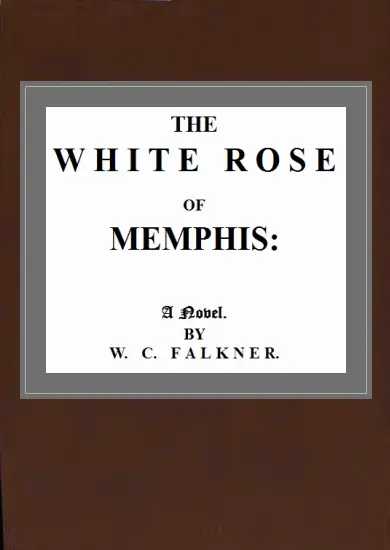
The White Rose of Memphis — digital edition cover

THE CLASSIC COLLECTION · 1881

The White Rose of Memphis

"The White Rose of Memphis" by William C. Falkner is a novel written in the late 19th century. The story centers around Captain Oliver Quitman and Samuel Brazzleman, two steamboat operators in Memphis, as they prepare for a grand inaugural trip of their newly chartered boat, the "White Rose of Memphis." The narrative elegantly unfolds the themes of adventure, romance, and the vibrant social scene of the time, promising an entertaining exploration of life on the Mississippi River." "The opening of the novel sets the stage for an exciting journey as Captain Quitman and Brazzleman discuss their plans for the steamboat's first voyage to New Orleans. They plan to make a splash with a masquerade ball aboard the boat to attract attention and fill the passenger list. As the festivities begin, the atmosphere is electric with anticipation, and various characters, all masked and adorned in splendid costumes, gather to celebrate. Amidst the excitement, a mysterious queen, who captures the interest of many attendees, piques the curiosity of the male maskers. The narrative hints at playful intrigue, romantic pursuits, and the social dynamics of the guests, leaving readers eager to discover how the festivities will unfold aboard the "White Rose."

Introduction adapted from the source catalogue; source summaries may be automatically generated.

Start reading ↓

Free to read · English · 207,018 words · No account needed

MAKE TIME FOR A GOOD BOOK

The White Rose of Memphis

On by default. Untick to stop anonymous reading totals. Each page counts after 10 seconds in view. How this works.

Anonymous counting is on unless you have switched it off.

The White Rose of Memphis

“Well, sure enough, she did wake up, and it was no halfway business, either--it was what you call a wide-awake sensation. The mustard began to heat her up, the emetic commenced business, the hot bricks got up steam--in fact, the skirmish commenced all along the line; but when the pill brigade made the charge, the engagement became general--the contest was hot and loud, and the drugs won the victory, and Miss Tadpoddle was saved--so completely cured that she never has been very ill since. My reputation as a first-class physician was then permanently established, because Miss Tadpoddle’s tongue was a better advertising medium than the New York Herald. She was president of the Tramp Reform Association; then she was a working member of many other benevolent associations. She made it her daily business to speak of my vigorous style of practice. I was certainly well prepared to treat any disease, because the experiments I had made on Miss Tadpoddle had enabled me to test the qualities of all the drugs known to the profession.

“It was somewhere about ten days after my treatment of Miss Tadpoddle’s case when she again sent for me. I found her in bed--and when I say in bed, I mean it. She was not propped up with pillows, as she was when I first visited her, but she was flat on the bed. The truth is, I had so completely taken the starch out of her that she couldn’t sit up.

“‘How do you feel this morning, Miss Tadpoddle?’ I inquired, pretending to be interested about her case.

“‘Oh, I am so weak, doctor; but for that, I would be very well. I did not send for you with a view of taking more medicine--no, no, indeed! I don’t think I ever shall need any more as long as I live. I merely wished to speak with you about Miss Bramlett’s case. I presume that my brother has told you of the valuable assistance I have rendered him? Very well; I have something more to say to you on that subject. I fear you will find that Miss Bramlett is a very bad woman. I confess I never had much faith in her at first. She was too proud, too cold-hearted--made too much display with her money. She was parading the streets continually, pretending to be assisting the poor, but evidently trying to create a sensation. One day I met her at the Widow Spratt’s house, and would you believe it, sir, she was dressed within an inch of her life! She had on a blue silk dress, with real lace trimmings--and, by the by, that was the identical dress she wore that night when I saw her go into Ben Bowles’ apartments, through the private entrance that opens from the alley. But I am going too fast.--I was telling you about meeting Miss Bramlett at Widow Spratt’s. Well, sir, she was sitting on a low truckle-bed, feeding the baby with condensed milk. It was the dirtiest, sickliest-looking thing I ever laid eyes on; and the other five children were cramming themselves with cold bread and turkey that Miss Bramlett had given them; and they were covered with dirty rags, just like the baby. Mrs. Spratt is the poorest manager I ever saw. Her children are half naked and starved. I was really vexed at Miss Bramlett for throwing away her money on such worthless people. Old Spratt was always drunk, and wouldn’t work. He fell overboard from a steam-boat and was drowned; it was a great pity he didn’t die ten years ago. His children are lazy, good-for-nothing brats, and ought to starve. Miss Bramlett has been supporting the whole family since old Spratt died. Mrs. Spratt, she lies in bed the live-long day, pretending to be sick, but it is pure laziness; and if Miss Bramlett would let her alone, she would have to get up and work, or starve. Well, there are many other families in this city depending on Miss Bramlett’s money for support. It’s a scandal and a shame that such laziness should be encouraged. Let ‘em work, or starve, is my motto. I asked Mrs. Spratt to subscribe something to our Tramp Reform Association, and she wouldn’t give a cent. I begged Miss Bramlett to help us, and she turned up her nose and absolutely sneered in my face--a hateful hussy! but I ought not to talk so, because I never bear malice against my neighbors; it is my character not to nurse ill-will--“Forgive those who trespass against us,” is my motto--this is what our Saviour taught us. There is Lottie Wallingford, who thinks the world and all of Miss Bramlett. I wonder how she will feel when she sees her friend hung for murder? Her brother was engaged to be married to Miss Bramlett when the murder was committed; but they say he has run away to California and left his affianced bride here to be hung, while he goes to get his uncle’s great fortune. Of course that will make honors easy--he loses his sweetheart, but wins a fortune. That ought to console him, at any rate. They say you are taking on about Lottie Wallingford. Doctor, she would no doubt make you a good wife, if she wasn’t so much like old Rockland--always talking about books and book-learning. She knows too much; I don’t like so much genius. I like business. It is my character to despise poetry. I hate these dreamy, sentimental women who can memorize a whole book and then repeat it in public. I hate these silly women who sing nothing but sentimental songs. They are always talking about sweet flowers, sweet poetry, sweet birds, sweet scenery, sweet music--everything is sweet with them. I hate sweet things; it is my character to hate sweet things. She and Miss Bramlett have converted the jail into a picture gallery, concert hall and book library. For my part, I don’t see how the jailer puts up with such doings. The idea that a murderess in jail, awaiting her trial, should be painting pictures, reading poetry and playing the guitar surpasses my comprehension. She had better be reading her Bible or prayer-book, and making preparations to meet her God, for she is certain to be hung. I know enough myself to hang her, and I mean to tell it. I saw her with my own eyes when she went into the apartments of that gambler, at the dark hour of night. You see I had my suspicions about her, anyway, and when I saw her meet Bowles in the garden that night I concluded that some deviltry was going on, and determined to watch her. I have the advantage you see, doctor, over other women--it is no trouble for me to disguise myself. I am very tall, you perceive, and my brother’s clothes fit me to a T. I made it my business to waylay Mr. Ragland’s premises every night until I succeeded in accomplishing my object. One night about eight o’clock I saw Miss Bramlett go out of the house by the back way and walk cautiously toward the rear side of the garden. I was concealed among the shrubbery, and saw her coming directly toward the spot where I was. She, however, turned to the left, passing within ten paces of me. She appeared to be looking for some one, for she stopped near me and waited for several minutes; then she turned square off to the right and entered the summer-house by the back door. I think she stayed in the summer-house about ten minutes; at any rate, she remained in it until I began to grow restless, and was thinking of trying to slip around to the front door, so as to enable me to see whether or not she was alone. I noticed that she had her face covered with a veil, but I knew her by the dress and shawl she wore--the same she had on the time I met her at the Widow Spratt’s. When she came out of the summer-house, she went in the direction of the carriage-house, which you know is east of the former, and about forty yards from it. She passed on without halting, until she reached the extreme back part of the garden. She paused and looked around in every direction, as if trying to ascertain whether or not any one was watching her. But she did not see me; I was too sharp to be caught that way. I am not one of those sap-heads that you have heard so much about. In fact, I hate sap-headed women--it is my character to hate ’em; and as to sap-headed men, they ought not to be permitted to live. But here I am again straggling off from the subject. I beg you to excuse me, doctor; you know I am quite weak yet--indeed I am. It is astonishing to me that I am able to utter a word. Your medicine cured my complaints, it is true, but left me completely prostrated. I don’t think I ever shall need any more drugs. But I declare, I must quit wandering off that way. I wouldn’t do it, I know, but I am afraid the strong medicine has, to some extent, weakened my mind. Everything seems like a dream. Do you ever dream, doctor? No? Ah, then, you don’t appreciate them. Where one’s dreams are pleasant, one enjoys the sensation very much; but when the stomach’s out of order, one is sure to have unpleasant dreams. Oh! I had such a nice dream last night! I thought that I was--but what do you care about my dreams? I suppose you want me to finish my narrative about Miss Bramlett’s movements.’

Your reading position is saved on this browser. Take it to another device with a library code. Reading pages adapt to text, rather than matching a printed edition.

BEHIND THE WORDS

About William C. (Clark) Falkner

William C. (Clark) Falkner (1825–1889). Explore The White Rose of Memphis in this collection. These books span adventure, classic fiction, romance.

Explore this author’s books →

THE READERS’ VERDICT

How did this story stay with you?

Not rated yet
Your rating for The White Rose of Memphis

Be the first to share your verdict.

One rating per browser, which you can change or remove. A necessary browser identifier remembers your vote. How ratings work

A GOOD STORY DESERVES COMPANY

Pass this book along.

A great read is even better when it’s shared.

SEND A LITTLE INSPIRATION

Share this book

BEHIND THE BOOK

Edition & source details.

Title
The White Rose of Memphis
Author
William C. (Clark) Falkner
Publication year
1881
Digital edition publisher
Project Gutenberg
Gutenberg release date
2012-10-21
Language
English
Source edition imprint
Not stated in source catalogue
Source identifier
Project Gutenberg #41134
Contributors
No additional named contributors in source metadata

Public-domain source & licence

This eBook is for the use of anyone anywhere in the United States and most other parts of the world at no cost and with almost no restrictions whatsoever. You may copy it, give it away or re-use it under the terms of the Project Gutenberg License included with this eBook or online at www.gutenberg.org. If you are not located in the United States, you will have to check the laws of the country where you are located before using this eBook. Read the source licence.

Full source licence and obtaining an original copy

The original source file, including credits and licence, is retained by this library. Request an original-format copy at no charge. Please include the book title and Project Gutenberg identifier #41134.

the full Project Gutenberg License must appear
prominently whenever any copy of a Project Gutenberg work (any work
on which the phrase “Project Gutenberg” appears, or with which the
phrase “Project Gutenberg” is associated) is accessed, displayed,
performed, viewed, copied or distributed:

This eBook is for the use of anyone anywhere in the United States and most
other parts of the world at no cost and with almost no restrictions
whatsoever. You may copy it, give it away or re-use it under the terms
of the Project Gutenberg™ License included with this eBook or online
at www.gutenberg.org. If you
are not located in the United States, you will have to check the laws
of the country where you are located before using this eBook.

1.E.2. If an individual Project Gutenberg electronic work is
derived from texts not protected by U.S. copyright law (does not
contain a notice indicating that it is posted with permission of the
copyright holder), the work can be copied and distributed to anyone in
the United States without paying any fees or charges. If you are
redistributing or providing access to a work with the phrase “Project
Gutenberg” associated with or appearing on the work, you must comply
either with the requirements of paragraphs 1.E.1 through 1.E.7 or
obtain permission for the use of the work and the Project Gutenberg
trademark as set forth in paragraphs 1.E.8 or 1.E.9.

1.E.3. If an individual Project Gutenberg electronic work is posted
with the permission of the copyright holder, your use and distribution
must comply with both paragraphs 1.E.1 through 1.E.7 and any
additional terms imposed by the copyright holder. Additional terms
will be linked to the Project Gutenberg License for all works
posted with the permission of the copyright holder found at the
beginning of this work.

1.E.4. Do not unlink or detach or remove the full Project Gutenberg
License terms from this work, or any files containing a part of this
work or any other work associated with Project Gutenberg.

1.E.5. Do not copy, display, perform, distribute or redistribute this
electronic work, or any part of this electronic work, without
prominently displaying the sentence set forth in paragraph 1.E.1 with
active links or immediate access to the full terms of the Project
Gutenberg License.

1.E.6. You may convert to and distribute this work in any binary,
compressed, marked up, nonproprietary or proprietary form, including
any word processing or hypertext form. However, if you provide access
to or distribute copies of a Project Gutenberg work in a format
other than “Plain Vanilla ASCII” or other format used in the official
version posted on the official Project Gutenberg website
(www.gutenberg.org), you must, at no additional cost, fee or expense
to the user, provide a copy, a means of exporting a copy, or a means
of obtaining a copy upon request, of the work in its original “Plain
Vanilla ASCII” or other form. Any alternate format must include the
full Project Gutenberg License as specified in paragraph 1.E.1.

1.E.7. Do not charge a fee for access to, viewing, displaying,
performing, copying or distributing any Project Gutenberg works
unless you comply with paragraph 1.E.8 or 1.E.9.

1.E.8. You may charge a reasonable fee for copies of or providing
access to or distributing Project Gutenberg electronic works
provided that:

• You pay a royalty fee of 20% of the gross profits you derive from
the use of Project Gutenberg works calculated using the method
you already use to calculate your applicable taxes. The fee is owed
to the owner of the Project Gutenberg trademark, but he has
agreed to donate royalties under this paragraph to the Project
Gutenberg Literary Archive Foundation. Royalty payments must be paid
within 60 days following each date on which you prepare (or are
legally required to prepare) your periodic tax returns. Royalty
payments should be clearly marked as such and sent to the Project
Gutenberg Literary Archive Foundation at the address specified in
Section 4, “Information about donations to the Project Gutenberg
Literary Archive Foundation.”

• You provide a full refund of any money paid by a user who notifies
you in writing (or by e-mail) within 30 days of receipt that s/he
does not agree to the terms of the full Project Gutenberg™
License. You must require such a user to return or destroy all
copies of the works possessed in a physical medium and discontinue
all use of and all access to other copies of Project Gutenberg™
works.

• You provide, in accordance with paragraph 1.F.3, a full refund of
any money paid for a work or a replacement copy, if a defect in the
electronic work is discovered and reported to you within 90 days of
receipt of the work.

• You comply with all other terms of this agreement for free
distribution of Project Gutenberg™ works.


1.E.9. If you wish to charge a fee or distribute a Project
Gutenberg™ electronic work or group of works on different terms than
are set forth in this agreement, you must obtain permission in writing
from the Project Gutenberg Literary Archive Foundation, the manager of
the Project Gutenberg™ trademark. Contact the Foundation as set
forth in Section 3 below.

1.F.

1.F.1. Project Gutenberg volunteers and employees expend considerable
effort to identify, do copyright research on, transcribe and proofread
works not protected by U.S. copyright law in creating the Project
Gutenberg™ collection. Despite these efforts, Project Gutenberg™
electronic works, and the medium on which they may be stored, may
contain “Defects,” such as, but not limited to, incomplete, inaccurate
or corrupt data, transcription errors, a copyright or other
intellectual property infringement, a defective or damaged disk or
other medium, a computer virus, or computer codes that damage or
cannot be read by your equipment.

1.F.2. LIMITED WARRANTY, DISCLAIMER OF DAMAGES - Except for the “Right
of Replacement or Refund” described in paragraph 1.F.3, the Project
Gutenberg Literary Archive Foundation, the owner of the Project
Gutenberg™ trademark, and any other party distributing a Project
Gutenberg™ electronic work under this agreement, disclaim all
liability to you for damages, costs and expenses, including legal
fees. YOU AGREE THAT YOU HAVE NO REMEDIES FOR NEGLIGENCE, STRICT
LIABILITY, BREACH OF WARRANTY OR BREACH OF CONTRACT EXCEPT THOSE
PROVIDED IN PARAGRAPH 1.F.3. YOU AGREE THAT THE FOUNDATION, THE
TRADEMARK OWNER, AND ANY DISTRIBUTOR UNDER THIS AGREEMENT WILL NOT BE
LIABLE TO YOU FOR ACTUAL, DIRECT, INDIRECT, CONSEQUENTIAL, PUNITIVE OR
INCIDENTAL DAMAGES EVEN IF YOU GIVE NOTICE OF THE POSSIBILITY OF SUCH
DAMAGE.

1.F.3. LIMITED RIGHT OF REPLACEMENT OR REFUND - If you discover a
defect in this electronic work within 90 days of receiving it, you can
receive a refund of the money (if any) you paid for it by sending a
written explanation to the person you received the work from. If you
received the work on a physical medium, you must return the medium
with your written explanation. The person or entity that provided you
with the defective work may elect to provide a replacement copy in
lieu of a refund. If you received the work electronically, the person
or entity providing it to you may choose to give you a second
opportunity to receive the work electronically in lieu of a refund. If
the second copy is also defective, you may demand a refund in writing
without further opportunities to fix the problem.

1.F.4. Except for the limited right of replacement or refund set forth
in paragraph 1.F.3, this work is provided to you ‘AS-IS’, WITH NO
OTHER WARRANTIES OF ANY KIND, EXPRESS OR IMPLIED, INCLUDING BUT NOT
LIMITED TO WARRANTIES OF MERCHANTABILITY OR FITNESS FOR ANY PURPOSE.

1.F.5. Some states do not allow disclaimers of certain implied
warranties or the exclusion or limitation of certain types of
damages. If any disclaimer or limitation set forth in this agreement
violates the law of the state applicable to this agreement, the
agreement shall be interpreted to make the maximum disclaimer or
limitation permitted by the applicable state law. The invalidity or
unenforceability of any provision of this agreement shall not void the
remaining provisions.

1.F.6. INDEMNITY - You agree to indemnify and hold the Foundation, the
trademark owner, any agent or employee of the Foundation, anyone
providing copies of Project Gutenberg™ electronic works in
accordance with this agreement, and any volunteers associated with the
production, promotion and distribution of Project Gutenberg™
electronic works, harmless from all liability, costs and expenses,
including legal fees, that arise directly or indirectly from any of
the following which you do or cause to occur: (a) distribution of this
or any Project Gutenberg work, (b) alteration, modification, or
additions or deletions to any Project Gutenberg work, and (c) any
Defect you cause.

Section 2. Information about the Mission of Project Gutenberg

Project Gutenberg is synonymous with the free distribution of
electronic works in formats readable by the widest variety of
computers including obsolete, old, middle-aged and new computers. It
exists because of the efforts of hundreds of volunteers and donations
from people in all walks of life.

Volunteers and financial support to provide volunteers with the
assistance they need are critical to reaching Project Gutenberg’s
goals and ensuring that the Project Gutenberg collection will
remain freely available for generations to come. In 2001, the Project
Gutenberg Literary Archive Foundation was created to provide a secure
and permanent future for Project Gutenberg and future
generations. To learn more about the Project Gutenberg Literary
Archive Foundation and how your efforts and donations can help, see
Sections 3 and 4 and the Foundation information page at www.gutenberg.org.

Section 3. Information about the Project Gutenberg Literary Archive Foundation

The Project Gutenberg Literary Archive Foundation is a non-profit
501(c)(3) educational corporation organized under the laws of the
state of Mississippi and granted tax exempt status by the Internal
Revenue Service. The Foundation’s EIN or federal tax identification
number is 64-6221541. Contributions to the Project Gutenberg Literary
Archive Foundation are tax deductible to the full extent permitted by
U.S. federal laws and your state’s laws.

The Foundation’s business office is located at 41 Watchung Plaza #516,
Montclair NJ 07042, USA, +1 (862) 621-9288. Email contact links and up
to date contact information can be found at the Foundation’s website
and official page at www.gutenberg.org/contact

Section 4. Information about Donations to the Project Gutenberg
Literary Archive Foundation

Project Gutenberg™ depends upon and cannot survive without widespread
public support and donations to carry out its mission of
increasing the number of public domain and licensed works that can be
freely distributed in machine-readable form accessible by the widest
array of equipment including outdated equipment. Many small donations
($1 to $5,000) are particularly important to maintaining tax exempt
status with the IRS.

The Foundation is committed to complying with the laws regulating
charities and charitable donations in all 50 states of the United
States. Compliance requirements are not uniform and it takes a
considerable effort, much paperwork and many fees to meet and keep up
with these requirements. We do not solicit donations in locations
where we have not received written confirmation of compliance. To SEND
DONATIONS or determine the status of compliance for any particular state
visit www.gutenberg.org/donate.

While we cannot and do not solicit contributions from states where we
have not met the solicitation requirements, we know of no prohibition
against accepting unsolicited donations from donors in such states who
approach us with offers to donate.

International donations are gratefully accepted, but we cannot make
any statements concerning tax treatment of donations received from
outside the United States. U.S. laws alone swamp our small staff.

Please check the Project Gutenberg web pages for current donation
methods and addresses. Donations are accepted in a number of other
ways including checks, online payments and credit card donations. To
donate, please visit: www.gutenberg.org/donate.

Section 5. General Information About Project Gutenberg electronic works

Professor Michael S. Hart was the originator of the Project
Gutenberg concept of a library of electronic works that could be
freely shared with anyone. For forty years, he produced and
distributed Project Gutenberg eBooks with only a loose network of
volunteer support.

Project Gutenberg eBooks are often created from several printed
editions, all of which are confirmed as not protected by copyright in
the U.S. unless a copyright notice is included. Thus, we do not
necessarily keep eBooks in compliance with any particular paper
edition.

Most people start at our website which has the main PG search
facility: www.gutenberg.org.

This website includes information about Project Gutenberg,
including how to make donations to the Project Gutenberg Literary
Archive Foundation, how to help produce our new eBooks, and how to
subscribe to our email newsletter to hear about new eBooks.


KEEP YOUR CURIOSITY GOING

Your next chapter awaits.