THE CLASSIC COLLECTION✦A dead man’s diaryCLASSIC FREE BOOKS
A dead man’s diary
Coulson Kernahan
THE CLASSIC COLLECTION · 1881
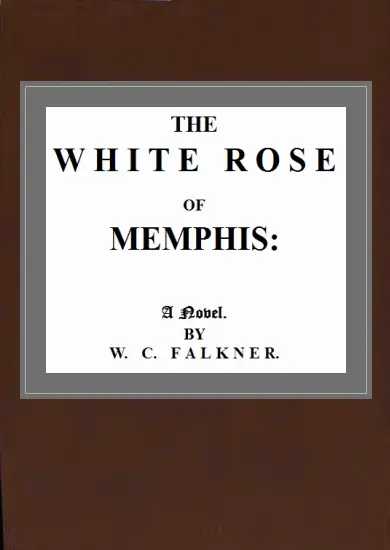
"The White Rose of Memphis" by William C. Falkner is a novel written in the late 19th century. The story centers around Captain Oliver Quitman and Samuel Brazzleman, two steamboat operators in Memphis, as they prepare for a grand inaugural trip of their newly chartered boat, the "White Rose of Memphis." The narrative elegantly unfolds the themes of adventure, romance, and the vibrant social scene of the time, promising an entertaining exploration of life on the Mississippi River." "The opening of the novel sets the stage for an exciting journey as Captain Quitman and Brazzleman discuss their plans for the steamboat's first voyage to New Orleans. They plan to make a splash with a masquerade ball aboard the boat to attract attention and fill the passenger list. As the festivities begin, the atmosphere is electric with anticipation, and various characters, all masked and adorned in splendid costumes, gather to celebrate. Amidst the excitement, a mysterious queen, who captures the interest of many attendees, piques the curiosity of the male maskers. The narrative hints at playful intrigue, romantic pursuits, and the social dynamics of the guests, leaving readers eager to discover how the festivities will unfold aboard the "White Rose."
Introduction adapted from the source catalogue; source summaries may be automatically generated.
Free to read · English · 207,018 words · No account needed
MAKE TIME FOR A GOOD BOOK
On by default. Untick to stop anonymous reading totals. Each page counts after 10 seconds in view. How this works.
Anonymous counting is on unless you have switched it off.
“‘DEAR ED--Come home as quickly as you can; we are all in the deepest distress; a great misfortune has fallen on us, and we need you here to help us. Poor Lottie is in great sorrow, and your presence may help to console her. I beseech you not to lose a moment in coming. Viola is in jail, charged with the murder of her little brother. Oh, it is horrible! To think that poor girl should be thrust into a dungeon--like a common murderer--when she is as innocent as a lamb! the very thought makes the blood run cold in my veins. My conscience tells me that I am responsible, to some extent, for this terrible calamity, though not intentionally. The bare idea that Viola would commit such a foul, cruel murder, is preposterous! If every man, woman and child in the city of Memphis were to swear she is guilty, I would believe they were mistaken. Some awful mystery, some deep-laid scheme of villainy, has mixed itself up with the whole affair, and I mean to devote my life to the task of unearthing it. I have registered a solemn vow in Heaven never to seek rest until the perpetrator of this horrible crime is brought to justice. That the poor child has been cruelly murdered by some treacherous, cowardly villain, is a fact beyond all dispute; but the perpetrator has covered up his tracks so effectually that I fear we shall have no little difficulty in catching him. I love Viola; and since this trouble has come upon her I love her more than ever. I hate to use extravagant language, but the circumstances will justify it; I pray God to give me courage, strength and prudence, until I shall have unraveled this strange mystery. I must confess that the evidence points directly to Viola as the perpetrator of this unnatural murder; and there is where the mystery comes in. I happen to know that she loved her little brother devotedly, and instead of killing him, I believe she would have given up her own life to save his. She is an angel in gentleness, as pure as Diana, and I would stake my life, and all my hopes of salvation, on her innocence; yet many people believe her guilty. The poor child was murdered by poison, administered in his medicine. The post-mortem examination developed this fact, so as to place it beyond question, large quantities of strychnine being found in the stomach. I was led to hope that the evidence would establish the fact that the poison had been administered by mistake; but that hope was extinguished when Doctor Dodson made his statement. The child had been suffering with chills and fever for several days, and Doctor Dodson was called in to take charge of the case; he left five small doses of quinine with Viola, directing her to administer one dose every two hours, commencing at four o’clock P. M. The quinine was wrapped in small slips of blue paper, and the bottle out of which the doctor took it was found setting on the mantel, where he had placed it when he measured out the quantity to be given the patient; and after the child was dead two of the doses of quinine which the doctor had made up were found on the table by the bedside, which, upon examination, were found to be unmixed with any poison; that, of course, destroyed the theory that strychnine had been administered by mistake. Viola says that she gave the child three doses of the medicine, commencing promptly at four o’clock, as instructed by the doctor, and that soon after she gave him the third dose he began to complain of a burning in his stomach, which continued to grow worse until she became alarmed and called a servant to go after Doctor Dodson. The servant was gone a long time, and, when he returned, said that he had been unable to find the doctor; that he had been called to see a patient, and no one could tell when he would be back. By this time the child was in convulsions; Mr. Ragland and his wife were at the theatre, and no other persons were on the premises except the servants, one of whom was dispatched with instructions to bring the first physician he could find, while another was sent to the theatre after Mr. Ragland. The servant who had been sent for a doctor returned in about an hour, accompanied by Doctor Plaxico. It was ten minutes after ten when the doctor arrived, and he found the child in a dying condition. Mr. Ragland and his wife reached home a few minutes before the doctor. The child expired at 11.45 P. M. He had been dead twenty minutes when Doctor Dodson came in, completely overwhelmed with astonishment at finding his patient dead. Doctor Plaxico requested Doctor Dodson to grant him a private interview, and they went into another room, when Doctor Plaxico closed the door, turned the key in the lock, and made a cautious survey of the room to assure himself that they were alone; then approaching Doctor Dodson, he spoke in a low, cautious tone, as if measuring every word he uttered:
Your reading position is saved on this browser. Take it to another device with a library code. Reading pages adapt to text, rather than matching a printed edition.
BEHIND THE BOOK
This eBook is for the use of anyone anywhere in the United States and most other parts of the world at no cost and with almost no restrictions whatsoever. You may copy it, give it away or re-use it under the terms of the Project Gutenberg License included with this eBook or online at www.gutenberg.org. If you are not located in the United States, you will have to check the laws of the country where you are located before using this eBook. Read the source licence.
The original source file, including credits and licence, is retained by this library. Request an original-format copy at no charge. Please include the book title and Project Gutenberg identifier #41134.
KEEP YOUR CURIOSITY GOING
Coulson Kernahan

Maurice Baring
Frances Wright
Cécile Tormay

Frederic Jesup Stimson

W. H. P. (William Henry Pope) Jarvis