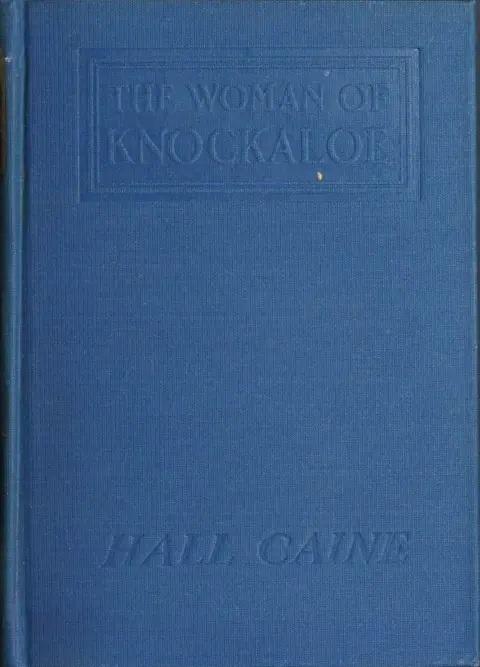
The Woman of Knockaloe: A Parable
Hall, Sir Caine
THE CLASSIC COLLECTION · 1909
"The White Prophet, Volume 1" by Sir Hall Caine is a novel written in the early 20th century. The narrative is set against the backdrop of British rule in Egypt, illustrating the complex cultural and political tensions of the era. At the center of the story is Gordon Lord, a British officer, who finds himself entangled in the struggles between the native Egyptians and their British rulers, particularly focusing on the rise of a charismatic new leader named Ishmael Ameer. At the start of the novel, a sham battle staged by British officers in Cairo escalates tensions between British forces and the local population, igniting feelings of resentment among the Cairenes. Amid this backdrop, Lord Gordon, who is depicted as empathetic toward the locals and proud of his Egyptian heritage, becomes concerned about a potential uprising incited by Ishmael Ameer, a preacher stirring discontent among the people. As Gordon prepares to undertake a mission to arrest Ameer, he grapples with his duty to the British Crown and his personal conviction, setting the stage for a deeper exploration of identity, loyalty, and the implications of colonialism in Egypt.
Introduction adapted from the source catalogue; source summaries may be automatically generated.
Free to read · English · 106,381 words · No account needed
MAKE TIME FOR A GOOD BOOK
On by default. Untick to stop anonymous reading totals. Each page counts after 10 seconds in view. How this works.
Anonymous counting is on unless you have switched it off.
"The Mohammedan Rani, you mean? My husband tells me she is perfectly lovely. But they say she will never let a European get a glimpse of her face--puts down her Parsee veil, I suppose--so goodness knows how he knows, you know."
"Perhaps your husband is a privileged person, my dear," said one of the other ladies, whereupon there was a trill of laughter and the little feet in satin slippers were beaten upon the floor.
"But a Rani! Think of that! Who can she be, I wonder?" said another of the ladies, and then the mistress of the Palace, Lady Mannering, hinted that she believed the Sirdar knew something about her.
"Oh, tell us! tell us!" cried a dozen female voices at once; but the Sirdar, a shrewd and kindly autocrat who had been smoking a cigarette in silence, merely answered--
"Time will tell you, perhaps." Then turning to the Inspector-General he
said--
"She has married the man, you say?"
"That's so, your Excellency."
"There must be some mistake about that, surely."
The company broke up late, and the ladies went on in light wraps and the men bare-headed through the soft, reverberant air of the southern night. But the Sirdar had asked certain of his officers to remain for a few moments, and among them were the Inspector-General, the Financial Secretary, and the Governor of the town. To the latter came his Zabit, a police officer, whose duty it was to report to his chief early and late, and as soon as the men had seated themselves the Sirdar said--
"Any further news about this man, Ishmael Ameer?"
"None, your Excellency," said the Governor.
"You've discovered nothing about his object in coming here?"
"Nothing at all."
"He is not sowing dissension between Moslems and Christians?"
"No! On the contrary, he professes to be opposed to all that, sir."
"Then you see no reason to think that he is likely to be a danger to the
public peace?"
"Unfortunately no, sir, no!"
The Sirdar laughed. "He hasn't yet given 'divine' sanction for your
removal, Colonel?"
"Not that I know of, at all events."
"Then you and your wife may sleep in peace for the present, I suppose."
There was a little general laughter, and then the Inspector-General, a sceptic with a contempt for holy men of all kinds, said--
"All the same, your Excellency, I should make short work of this
pseudo-Messiah."
"Without plain cause we cannot," said the Sirdar, who was the friend of all faiths and the enemy of none. "Indeed, a broad-minded Mohammedan such as this man is said to be might possibly be of service in directing the religion of the Soudan."
Your reading position is saved on this browser. Take it to another device with a library code. Reading pages adapt to text, rather than matching a printed edition.
Hall, Sir Caine

Hall, Sir Caine
Hall, Sir Caine
Hall, Sir Caine
BEHIND THE BOOK
This eBook is for the use of anyone anywhere in the United States and most other parts of the world at no cost and with almost no restrictions whatsoever. You may copy it, give it away or re-use it under the terms of the Project Gutenberg License included with this eBook or online at www.gutenberg.org. If you are not located in the United States, you will have to check the laws of the country where you are located before using this eBook. Read the source licence.
The original source file, including credits and licence, is retained by this library. Request an original-format copy at no charge. Please include the book title and Project Gutenberg identifier #52342.
KEEP YOUR CURIOSITY GOING
Cécile Tormay

Moritz Busch
Coulson Kernahan
John L. Ransom

Maurice Baring
Frances Wright