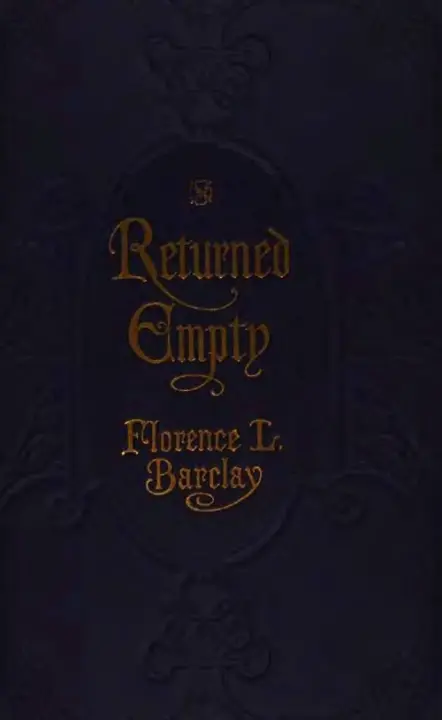
Returned Empty
Florence L. (Florence Louisa) Barclay
THE CLASSIC COLLECTION · 1917
"The White Ladies of Worcester: A Romance of the Twelfth Century" by Florence L. Barclay is a historical romance novel written in the early 20th century. The story unfolds within a convent, centering around the daily lives of the nuns, particularly focusing on Sister Mary Antony and her unique interactions with the other White Ladies. Themes of spirituality, the tension between earthly desires and the holy life, and the ghostly echoes of the past loom large in the narrative. The opening of the story introduces us to Mary Antony, the oldest lay-sister at the convent, who has an important ritual of counting the nuns as they return from Vespers through a subterranean passage. This count originates from a tragic past incident involving Sister Agatha, which has left a lasting impression on the community. The narrative quickly highlights various characters in the convent, including the stern yet compassionate Prioress and the troubled Sister Mary Seraphine, who longs for the life she left behind. As Mary Antony contemplates her daily duties and playful thoughts, the atmosphere becomes rich with both tangible life and the spectral weight of memories, setting the stage for conflict that intertwines personal desires with spiritual obligations.
Introduction adapted from the source catalogue; source summaries may be automatically generated.
Free to read · English · 122,172 words · No account needed
MAKE TIME FOR A GOOD BOOK
On by default. Untick to stop anonymous reading totals. Each page counts after 10 seconds in view. How this works.
Anonymous counting is on unless you have switched it off.
That evening when, after much adventure, he at length gained the streets of the city, he had trodden them with the mien of a victor.
That night he had slept as he had not slept since the hour when his
whole life had been embittered by a lying letter and a traitorous
tongue.
But morning, alas, had brought its doubts; noon, its dark uncertainties; and as the hour of Vespers drew near, he had realised, with the helpless misery of despair, that it was madness to expect the Prioress of the White Ladies to break her vows, leave her Nunnery, and fly with him to Warwick.
Yet he carried out his plan, and kept to his undertaking, though here, in the calm atmosphere of the crypt, holy chanting descending from above, the remembrance still with him of the aloofness of those stately white figures gliding between the pillars in the distance, he faced the madness of his hopes, and the mournful prospect of a life of loneliness.
Presently he arose, crossed the crypt, and took up his position behind a pillar to the right of the exit from the winding stair.
The chanting ceased. Vespers were over.
He heard the sound of soft footsteps drawing nearer.
The White Ladies were coming.
They came.
The Knight was not kept long in suspense. The Prioress walked first. Her face was hidden, but her height and carriage revealed her to her lover. She looked neither to right nor left but, turning away from the pillar behind which the Knight stood concealed, crossed to the steps leading down to the subterranean way, and so passed swiftly out of sight.
The Knight stood motionless until all had appeared, and had vanished
once more from view.
One, tall but ungainly, crooked of body, and doubtless short of vision, missed her way among the columns and passed perilously near to the Knight. With his long arm, he could have clasped her. How old Antony would have chuckled, could she but have known! "Sister Mary Rebecca embraced by the Knight of the Bloody Vest? Nay then; the Saints forbid!"
The stretcher, borne by four men-at-arms, passed out from the Cathedral.
The Knight walked beside it, with bent head, and eyes upon the ground.
As it passed through the Precincts, the Lord Bishop himself rode out on his white palfrey, on his way to the Nunnery at Whytstone.
The Knight, being downhearted, did not lift his eyes.
The Bishop looked, kindly, upon the stretcher and upon the Knight's
dark face.
The Bishop had known Hugh d'Argent as a boy.
He grieved to see him thus in sorrow.
Yet the Bishop smiled as he rode on.
Your reading position is saved on this browser. Take it to another device with a library code. Reading pages adapt to text, rather than matching a printed edition.
Florence L. (Florence Louisa) Barclay

Florence L. (Florence Louisa) Barclay
Florence L. (Florence Louisa) Barclay
Florence L. (Florence Louisa) Barclay
BEHIND THE BOOK
This eBook is for the use of anyone anywhere in the United States and most other parts of the world at no cost and with almost no restrictions whatsoever. You may copy it, give it away or re-use it under the terms of the Project Gutenberg License included with this eBook or online at www.gutenberg.org. If you are not located in the United States, you will have to check the laws of the country where you are located before using this eBook. Read the source licence.
The original source file, including credits and licence, is retained by this library. Request an original-format copy at no charge. Please include the book title and Project Gutenberg identifier #16368.
KEEP YOUR CURIOSITY GOING
Cécile Tormay

Moritz Busch
Coulson Kernahan
John L. Ransom

Maurice Baring
Frances Wright