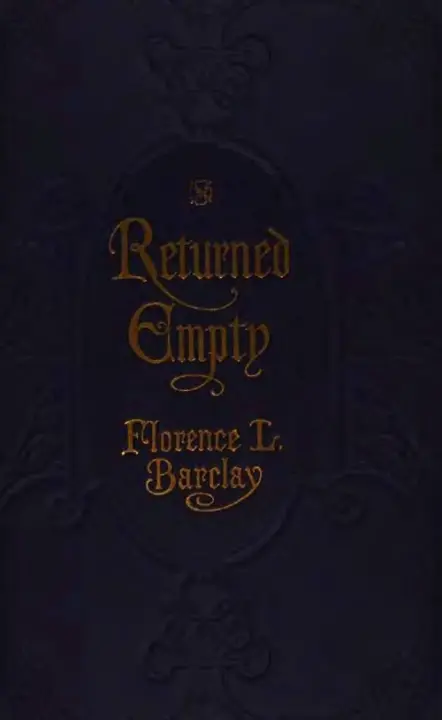
Returned Empty
Florence L. (Florence Louisa) Barclay
THE CLASSIC COLLECTION · 1917
"The White Ladies of Worcester: A Romance of the Twelfth Century" by Florence L. Barclay is a historical romance novel written in the early 20th century. The story unfolds within a convent, centering around the daily lives of the nuns, particularly focusing on Sister Mary Antony and her unique interactions with the other White Ladies. Themes of spirituality, the tension between earthly desires and the holy life, and the ghostly echoes of the past loom large in the narrative. The opening of the story introduces us to Mary Antony, the oldest lay-sister at the convent, who has an important ritual of counting the nuns as they return from Vespers through a subterranean passage. This count originates from a tragic past incident involving Sister Agatha, which has left a lasting impression on the community. The narrative quickly highlights various characters in the convent, including the stern yet compassionate Prioress and the troubled Sister Mary Seraphine, who longs for the life she left behind. As Mary Antony contemplates her daily duties and playful thoughts, the atmosphere becomes rich with both tangible life and the spectral weight of memories, setting the stage for conflict that intertwines personal desires with spiritual obligations.
Introduction adapted from the source catalogue; source summaries may be automatically generated.
Free to read · English · 122,172 words · No account needed
MAKE TIME FOR A GOOD BOOK
On by default. Untick to stop anonymous reading totals. Each page counts after 10 seconds in view. How this works.
Anonymous counting is on unless you have switched it off.
He was reminded of his difficulties when he tried to walk disguised in the dress of the White Ladies, and found his stride impeded by those trailing garments. He remembered the relief of wrenching them off, and stepping clear.
Why not now take the short, quick road to mastery?
But instantly that love which seeketh not its own, the strange new sense so recently awakened in him, laid its calm touch upon his throbbing heart. Until that moment in the crypt the day before, he had loved Mora for his own delight, sought her for his own joy. Now, he knew that he could take no happiness at the cost of one pang to her.
"She must be taught not to shudder," cried the masterfulness which was
his by nature.
"She must be given no cause to shudder," amended this new, loyal tenderness, which now ruled his every thought of her.
Presently, returning to the arbour, he found her seated, her elbows on the table, her chin cupped in her hands.
She had been weeping; yet her smile of welcome, as he entered, held a quality he had scarce expected.
He spoke straight to the point. It seemed the only way to step clear
of immeshing trammels.
"Mora, it cuts me to the heart that, in striving to be honest with you, I have all unwittingly trampled upon those flower-beds in which you long had tended fair blossoms of memory. Also I fear this knowledge of a nobler love, makes it hard for you to contemplate life linked to a love which seems to you less able for self-sacrifice."
She gazed at him, wide-eyed, in sheer amazement.
"Dear Knight," she said, "true, I am disillusioned, but not in aught that concerns you. You trampled on no flower-beds of mine. My shattered idol is the image of one whom I, with deepest reverence, loved, as a nun might love her Guardian Angel. To learn that he loved me as a man loves a woman, and that he had to flee before that love, lest it should harm me and himself, changes the hallowed memory of years. This morning, three names stood to me for all that is highest, noblest, best: Father Gervaise, Symon of Worcester, and Hugh d'Argent. Now, the Bishop and yourself alone are left. Fail me not, Hugh, or I shall be bereft indeed."
The Knight laughed, joyously. The relief at his heart demanded that
much vent. "Then, if I failed thee, Mora, there would be but the
Bishop?"
"There would be but the Bishop."
Your reading position is saved on this browser. Take it to another device with a library code. Reading pages adapt to text, rather than matching a printed edition.
Florence L. (Florence Louisa) Barclay

Florence L. (Florence Louisa) Barclay
Florence L. (Florence Louisa) Barclay
Florence L. (Florence Louisa) Barclay
BEHIND THE BOOK
This eBook is for the use of anyone anywhere in the United States and most other parts of the world at no cost and with almost no restrictions whatsoever. You may copy it, give it away or re-use it under the terms of the Project Gutenberg License included with this eBook or online at www.gutenberg.org. If you are not located in the United States, you will have to check the laws of the country where you are located before using this eBook. Read the source licence.
The original source file, including credits and licence, is retained by this library. Request an original-format copy at no charge. Please include the book title and Project Gutenberg identifier #16368.
KEEP YOUR CURIOSITY GOING
Cécile Tormay

Moritz Busch
Coulson Kernahan
John L. Ransom

Maurice Baring
Frances Wright