
The Milkmaid of Montfermeil (Novels of Paul de Kock Volume XX)
Paul de Kock
THE CLASSIC COLLECTION · 1904
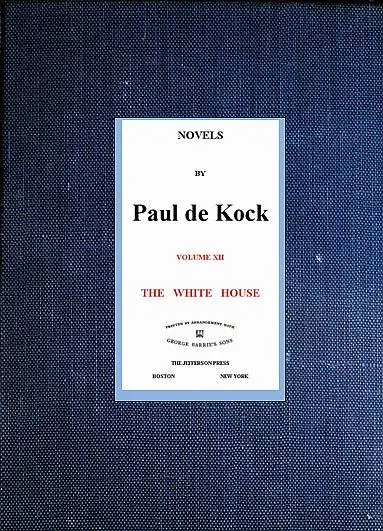
"The White House" by Paul de Kock is a novel written in the early 19th century. Set against the backdrop of Parisian society, the story revolves around the life of a government clerk named Robineau. The plot explores themes of social status, romance, and the comedic misadventures of its characters through their interactions at a lavish reception hosted by the affluent Baron de Marcey. The opening of the novel introduces us to Robineau as he navigates his mundane life as a clerk while yearning for social advancement and romance. He encounters two wealthy acquaintances in the Palais-Royal garden, Alfred and Edouard, who invite him to a grand reception at the baron's residence. Despite his self-deprecating humor and jealousy over his friends' wealth, Robineau struggles with his own lack of fortunes, especially as he prepares for the social event amid thoughts of his love interest, a milliner named Fifine. The introduction sets the stage for Robineau's hopes and aspirations, depicting a blend of lighthearted banter and the underlying social commentary of the era.
Introduction adapted from the source catalogue; source summaries may be automatically generated.
Free to read · English · 152,580 words · No account needed
MAKE TIME FOR A GOOD BOOK
On by default. Untick to stop anonymous reading totals. Each page counts after 10 seconds in view. How this works.
Anonymous counting is on unless you have switched it off.
There was a fire in one corner of the first room; a huge earthenware kettle was set upon some crackling twigs; a woman of some forty years, seated, or rather crouching, in front of the fire, was stirring the contents of the kettle with a wooden spoon, and by her side knelt three tall, sturdy boys, gazing at what was on the fire. Farther on, an old man, still hale and hearty, sat upon a bunch of straw, patting an old he-goat that lay on the floor beside him. This picture was lighted but dimly by a lamp standing on a small wooden table, because the smoke from the fire formed dense clouds which emerged very slowly through the vent in the roof.
The three travellers, having entered the hovel, stopped to examine the curious scene before their eyes. The occupants scrutinized them in their turn, but with a sort of stupid amazement, and without moving.
"This is very original!" said Alfred to his friends.
"It is very ugly!" said Robineau.
"It is a most picturesque interior, strongly tinged with local color,"
said Edouard.
"I don’t know whether it has any color," muttered Robineau, "but this same picturesque interior smells horribly!"
"Where are we, please, good people?" inquired Alfred.
"At Chadrat," the old man replied.
"At Chadrat!" cried Robineau; "what! this is Chadrat! and they dare to call this a village! I wouldn’t take it to stable my horses in."
Apparently paying no attention to Robineau, the shepherd, who had entered with the travellers, made an imperative sign to the boys kneeling by the fire; whereupon they decided, although with regret, to rise, and brought forward some small wooden benches for the travellers.
"Sit down, messieurs, and rest yourselves," said the Auvergnat.
Alfred and Edouard seated themselves, while Robineau gazed in alarm at the three tall youths who had risen, and glanced out of the corner of his eye toward the doorway of the hovel. But his companions paid no heed to the signs he made them, so he decided at last to take a seat.
"We were anxious to arrive to-night at a château called La Roche-Noire," said Alfred; "do you know it?"
The peasants looked at one another and shook their heads.
"Parbleu! how does he suppose that these clowns, these idiots should know my château?" said Robineau to himself.
"But you know the town of Saint-Amand?" said Edouard.
"Saint-Amand-Talende--oh, yes, monsieur!"
"Are we far from it?"
"Not very--still, it’s some distance."
"Look you, my good man--these three tall fellows are your sons, I’ll
wager."
The peasant made an affirmative movement with his head.
Your reading position is saved on this browser. Take it to another device with a library code. Reading pages adapt to text, rather than matching a printed edition.
Paul de Kock

Paul de Kock

Paul de Kock

Paul de Kock
BEHIND THE BOOK
This eBook is for the use of anyone anywhere in the United States and most other parts of the world at no cost and with almost no restrictions whatsoever. You may copy it, give it away or re-use it under the terms of the Project Gutenberg License included with this eBook or online at www.gutenberg.org. If you are not located in the United States, you will have to check the laws of the country where you are located before using this eBook. Read the source licence.
The original source file, including credits and licence, is retained by this library. Request an original-format copy at no charge. Please include the book title and Project Gutenberg identifier #40712.
KEEP YOUR CURIOSITY GOING
Coulson Kernahan

Maurice Baring
Frances Wright
Cécile Tormay

Frederic Jesup Stimson

W. H. P. (William Henry Pope) Jarvis