
The Milkmaid of Montfermeil (Novels of Paul de Kock Volume XX)
Paul de Kock
THE CLASSIC COLLECTION · 1904
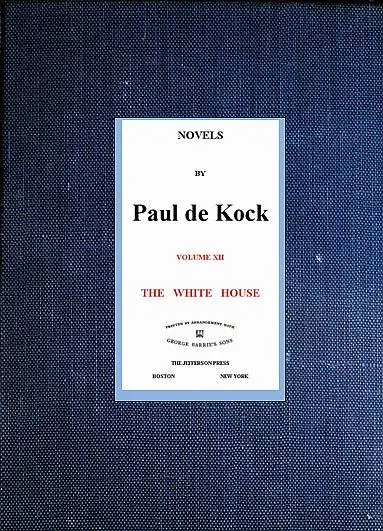
"The White House" by Paul de Kock is a novel written in the early 19th century. Set against the backdrop of Parisian society, the story revolves around the life of a government clerk named Robineau. The plot explores themes of social status, romance, and the comedic misadventures of its characters through their interactions at a lavish reception hosted by the affluent Baron de Marcey. The opening of the novel introduces us to Robineau as he navigates his mundane life as a clerk while yearning for social advancement and romance. He encounters two wealthy acquaintances in the Palais-Royal garden, Alfred and Edouard, who invite him to a grand reception at the baron's residence. Despite his self-deprecating humor and jealousy over his friends' wealth, Robineau struggles with his own lack of fortunes, especially as he prepares for the social event amid thoughts of his love interest, a milliner named Fifine. The introduction sets the stage for Robineau's hopes and aspirations, depicting a blend of lighthearted banter and the underlying social commentary of the era.
Introduction adapted from the source catalogue; source summaries may be automatically generated.
Free to read · English · 152,580 words · No account needed
MAKE TIME FOR A GOOD BOOK
On by default. Untick to stop anonymous reading totals. Each page counts after 10 seconds in view. How this works.
Anonymous counting is on unless you have switched it off.
These words induced the new landed proprietor to climb the hill. He reached the top drenched with perspiration, and mopped his brow as he looked about.
"Well! are you sorry that you came up?" said Alfred.
"Isn’t it worth while to tire oneself a bit for this, eh, Monsieur
Jules?"
"It is very pretty, messieurs, I agree; you can see a long distance. But I have seen just as much in Messieurs Daguerre and Bouton’s Diorama."
"The Diorama is certainly a beautiful thing, my friend; it is impossible to carry illusion and perfection of detail any farther; but art should not interfere with our admiration of nature."
"You may say what you please, messieurs, but I prefer the Diorama; there at least I have an explanation of what I see; but here I have no idea what I am looking at.--There’s a village yonder, and I don’t know what village it is."
"Wait a moment! here comes a worthy peasant who will be our cicerone."
A villager approached, with a spade and pickaxe over his shoulder. He was about to descend the hill. Alfred called him and he came toward them touching his hat. The peasants are much more polite in Auvergne than in the suburbs of Paris.
"Will you be kind enough to tell us, my good man, the name of the little town we see yonder, between two streams?"
"That is Saint-Amand, messieurs. It’s a pretty little town. The little stream you see over here is the Veyre, which rises at Pagnia, a village over in this direction; it runs into the Mone, and they both run into the Allier. The Mone comes from Saint-Saturnin, half a league from Saint-Amand. See, where I’m pointing."
"What sort of a place is Saint-Saturnin?"
"Oh! it’s a big village; it used to be a town, and a fortified town
too."
"Is there a château thereabout?" inquired Robineau.
"Oh, yes, monsieur; there’s a castle."
"Called La Roche-Noire?"
"No, monsieur, no; that one’s the Château of Saint-Saturnin."
"And La Roche-Noire, where is that?"
"You mean La Roche-Blanche, I suppose, don’t you?--That’s that little
village over there."
"I am not talking about your Roche-Blanche!--What astonishing creatures these Auvergnats are! they absolutely insist that black and white (noir and blanc) are the same thing!"
"Dame! then I don’t know, monsieur."
"And in this direction, my good man?"
"That’s the village of Chanonat, monsieur."
"Chanonat!" cried Edouard; "where Delille was born?"
"Delille?" replied the peasant; "as to that, I can’t say, monsieur. What did this Delille do? Wasn’t he a vine-dresser? Didn’t he make wine?"
Your reading position is saved on this browser. Take it to another device with a library code. Reading pages adapt to text, rather than matching a printed edition.
Paul de Kock

Paul de Kock

Paul de Kock

Paul de Kock
BEHIND THE BOOK
This eBook is for the use of anyone anywhere in the United States and most other parts of the world at no cost and with almost no restrictions whatsoever. You may copy it, give it away or re-use it under the terms of the Project Gutenberg License included with this eBook or online at www.gutenberg.org. If you are not located in the United States, you will have to check the laws of the country where you are located before using this eBook. Read the source licence.
The original source file, including credits and licence, is retained by this library. Request an original-format copy at no charge. Please include the book title and Project Gutenberg identifier #40712.
KEEP YOUR CURIOSITY GOING
Coulson Kernahan

Maurice Baring
Frances Wright
Cécile Tormay

Frederic Jesup Stimson

W. H. P. (William Henry Pope) Jarvis