
The Milkmaid of Montfermeil (Novels of Paul de Kock Volume XX)
Paul de Kock
THE CLASSIC COLLECTION · 1904
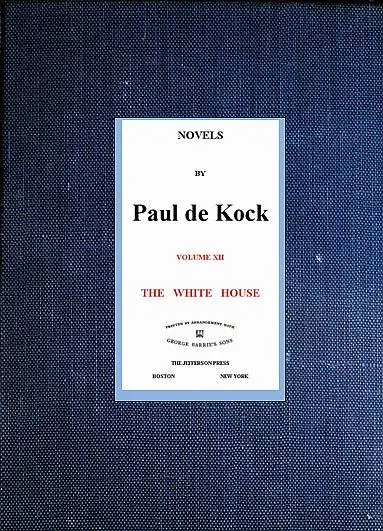
"The White House" by Paul de Kock is a novel written in the early 19th century. Set against the backdrop of Parisian society, the story revolves around the life of a government clerk named Robineau. The plot explores themes of social status, romance, and the comedic misadventures of its characters through their interactions at a lavish reception hosted by the affluent Baron de Marcey. The opening of the novel introduces us to Robineau as he navigates his mundane life as a clerk while yearning for social advancement and romance. He encounters two wealthy acquaintances in the Palais-Royal garden, Alfred and Edouard, who invite him to a grand reception at the baron's residence. Despite his self-deprecating humor and jealousy over his friends' wealth, Robineau struggles with his own lack of fortunes, especially as he prepares for the social event amid thoughts of his love interest, a milliner named Fifine. The introduction sets the stage for Robineau's hopes and aspirations, depicting a blend of lighthearted banter and the underlying social commentary of the era.
Introduction adapted from the source catalogue; source summaries may be automatically generated.
Free to read · English · 152,580 words · No account needed
MAKE TIME FOR A GOOD BOOK
On by default. Untick to stop anonymous reading totals. Each page counts after 10 seconds in view. How this works.
Anonymous counting is on unless you have switched it off.
"Whether I find it good or bad, I must drink it, I suppose?"
"Oh! to be sure! Still, if you wanted something better, I might----"
"If I wanted other wine, I shouldn’t have waited for your permission to
order it."
"True; but----"
"But I am not so particular now!"
"Not so particular now?--Ah! I understand: that means that you used to
be--eh?"
The stranger looked up at the inn-keeper, and after gazing fixedly at him for several seconds, observed:
"There is something that you used to be, still are, and probably always
will be!"
Thereupon the inn-keeper fastened his little red eyes on the strange guest’s, as if trying to understand him; but, after cudgelling his brains in vain, he said:
"I don’t catch your meaning at all. Are you a fortune teller?"
The stranger shrugged his shoulders and returned to his bread and cheese, making no further reply.
"Do you expect to stay for some time in our town?" continued the inn-keeper after a moment. "I have no idea; if it amuses me to stay here, I shall stay."
"To be sure!--Oh! you will see some pretty things here: a magnificent botanical garden, a fine college, and our bridge, formed by the calcareous deposits from the water of a spring!--I say nothing of our apricot pies; you don’t seem to care for sweetmeats. But you will be surprised, amazed, by the beauty of the neighborhood!"
"Nothing surprises or amazes me now."
"Oh! that makes a difference.--By the way, do you intend to sleep here?"
The stranger did not answer this question; he passed his hand across his brow and seemed to reflect; at last he asked the landlord:
"Are there none of the Granval family left in this town?"
"The Granval family!" rejoined the astonished host; "what! did you ever know them? They were very rich people, the Granvals! very highly esteemed and----"
"I know what they were; I ask you if there are any of the family still
here?"
"No, not one. Monsieur Granval the elder died about five years ago, leaving a son and a daughter. The son enjoyed very poor health; it didn’t do him any good to take the waters at Mont d’Or--they didn’t make him any stouter. He took it into his head to marry, and that finished him; he died two years ago. As for the daughter, she married a merchant and went to Italy with him."
The stranger listened with his elbows on the table and his head resting on his hands. When the inn-keeper had ceased to speak, he uttered a fierce oath, then muttered:
Your reading position is saved on this browser. Take it to another device with a library code. Reading pages adapt to text, rather than matching a printed edition.
Paul de Kock

Paul de Kock

Paul de Kock

Paul de Kock
BEHIND THE BOOK
This eBook is for the use of anyone anywhere in the United States and most other parts of the world at no cost and with almost no restrictions whatsoever. You may copy it, give it away or re-use it under the terms of the Project Gutenberg License included with this eBook or online at www.gutenberg.org. If you are not located in the United States, you will have to check the laws of the country where you are located before using this eBook. Read the source licence.
The original source file, including credits and licence, is retained by this library. Request an original-format copy at no charge. Please include the book title and Project Gutenberg identifier #40712.
KEEP YOUR CURIOSITY GOING
Coulson Kernahan

Maurice Baring
Frances Wright
Cécile Tormay

Frederic Jesup Stimson

W. H. P. (William Henry Pope) Jarvis