
The Milkmaid of Montfermeil (Novels of Paul de Kock Volume XX)
Paul de Kock
THE CLASSIC COLLECTION · 1904
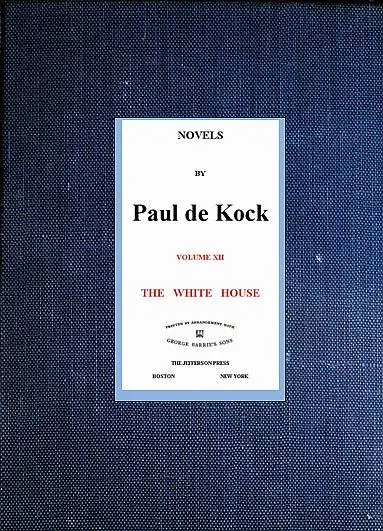
"The White House" by Paul de Kock is a novel written in the early 19th century. Set against the backdrop of Parisian society, the story revolves around the life of a government clerk named Robineau. The plot explores themes of social status, romance, and the comedic misadventures of its characters through their interactions at a lavish reception hosted by the affluent Baron de Marcey. The opening of the novel introduces us to Robineau as he navigates his mundane life as a clerk while yearning for social advancement and romance. He encounters two wealthy acquaintances in the Palais-Royal garden, Alfred and Edouard, who invite him to a grand reception at the baron's residence. Despite his self-deprecating humor and jealousy over his friends' wealth, Robineau struggles with his own lack of fortunes, especially as he prepares for the social event amid thoughts of his love interest, a milliner named Fifine. The introduction sets the stage for Robineau's hopes and aspirations, depicting a blend of lighthearted banter and the underlying social commentary of the era.
Introduction adapted from the source catalogue; source summaries may be automatically generated.
Free to read · English · 152,580 words · No account needed
MAKE TIME FOR A GOOD BOOK
On by default. Untick to stop anonymous reading totals. Each page counts after 10 seconds in view. How this works.
Anonymous counting is on unless you have switched it off.
The baron took Edouard’s hand and tried to allay his grief, although it was easy to see that he was no less affected himself. Alfred rose; he examined the place where they were, and, noticing the staircase, said to Charlot:
"You have another room upstairs?"
"Yes, monsieur."
"I suppose it looks on the narrow path by which we came; could we rest more comfortably there than here?"
Without awaiting the old shepherd’s reply, Alfred went to the upper room, but he found it empty, and came sadly down again, seated himself by his companions and said:
"We shall be quite as comfortable here."
"This part of the mountains is quite unfrequented," said the baron. "How do you manage to live here?"
"I go to the village and buy bread enough to last ten days."
"What a dismal place to live in!" said Alfred. "How in the deuce can a man make up his mind to pass his life here?"
"Poor Isaure!" said Edouard, "who knows that you are not living in some hovel as wretched as this? Three weeks have passed already since you were torn away from our love, and no indication,--nothing to lead us to hope that we are on the track of your abductors!"
The three travellers were silent for a long time. The vagabond, hidden behind the partition at the rear, did not take his eyes from them, and did not leave his place; after half an hour, the baron rose, saying:
"Let us go on; it is useless to remain here any longer."
"Yes, let us go," said Alfred, "and let us try to remember the road, so that we need not go over the same ground twice, which would cause us to waste time. However, this place is easily recognized; I have seen few spots so wild, so melancholy as this, where somebody has thought fit to build this house.--Well, Edouard, are you coming?"
Edouard rose, casting a last glance at the walls of the hut, and walked slowly off with his companions. Soon their steps died away along the path, then the travellers disappeared altogether from the sight of Charlot, who was looking after them from the doorway.
Thereupon the vagabond returned triumphantly to Isaure, crying:
"It was they! but they haven’t the slightest suspicion, and they have gone away from this place, and will never return to it!"
"It was they!" murmured the girl; it seemed to her then that she had been torn once more from those whom she loved; she had not yet experienced such a feeling of anguish; her last hope was gone; and she fell, sobbing, at the vagabond’s feet.
Your reading position is saved on this browser. Take it to another device with a library code. Reading pages adapt to text, rather than matching a printed edition.
Paul de Kock

Paul de Kock

Paul de Kock

Paul de Kock
BEHIND THE BOOK
This eBook is for the use of anyone anywhere in the United States and most other parts of the world at no cost and with almost no restrictions whatsoever. You may copy it, give it away or re-use it under the terms of the Project Gutenberg License included with this eBook or online at www.gutenberg.org. If you are not located in the United States, you will have to check the laws of the country where you are located before using this eBook. Read the source licence.
The original source file, including credits and licence, is retained by this library. Request an original-format copy at no charge. Please include the book title and Project Gutenberg identifier #40712.
KEEP YOUR CURIOSITY GOING
Coulson Kernahan

Maurice Baring
Frances Wright
Cécile Tormay

Frederic Jesup Stimson

W. H. P. (William Henry Pope) Jarvis