
The Milkmaid of Montfermeil (Novels of Paul de Kock Volume XX)
Paul de Kock
THE CLASSIC COLLECTION · 1904
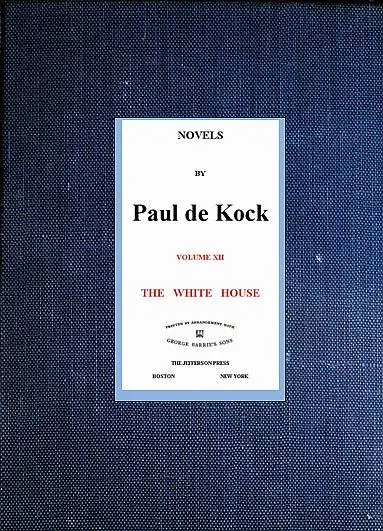
"The White House" by Paul de Kock is a novel written in the early 19th century. Set against the backdrop of Parisian society, the story revolves around the life of a government clerk named Robineau. The plot explores themes of social status, romance, and the comedic misadventures of its characters through their interactions at a lavish reception hosted by the affluent Baron de Marcey. The opening of the novel introduces us to Robineau as he navigates his mundane life as a clerk while yearning for social advancement and romance. He encounters two wealthy acquaintances in the Palais-Royal garden, Alfred and Edouard, who invite him to a grand reception at the baron's residence. Despite his self-deprecating humor and jealousy over his friends' wealth, Robineau struggles with his own lack of fortunes, especially as he prepares for the social event amid thoughts of his love interest, a milliner named Fifine. The introduction sets the stage for Robineau's hopes and aspirations, depicting a blend of lighthearted banter and the underlying social commentary of the era.
Introduction adapted from the source catalogue; source summaries may be automatically generated.
Free to read · English · 152,580 words · No account needed
MAKE TIME FOR A GOOD BOOK
On by default. Untick to stop anonymous reading totals. Each page counts after 10 seconds in view. How this works.
Anonymous counting is on unless you have switched it off.
"I flatter myself, madame, that you will find, on the contrary, that it is too short," replied Férulus, who was not overjoyed at this reference to his last ballad. Then, taking the roll from his pocket, and untying the ribbon, he rose and began:
"Compliment in verse in honor of the union of the newly-married pair."
"It seems to me, monsieur," said the marquis, "that you would have done well to say: the union of Mademoiselle Cornélie, daughter of the Marquis de la Pincerie, with Monsieur de la Roche-Noire; that would have been more becoming than to say ‘the newly-married pair,’ exactly as if you were talking about Jacquot and Pierrette!"
"My noble father-in-law is right," said Robineau, "I don’t like ‘the
newly-married pair.’"
"Monsieur," replied Férulus, dissembling his mortification, "that phrase is strictly grammatical; you will find it in Lhomond, in Wailly, in Boiste, and in all the dictionaries."
"Oh! for heaven’s sake, monsieur, don’t talk about dictionaries!" cried Eudoxie; "it seems to me that to-day you should talk to us of something pleasant and attractive."
"Therefore, madame," continued Férulus, "I have taken for the text of my trifle, this line from Propertius:
"‘Nec domina ulla meo ponet vestigia lecto.’"
"And what may that mean?" said Cornélie; "for it seems to me that you would do better to give us a translation of it."
"Yes," said Robineau, "he is a terrible fellow for that! I have told him a hundred times that I cared for nothing but translations."
"Madame," rejoined Férulus, with an amiable smile, "that means: ‘No other mistress shall disturb my bed.’"
"Mon Dieu! how shocking! how indecent!" cried Eudoxie, hiding her face behind Alfred’s shoulder.
"What, monsieur!" said Cornélie; "you presume to compose such loose
verses!"
"Madame, I have the honor to inform you that the author is Propertius,
and that----"
"No mistress in his bed!" cried the Marquis de la Pincerie. "Corbleu! I would like to see--Son-in-law, what is the meaning of this allusion?"
"I swear to you, father-in-law, that I have no idea," said Robineau; "I do not understand Monsieur Férulus’s motive in perpetrating such a wretched jest!"
"Monsieur," said Férulus, "I say again that that is the translation of
the line, and that----"
"Very well, monsieur, that will do," said Cornélie; "after such a beginning, I do not care to hear any more! If the remainder corresponds with the text, it cannot be repeated to ladies."
"But, madame, allow me to call your attention----"
Your reading position is saved on this browser. Take it to another device with a library code. Reading pages adapt to text, rather than matching a printed edition.
Paul de Kock

Paul de Kock

Paul de Kock

Paul de Kock
BEHIND THE BOOK
This eBook is for the use of anyone anywhere in the United States and most other parts of the world at no cost and with almost no restrictions whatsoever. You may copy it, give it away or re-use it under the terms of the Project Gutenberg License included with this eBook or online at www.gutenberg.org. If you are not located in the United States, you will have to check the laws of the country where you are located before using this eBook. Read the source licence.
The original source file, including credits and licence, is retained by this library. Request an original-format copy at no charge. Please include the book title and Project Gutenberg identifier #40712.
KEEP YOUR CURIOSITY GOING
Coulson Kernahan

Maurice Baring
Frances Wright
Cécile Tormay

Frederic Jesup Stimson

W. H. P. (William Henry Pope) Jarvis