
The Milkmaid of Montfermeil (Novels of Paul de Kock Volume XX)
Paul de Kock
THE CLASSIC COLLECTION · 1904
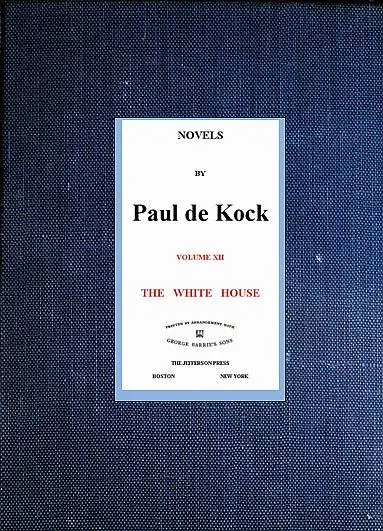
"The White House" by Paul de Kock is a novel written in the early 19th century. Set against the backdrop of Parisian society, the story revolves around the life of a government clerk named Robineau. The plot explores themes of social status, romance, and the comedic misadventures of its characters through their interactions at a lavish reception hosted by the affluent Baron de Marcey. The opening of the novel introduces us to Robineau as he navigates his mundane life as a clerk while yearning for social advancement and romance. He encounters two wealthy acquaintances in the Palais-Royal garden, Alfred and Edouard, who invite him to a grand reception at the baron's residence. Despite his self-deprecating humor and jealousy over his friends' wealth, Robineau struggles with his own lack of fortunes, especially as he prepares for the social event amid thoughts of his love interest, a milliner named Fifine. The introduction sets the stage for Robineau's hopes and aspirations, depicting a blend of lighthearted banter and the underlying social commentary of the era.
Introduction adapted from the source catalogue; source summaries may be automatically generated.
Free to read · English · 152,580 words · No account needed
MAKE TIME FOR A GOOD BOOK
On by default. Untick to stop anonymous reading totals. Each page counts after 10 seconds in view. How this works.
Anonymous counting is on unless you have switched it off.
"Oh! yes, monsieur," said Eudoxie; "we must find out what it is, for I am afraid of everything; and it would be a shameful thing to bring us to a château inhabited by ghosts."
"Indeed, it would be dishonorable," said Uncle Mignon in an undertone, as he followed the company, who left the table to repair to the salon, where all the servants soon arrived in a body, in accordance with their master’s orders.
"Which of you is it who saw something or somebody at night in the North Tower?" asked Robineau, perching himself gracefully in a large easy-chair, while the ladies and the two young men talked together on an enormous couch at a little distance.
The servants looked at one another for some time without replying; at last Benoît stepped forward and said:
"I believe it was me, monseigneur."
"You see! he is uncertain about it already," said Férulus; "oculos
habent et non videbunt!"
"Monsieur Férulus," said Robineau testily, "why do you speak Latin to my people? You know very well that they don’t understand it! Parbleu! if I chose, I could speak Latin to them too; and even cookery Latin, which would be much more within their reach."
"Monseigneur, I was quoting a passage of Scripture."
"You are a terrible man with your passages! But, when one is with ladies, one should never use a dead language."
Férulus bowed, and seated himself in a corner of the salon, whence he ogled Jeannette. Robineau resumed his examination.
"Tell me, Benoît, what it was that frightened you?"
"Frightened! Oh! I wasn’t frightened, monseigneur! I was just surprised,
that’s all!"
"He is lying like a tooth-puller!" cried Mademoiselle Cheval; "he was so frightened that when he told us about it the next day he was still as pale as a turnip."
"Yes," said Cunette, who was standing behind his comrades, because he had dined and did not feel very firm upon his legs, which fact he was terribly afraid that his master would discover; but which did not prevent his persisting in talking all the time. "Yes, he was frightened! He pretends to be brave, and he hasn’t any marrow in his bones!"
"Hold your tongue, you others, and let Benoît speak.--What was it you
saw at night?"
"Monseigneur," said Benoît, "I was at my window because I couldn’t
sleep."
"Well, you ought to sleep," said Cunette. Robineau made a threatening gesture and the concierge said no more.
"I happened to look at the old tower, where no one lives, and I saw a light in the windows on top."
Your reading position is saved on this browser. Take it to another device with a library code. Reading pages adapt to text, rather than matching a printed edition.
Paul de Kock

Paul de Kock

Paul de Kock

Paul de Kock
BEHIND THE BOOK
This eBook is for the use of anyone anywhere in the United States and most other parts of the world at no cost and with almost no restrictions whatsoever. You may copy it, give it away or re-use it under the terms of the Project Gutenberg License included with this eBook or online at www.gutenberg.org. If you are not located in the United States, you will have to check the laws of the country where you are located before using this eBook. Read the source licence.
The original source file, including credits and licence, is retained by this library. Request an original-format copy at no charge. Please include the book title and Project Gutenberg identifier #40712.
KEEP YOUR CURIOSITY GOING
Coulson Kernahan

Maurice Baring
Frances Wright
Cécile Tormay

Frederic Jesup Stimson

W. H. P. (William Henry Pope) Jarvis