
The Milkmaid of Montfermeil (Novels of Paul de Kock Volume XX)
Paul de Kock
THE CLASSIC COLLECTION · 1904
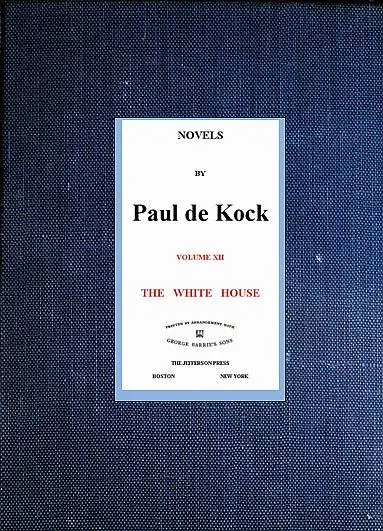
"The White House" by Paul de Kock is a novel written in the early 19th century. Set against the backdrop of Parisian society, the story revolves around the life of a government clerk named Robineau. The plot explores themes of social status, romance, and the comedic misadventures of its characters through their interactions at a lavish reception hosted by the affluent Baron de Marcey. The opening of the novel introduces us to Robineau as he navigates his mundane life as a clerk while yearning for social advancement and romance. He encounters two wealthy acquaintances in the Palais-Royal garden, Alfred and Edouard, who invite him to a grand reception at the baron's residence. Despite his self-deprecating humor and jealousy over his friends' wealth, Robineau struggles with his own lack of fortunes, especially as he prepares for the social event amid thoughts of his love interest, a milliner named Fifine. The introduction sets the stage for Robineau's hopes and aspirations, depicting a blend of lighthearted banter and the underlying social commentary of the era.
Introduction adapted from the source catalogue; source summaries may be automatically generated.
Free to read · English · 152,580 words · No account needed
MAKE TIME FOR A GOOD BOOK
On by default. Untick to stop anonymous reading totals. Each page counts after 10 seconds in view. How this works.
Anonymous counting is on unless you have switched it off.
The stranger threw himself upon a chair, put aside his hat and his stick, and examined with interest the interior of the cottage. When the girl returned to the living room, he scrutinized her again, and the more he looked at her the more amazement his eyes seemed to express.
Isaure, having placed the food upon a table which she moved to her guest’s side, said to him pleasantly:
"There, monsieur, is all that I have to offer you, but I do it gladly."
"There is much more than I need, and it is a most sumptuous repast, compared with those which I have had for some time past," said the stranger, seating himself at the table. "But I warn you, my child, that I shall not be able to pay you for what I consume in your house."
"Pay me, monsieur! Oh! I am not in the habit of asking pay for such trifling services as I can render. Is not one too fortunate to be able to be of use sometimes to one’s fellow creatures?"
"That is a most beautiful reflection, my child!" said the stranger ironically; "but I doubt whether your fellow creatures would do so much for you, if the opportunity should offer! You are still young; it will be well for you to learn thus early never to rely upon the gratitude of those whom you have obliged."
"I do not need their gratitude to take pleasure in doing good; my reward is in my heart." As she said this, Isaure raised her blue eyes with a touching expression of sincerity, and her whole face seemed lovelier than ever. The stranger gazed at her constantly while he ate.
"Young woman," said he, "it was not among your goats and your dull-witted mountaineers that you learned to express yourself thus."
Isaure blushed and faltered:
"What! do you think, monsieur, that the people in our mountains are not
so hospitable as I am?"
"Hospitable! yes, indeed! But there are so many ways of being hospitable; and I see by your manner, by your speech--yes, yes, I know what I am talking about, and hereafter I think it would be difficult to deceive me.--Come, sit down here, and keep me company. I don’t frighten you, I trust?"
"No, monsieur," replied the girl timidly, as she seated herself a few steps from the table, taking care to keep Vaillant beside her.
After eating and drinking for some time, the stranger rested his elbows on the table, placed his head on his hands, and, gazing steadfastly at Isaure, said to her:
"People talk much about you in the neighborhood."
"About me, monsieur?"
Your reading position is saved on this browser. Take it to another device with a library code. Reading pages adapt to text, rather than matching a printed edition.
Paul de Kock

Paul de Kock

Paul de Kock

Paul de Kock
BEHIND THE BOOK
This eBook is for the use of anyone anywhere in the United States and most other parts of the world at no cost and with almost no restrictions whatsoever. You may copy it, give it away or re-use it under the terms of the Project Gutenberg License included with this eBook or online at www.gutenberg.org. If you are not located in the United States, you will have to check the laws of the country where you are located before using this eBook. Read the source licence.
The original source file, including credits and licence, is retained by this library. Request an original-format copy at no charge. Please include the book title and Project Gutenberg identifier #40712.
KEEP YOUR CURIOSITY GOING
Coulson Kernahan

Maurice Baring
Frances Wright
Cécile Tormay

Frederic Jesup Stimson

W. H. P. (William Henry Pope) Jarvis