
The Milkmaid of Montfermeil (Novels of Paul de Kock Volume XX)
Paul de Kock
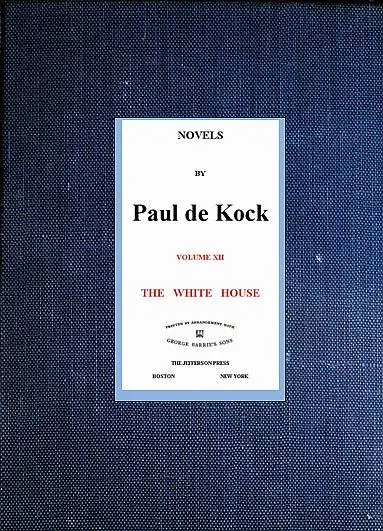
THE CLASSIC COLLECTION · 1904
"The White House" by Paul de Kock is a novel written in the early 19th century. Set against the backdrop of Parisian society, the story revolves around the life of a government clerk named Robineau. The plot explores themes of social status, romance, and the comedic misadventures of its characters through their interactions at a lavish reception hosted by the affluent Baron de Marcey. The opening of the novel introduces us to Robineau as he navigates his mundane life as a clerk while yearning for social advancement and romance. He encounters two wealthy acquaintances in the Palais-Royal garden, Alfred and Edouard, who invite him to a grand reception at the baron's residence. Despite his self-deprecating humor and jealousy over his friends' wealth, Robineau struggles with his own lack of fortunes, especially as he prepares for the social event amid thoughts of his love interest, a milliner named Fifine. The introduction sets the stage for Robineau's hopes and aspirations, depicting a blend of lighthearted banter and the underlying social commentary of the era.
Introduction adapted from the source catalogue; source summaries may be automatically generated.
Free to read · English · 152,580 words · No account needed
MAKE TIME FOR A GOOD BOOK
On by default. Untick to stop anonymous reading totals. Each page counts after 10 seconds in view. How this works.
Anonymous counting is on unless you have switched it off.
"I have not gone into those details, monsieur; but in order that it may be easier for the ladies to reach the top, I have conceived rather a happy idea: while the men’s pole will be greased and rubbed with soap, I shall have the ladies’ pole rubbed with honey from top to bottom; in that way, they will be able to ascend as easily as if it were a ladder."
"That is altogether novel!" said Robineau; "and what are the prizes to
be?"
"Superb, monseigneur! a Syntax and the De Viris Illustribus for the men; the Explanation of Participles and the Cuisinière Bourgeoise for the ladies."
"The Auvergnats who win those will be well pleased!" said Edouard.
"What next, my dear friend?" said Robineau.
"Next, monseigneur, to take the place of tournaments, which we could not give for lack of knights, it occurred to me that you would not be sorry to have an imitation of the gymnastic games, as they used to be performed at the festival of Eleusis, and even before the Roman Emperors. Consequently, some Auvergnats, to whom I have given full instructions, will execute in the courtyard such sports as throwing the discus, foot-races, wrestling and boxing."
"You won’t serve them with anything to drink beforehand, I trust!"
"No, monseigneur! Next, flourishes, executed by the three musicians whom I have hired in the town, will announce that the banquet is served. At dessert, I shall sing couplets in your honor, and you will be kind enough to encore the last--that is always done."
"Very well, that is understood."
"Next, monseigneur, we shall go to the ball room, which will be decorated as the Greeks used to decorate the places devoted to such assemblages: flowers, garlands, and mottoes everywhere."
"You will have the mottoes written in French, won’t you, Monsieur
Férulus?"
"No, monseigneur, in Latin and Greek, that is more dignified."
"Never mind, do me the favor to write them in French; otherwise, if the ladies should ask me for their meaning, it might embarrass me."
"If you absolutely insist upon it----"
"Yes, I insist upon it. What next?"
"Next, monseigneur, a bomb, fired in your courtyard, will announce the fireworks, which will crown that beautiful day by a rain of fire."
"A rain of fire! The deuce! You will take care that it doesn’t rain on
the company."
"I will answer for everything, monseigneur; I, myself, shall handle the fireworks, and I am as expert at it as if I had invented powder."
"Well, messieurs, what do you think of this fête?" said Robineau, rubbing his hands in high glee.
Your reading position is saved on this browser. Take it to another device with a library code. Reading pages adapt to text, rather than matching a printed edition.
Paul de Kock

Paul de Kock

Paul de Kock

Paul de Kock
BEHIND THE BOOK
This eBook is for the use of anyone anywhere in the United States and most other parts of the world at no cost and with almost no restrictions whatsoever. You may copy it, give it away or re-use it under the terms of the Project Gutenberg License included with this eBook or online at www.gutenberg.org. If you are not located in the United States, you will have to check the laws of the country where you are located before using this eBook. Read the source licence.
The original source file, including credits and licence, is retained by this library. Request an original-format copy at no charge. Please include the book title and Project Gutenberg identifier #40712.
KEEP YOUR CURIOSITY GOING
Coulson Kernahan

Maurice Baring
Frances Wright
Cécile Tormay

Frederic Jesup Stimson

W. H. P. (William Henry Pope) Jarvis